

A Coordinated Electric System Interconnection Review—the utility’s deep-dive on technical and cost impacts of your project.

Challenge: Frequent false tripping using conventional electromechanical relays
Solution: SEL-487E integration with multi-terminal differential protection and dynamic inrush restraint
Result: 90% reduction in false trips, saving over $250,000 in downtime

Category Metric
VPP capacity (Lunar Energy) 650 MW
Lunar funding raised US$232 million
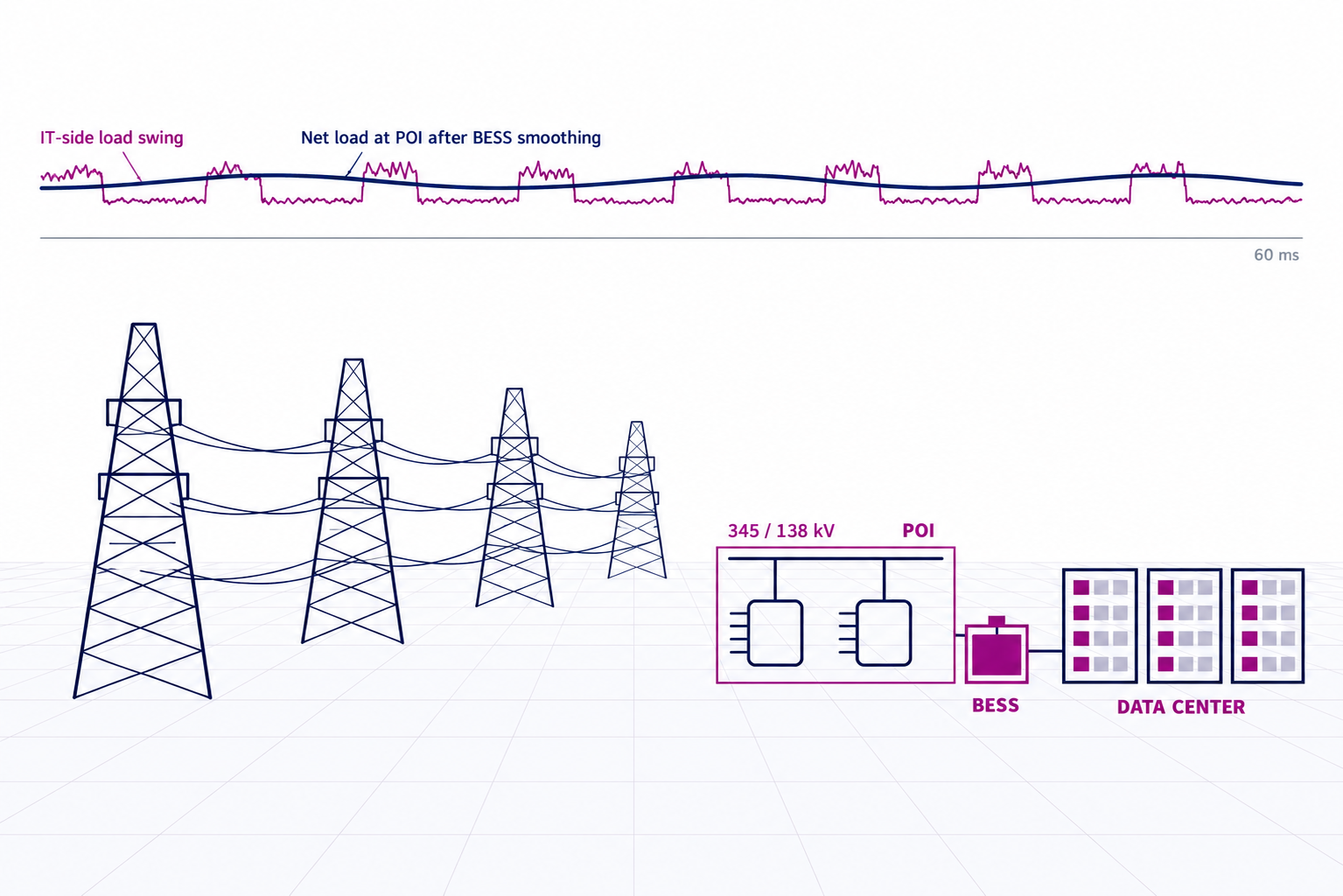
Data center BESS example 31 MW / 62 MWh
ERCOT grid-scale batteries 15+ GW
LDES tenders (H1 2026) Up to 9.3 GW
Lithium-ion share of LDES by 2030 77%
FEOC initial threshold 55%
BESS tariff rate (2026) ~55%
Capacity gain from analytics 5–15%

PJM’s Distribution-Level Interconnection Reform:Eliminating “First Use” in the Era of FERC Order 2222

PJM First Use rule elimination for DER interconnection under FERC Order 2222
Calendar icon. D

Apr 7, 2026  | blog

Introduction

The U.S. power grid is undergoing a structural transformation driven by the rapid growth of Distributed Energy Resources (DERs) such as solar PV, battery storage, EVs, and demand response technologies. To accommodate this shift, PJM Interconnection has proposed a major regulatory reform: elimination of the “First Use” rule for distribution-level interconnections.


Filed with FERC in October 2025 and supported unanimously by stakeholders, this reform is designed to:


  • Simplify interconnection pathways 
  • Reduce regulatory overlap 
  • Accelerate DER deployment 
  • Align PJM processes with FERC Order No. 2222 


This article provides a deep technical and regulatory breakdown of PJM’s proposal, its engineering implications, and how it reshapes the future of DER integration.


Background: DER Growth and FERC Order No. 2222

What is FERC Order 2222?

FERC Order No. 2222 (2020) was a landmark ruling aimed at:


  • Enabling aggregated DER participation in wholesale markets 
  • Removing barriers for small-scale distributed resources 
  • Promoting grid flexibility, reliability, and competition 


DERs include:


  • Rooftop solar 
  • Battery energy storage systems (BESS) 
  • Electric vehicles and charging infrastructure 
  • Smart thermostats and demand response systems 
  • Energy efficiency and thermal storage systems 


Because individual DERs are often too small, Order 2222 allows them to aggregate into a single market participant, enabling participation in:


  • Energy markets 
  • Capacity markets 
  • Ancillary services markets 

Why This Matters for PJM

PJM, as an RTO, must integrate:


  • Thousands of small DERs 
  • Increasing interconnection requests 
  • Complex coordination between: 


  • Transmission systems (FERC jurisdiction) 
  • Distribution systems (state/local jurisdiction) 


This complexity exposed limitations in PJM’s existing framework especially the “First Use” rule.


The “First Use” Rule: A Legacy Constraint

How It Works

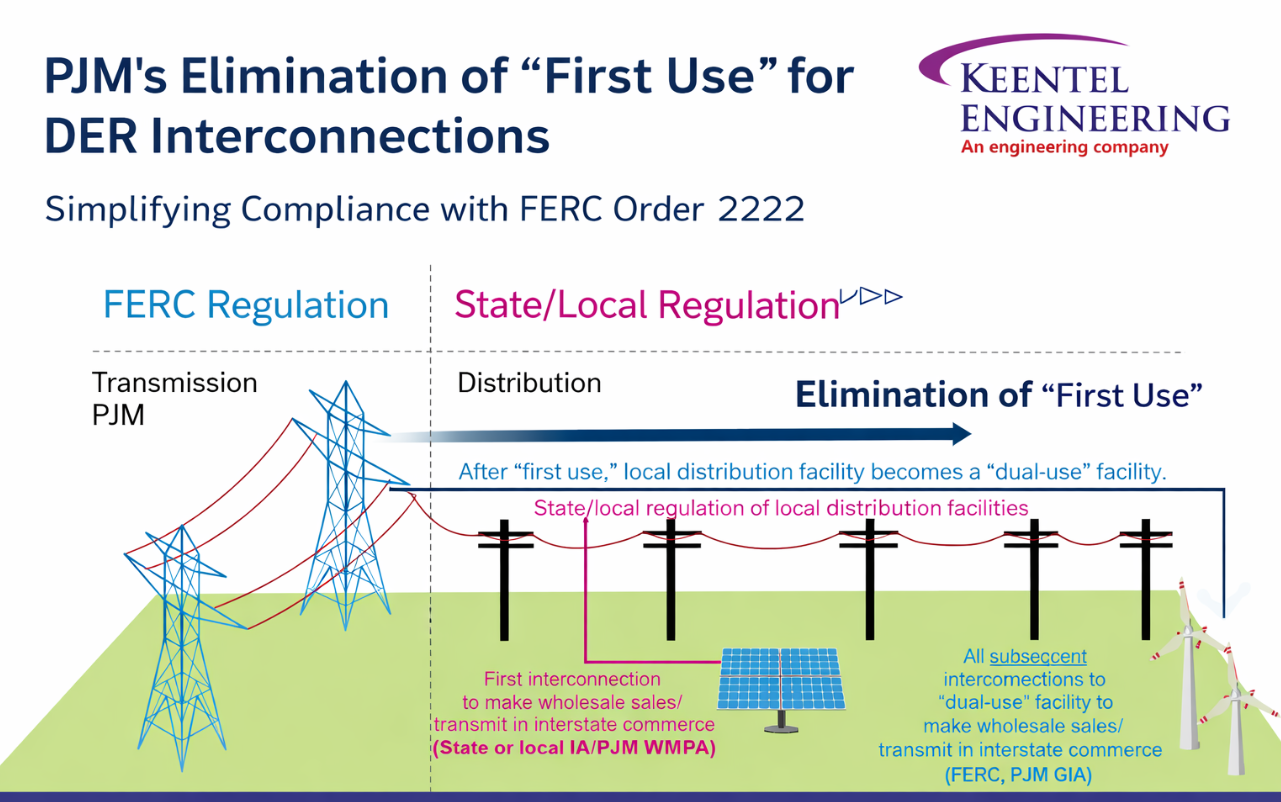
The “First Use” rule determines jurisdiction over interconnection facilities:


  • First generator connecting to a distribution line: 


  • Uses state/local interconnection agreement + WMPA 


  • Subsequent generators: 


  • Facility becomes “dual-use” 
  • Requires PJM GIA (FERC jurisdiction)


As illustrated in the diagram on page 3, once wholesale power flows through a distribution facility, it triggers federal oversight for all future interconnections. 

Key Problems Identified

1. Regulatory Confusion


Developers struggle to determine whether:


  • PJM (FERC) rules apply 
  • Or state/local interconnection rules apply 


2. Inefficiency


Small projects (even <5 MW) are forced into:


  • Full PJM interconnection queue 
  • Lengthy study processes 


3. Operational Burden


  • Transmission Owners (TOs) must track “dual-use” assets 
  • PJM queue congestion increases 


4. Misalignment with DER Policy


FERC Order 2222 explicitly supports:


  • State/local control for DER interconnections 
  • Aggregated participation without unnecessary barriers 

PJM’s Proposed Reform: Elimination of “First Use”

Core Concept


PJM proposes that:


  • All distribution-level resources interconnect through state/local processes and use WMPA for market participation instead of PJM GIA.


Confirmed in page 2 (Key Takeaway) of the presentation. 

What Changes?

Aspect Current (First Use) Proposed Reform
Jurisdiction Mixed (state + FERC) Clearly defined
Small DER Projects PJM GIA required (often) State/local IA only
Market Access Via GIA Via WMPA
Complexity High Reduced

Bright-Line Test: Engineering-Based Jurisdiction

To remove ambiguity, PJM introduces a voltage-based classification :


  • ≥ 69 kV → Transmission → PJM GIA (FERC jurisdiction) 
  • < 69 kV → Distribution → State/local IA + WMPA 


Clearly shown on page 6 of the PDF. 


Why This Matters (Engineering Perspective)

This aligns jurisdiction with physical system characteristics:


  • Transmission systems → Bulk power transfer 
  • Distribution systems → Local load and DER integration 


It simplifies:


  • Study scope 
  • Protection coordination responsibility 
  • Planning authority 

Alignment with Order 2222: A Critical Link

FERC Order 2222 states:


  • DER interconnections to distribution systems should not fall under transmission interconnection rules 
  • Aggregations should enable participation without overburdening RTO processes


PJM’s compliance language (page 4) confirms:


  • DER interconnections are governed by state/local law 
  • PJM focuses on market participation, not physical interconnection 

Operational Benefits of the Reform

1. Faster Interconnection Timelines


  • Removes PJM queue delays for small projects 
  • Enables faster deployment of solar + BESS 


2. PJM Resource Optimization


  • Staff can focus on: 


  • Large transmission projects 
  • Reliability-critical studies 


3. Increased DER Penetration


  • Simplified entry for: 


  • Community solar 
  • Behind-the-meter systems 
  • Microgrids 


4. Improved Cost Transparency


  • Developers gain early clarity on: 


  • Upgrade costs 
  • Scope 
  • Timeline 

Dispute Resolution and Governance

PJM includes a structured dispute framework:


  • Resolution options: 


  • Bilateral agreements 
  • State/local processes 
  • PJM tariff mechanisms 


  • Must be resolved before Phase I studies 


Detailed in page 7 of the presentation. 


What Is Not Affected

1. PURPA Qualifying Facilities (QFs)


  • Governed under separate federal law 


2. DER Aggregation Model (Order 2222)


  • Aggregations: 


  • Use DAPSA agreements 
  • Do not enter PJM interconnection queue 


Confirmed on page 9.


Engineering Implications for Developers and Utilities

This reform fundamentally changes project execution strategy:


For Developers


  • Focus shifts to: 


  • Utility distribution studies 
  • Hosting capacity analysis 
  • Protection coordinatio


For Engineers (Keentel Perspective)


Critical studies will include:


  • Distribution load flow 
  • Short circuit analysis 
  • Protection coordination 
  • Voltage regulation and flicker 
  • DER integration studies 


For Utilities


  • Increased responsibility for: 


  • Interconnection approval 
  • Grid impact studies 
  • Local reliability 

Implementation Timeline

  • PJM Filing: October 1, 2025 
  • Stakeholder Approval: September 25, 2025 
  • Expected Effective Date: April 28, 2026 

Conclusion

PJM’s elimination of the “First Use” rule represents a paradigm shift in interconnection policy. It aligns regulatory structure with:


  • The decentralized nature of DERs 
  • FERC Order 2222 objectives 
  • Modern grid operational realities 


This reform will:


  • Reduce interconnection bottlenecks 
  • Accelerate renewable deployment 
  • Improve coordination between RTOs and utilities 


For engineering firms like Keentel Engineering  this opens opportunities in:


  • Distribution-level studies 
  • DER integration 
  • Utility coordination 
  • Compliance and interconnection support 

Technical FAQ (Enhanced – SEO Ready)

  • 1. What is the First Use rule in PJM?

    A regulatory test determining when a distribution facility becomes subject to FERC jurisdiction after initial wholesale use.


  • 2. Why is PJM eliminating First Use?

    To reduce complexity, improve efficiency, and align with DER-focused policies under FERC Order 2222.


  • 3. What is FERC Order 2222?

    A rule enabling aggregated DERs to participate in wholesale electricity markets through RTOs. 


  • 4. What are DERs?

    Small-scale energy resources such as solar, battery storage, EVs, and demand response systems. 


  • 5. What is a DER aggregation?

    A grouping of multiple small DERs combined to meet market participation requirements.


  • 6. What is a WMPA?

    A Wholesale Market Participation Agreement that allows resources to participate in PJM markets without a full GIA.


  • 7. What is the Bright-Line test?

    A voltage-based rule:

    • ≥69 kV → Transmission 
    • <69 kV → Distribution 

  • 8. How does this impact solar and BESS projects?

    They will benefit from faster and simpler interconnection processes.


  • 9. Will projects still need system studies?

    Yes, but primarily at the distribution utility level, not PJM.


  • 10. What markets can DERs participate in?

    • Energy 
    • Capacity 
    • Ancillary services 

  • 11. Does this reduce PJM queue congestion?

    Yes, by removing smaller distribution-level projects from the queue.

  • 12. Who regulates distribution interconnections?

    State and local regulatory authorities.


  • 13. What is DAPSA?

    DER Aggregator Participation Service Agreement used for aggregated DER participation.


  • 14. When will PJM implement this change?

    Expected April 28, 2026, pending FERC approval.


  • 15. What should developers do now?

    • Engage with utilities early 
    • Understand state interconnection processes 
    • Prepare for DER aggregation opportunities

Conclusion

Solid-State Transformers are redefining how power is delivered especially in data centers. But their successful deployment depends on accurate, validated modeling across both RMS and EMT domains.


Keentel Engineering brings the expertise, tools, and experience needed to deliver high-fidelity modeling solutions that enable confidence, compliance, and scalability.


A smiling man with glasses and a beard wearing a blue blazer stands in front of server racks in a data center.

About the Author:

Sonny Patel P.E. EC

IEEE Senior Member

In 1995, Sandip (Sonny) R. Patel earned his Electrical Engineering degree from the University of Illinois, specializing in Electrical Engineering . But degrees don’t build legacies—action does. For three decades, he’s been shaping the future of engineering, not just as a licensed Professional Engineer across multiple states (Florida, California, New York, West Virginia, and Minnesota), but as a doer. A builder. A leader. Not just an engineer. A Licensed Electrical Contractor in Florida with an Unlimited EC license. Not just an executive. The founder and CEO of KEENTEL LLC—where expertise meets execution. Three decades. Multiple states. Endless impact.

Four workers in safety vests and helmets stand with arms crossed near wind turbines.

Let's Discuss Your Project

Let's book a call to discuss your electrical engineering project that we can help you with.

Man in a blazer and open shirt, looking at the camera, against a blurred background.

About the Author:

Sonny Patel P.E. EC

IEEE Senior Member

In 1995, Sandip (Sonny) R. Patel earned his Electrical Engineering degree from the University of Illinois, specializing in Electrical Engineering . But degrees don’t build legacies—action does. For three decades, he’s been shaping the future of engineering, not just as a licensed Professional Engineer across multiple states (Florida, California, New York, West Virginia, and Minnesota), but as a doer. A builder. A leader. Not just an engineer. A Licensed Electrical Contractor in Florida with an Unlimited EC license. Not just an executive. The founder and CEO of KEENTEL LLC—where expertise meets execution. Three decades. Multiple states. Endless impact.

Leave a Comment

Related Posts

By SANDIP R PATEL May 4, 2026
Learn transmission injection and withdrawal studies, TIR & TWR, system impact studies, and grid analysis for solar, BESS, and HVDC. Discover more.
US Grid Code Requirements – Droop Control & Fast Frequency Response (FFR) | BESS IEEE 2800
By SANDIP R PATEL May 4, 2026
Learn how droop control and fast frequency response (FFR) enable IEEE 2800 compliance for BESS, solar, and wind in US grid interconnections.
ASPEN OneLiner V15 advanced protection system modeling white paper cover for relay coordination
By SANDIP R PATEL May 3, 2026
Master ASPEN OneLiner V15 for protection system modeling, relay coordination, and fault analysis. Learn advanced power system workflows today.
Texas Energy System Explained infographic showing ERCOT power market, Texas grid operations,
By SANDIP R PATEL May 3, 2026
Learn how ERCOT manages the Texas electricity grid, including LMP pricing, SCED dispatch, ancillary services, congestion, and wholesale power markets.
PJM Cycle 1 Interconnection Infographic: 220 GW Storage & Grid Update
By SANDIP R PATEL May 2, 2026
PJM's Cycle 1 reform brings a 220 GW storage-led pipeline. See how BESS and new modeling impact grid reliability.
Battery storage financing project with utility-scale BESS and solar farm infrastructure
By SANDIP R PATEL May 2, 2026
Explore battery storage financing strategies, tax credits, tariffs, and BESS revenue models. Learn how to optimize projects and maximize returns.
CAISO IPE 5.0 Cluster 16 deliverability and queue management infographic
By SANDIP R PATEL May 2, 2026
Discover CAISO IPE 5.0 interconnection updates, including queue reforms, deliverability changes, and Cluster 16 impacts. Learn how it affects your projects.
FERC Order 2023 interconnection process diagram showing power generation
By SANDIP R PATEL May 1, 2026
FERC Order 2023: interconnection reforms, cluster studies & grid impact. Learn key changes fast.
SEL-2240 Axion industrial automation platform
By SANDIP R PATEL May 1, 2026
Explore SEL-2240 Axion, a modular I/O control system with RTAC automation and EtherCAT networking. Discover applications, features, and benefits.