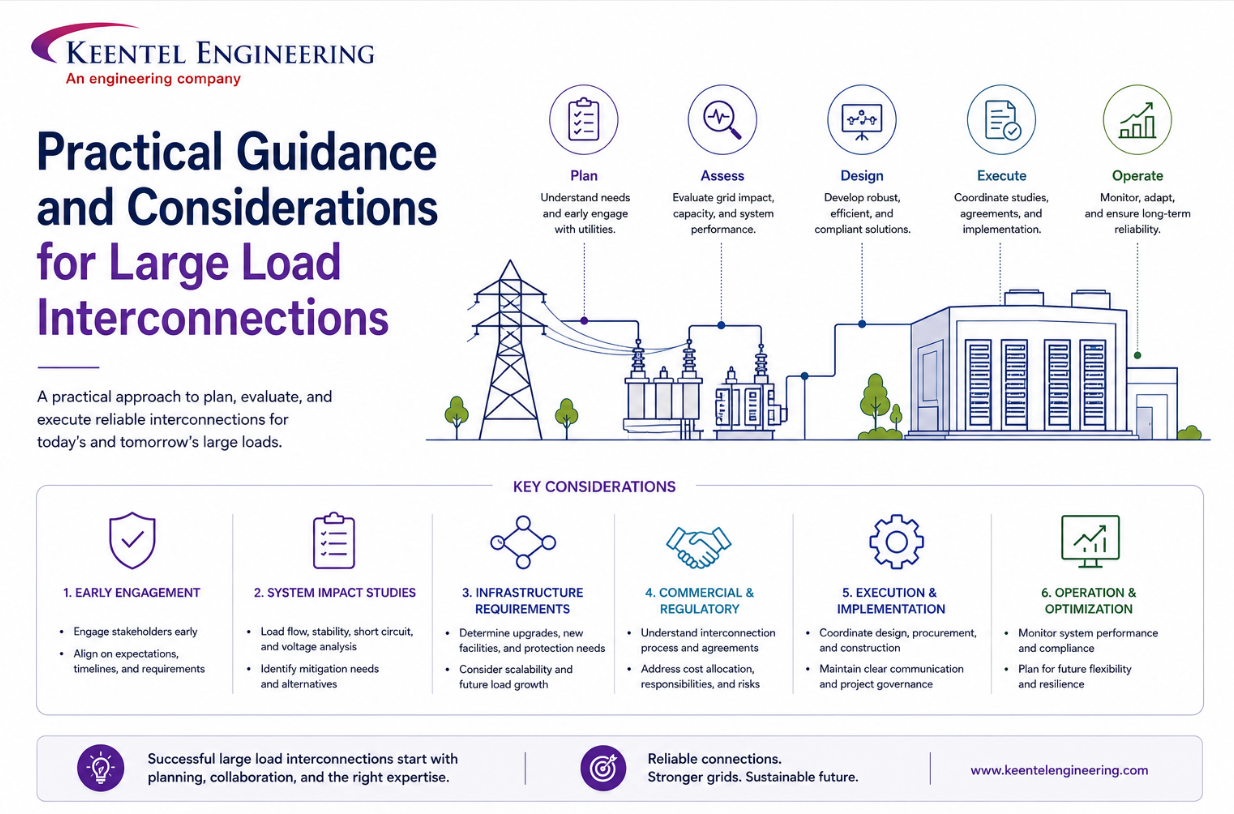
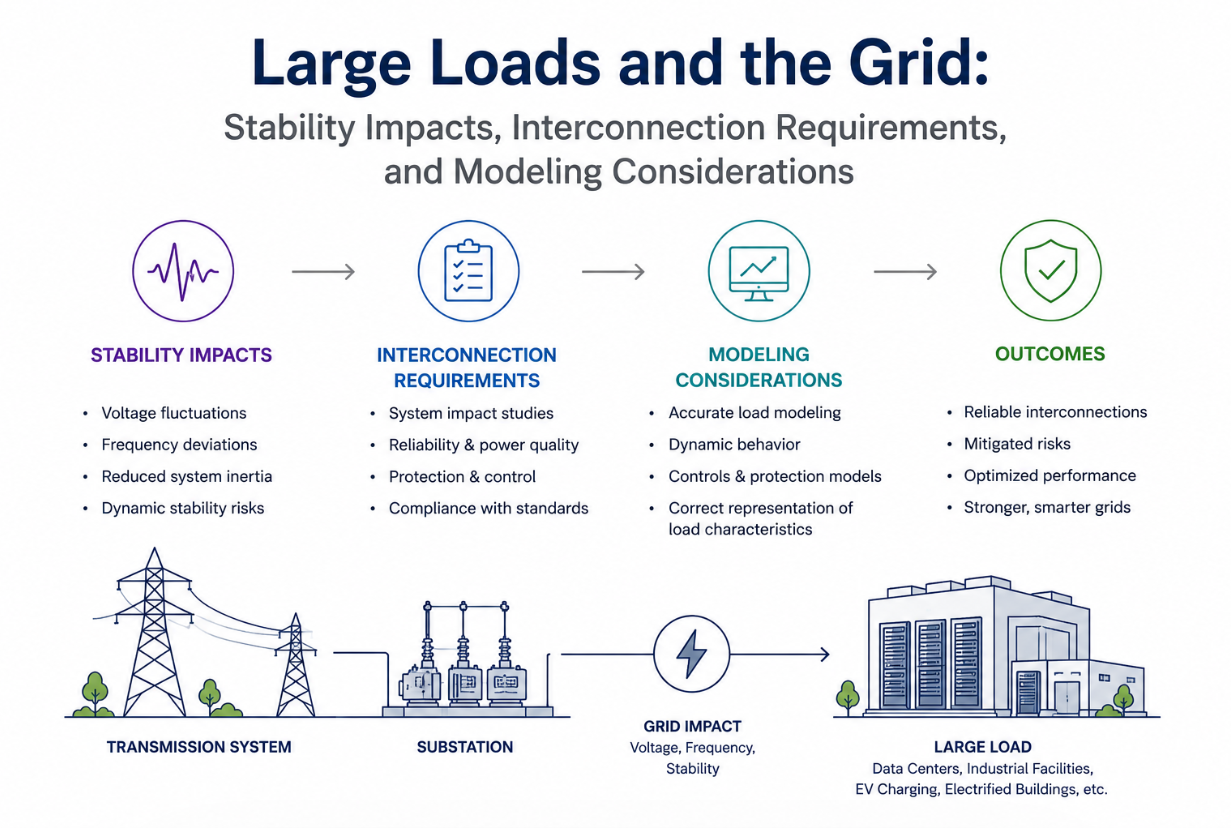
A Coordinated Electric System Interconnection Review—the utility’s deep-dive on technical and cost impacts of your project.
Challenge: Frequent false tripping using conventional electromechanical relays
Solution: SEL-487E integration with multi-terminal differential protection and dynamic inrush restraint
Result: 90% reduction in false trips, saving over $250,000 in downtime
From Silicon to Substation: The Programming Languages Powering the Modern Grid
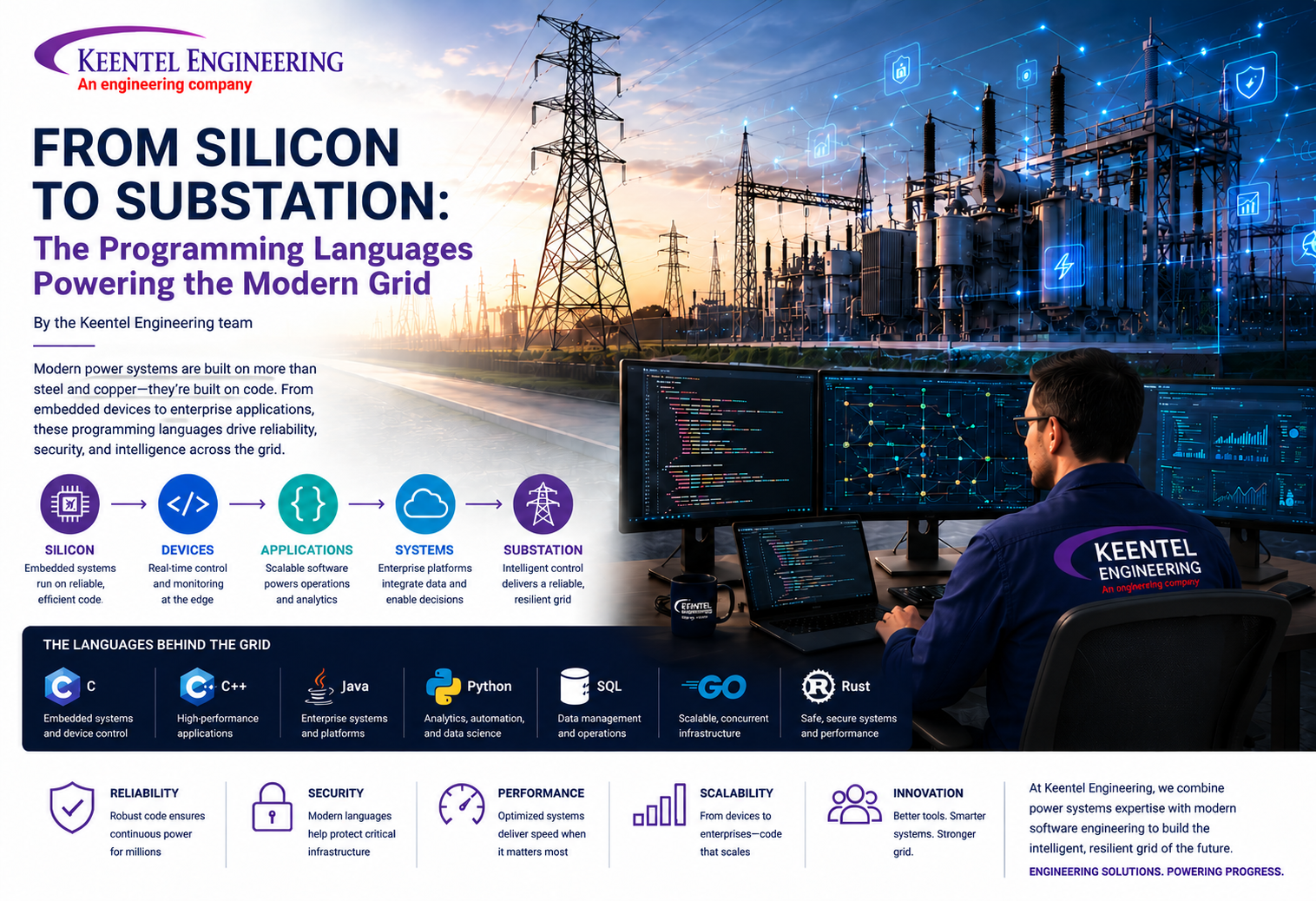
For most of its history, the electrical grid was a world of copper, steel, and electromechanical relays. A protection scheme was a set of physical discs and springs; a control panel was a wall of wired contacts. That era is over. The modern substation is, first and foremost, a software system — a layered stack of microprocessors, real-time operating systems, communication protocols, and data platforms that happen to switch high voltage.
This shift changes what it means to be a competent power engineer. Understanding fault current and impedance is still essential, but it is no longer sufficient. The engineers who design, commission, and maintain today's grid also need fluency in the languages that make digital protection, substation automation, and grid analytics possible.
This guide walks through the seven language families that matter most in contemporary power engineering, why each one occupies the niche it does, and how to start learning them — organized the way the grid itself is organized, from the microsecond world of the silicon up to the enterprise systems that watch over entire networks.
Why language choice is an engineering decision, not a preference
1. C and C++ — the deterministic core
At the lowest layer of any digital protection device sits firmware written almost exclusively in C, with C++ used for the parts that benefit from structure.
The reason is determinism. When a fault appears on a transmission line, the protection algorithm cannot "usually" respond quickly — it must respond within a guaranteed time bound, every single time. C gives the engineer direct access to memory and hardware registers with almost no abstraction sitting between the code and the silicon. That predictability is exactly what a real-time operating system such as VxWorks or FreeRTOS needs.
C and C++ show up in several specific places inside an IED:
- Protection algorithms themselves — differential (ANSI 87), distance (ANSI 21), overcurrent, and so on.
- Parsing GOOSE and Sampled Value traffic. In a digital substation, these messages travel as raw Ethernet frames at Layer 2. Decoding them efficiently requires the bit-level and pointer manipulation that C does naturally.
- Redundancy protocols like PRP and HSR, which continuously duplicate and discard frames with zero recovery time — work that is far too timing-sensitive for a higher-level language.
- Digital signal processing, such as the FFT routines used to measure harmonic distortion for power-quality monitoring.
C++ adds object orientation on top, letting engineers modularize complex protection logic and communication stacks without giving up speed — provided they stick to "zero-cost abstraction" discipline and avoid dynamic memory allocation, which reintroduces unpredictable timing.
How to start: Master raw C first, with real focus on pointers and bitwise operations. Then program a bare-metal ARM Cortex microcontroller so you understand interrupts and peripherals with no OS in the way. Add an RTOS like FreeRTOS to learn task scheduling and preemption.
Only then move to disciplined, allocation-free C++. Texas Instruments' C2000 real-time control MCUs are a good hardware target for grid-focused DSP work.
2. IEC 61131-3 — the language of industrial control
Embedded firmware handles the relay's core job, but a substation is full of supporting systems — cooling, tap changers, interlocking logic, general plant automation — that run on Programmable Logic Controllers (PLCs) and Programmable Automation Controllers (PACs). These are programmed using the five languages defined by the IEC 61131-3 standard, of which two dominate in power work.
PLC programming follows a cyclic execution model: the controller reads its inputs, runs the program, writes its outputs, and repeats — continuously, on a fixed scan time. That predictable loop is what makes industrial automation stable and analyzable.
- Ladder Diagram (LD) is a graphical language that mirrors traditional relay-logic schematics. Its visual form makes it readable to technicians who don't come from a software background, which matters enormously for review and long-term maintenance.
- Structured Text (ST) is a high-level, Pascal-like language ideal for the parts of automation that involve real math — PID control for generator excitation, for example, or state machines that govern automated switching sequences.
Two more graphical forms, Function Block Diagram (FBD) and Continuous Function Chart (CFC), let engineers wire standardized blocks (timers, counters, logic gates, larger pre-built functions) together in a way that looks like an engineering schematic.
How to start: Learn the cyclic-execution model and PLC architecture before any syntax. Begin with Ladder to internalize visual relay logic, then move to Structured Text for the heavier algorithmic work. Download CODESYS — it's a free, hardware-agnostic IDE with a built-in soft-PLC simulator that runs all five languages on your laptop, so you can practice without buying hardware. Build reusable Function Blocks early; modular code is what keeps large automation projects manageable.
3. MATLAB and Simulink — where algorithms are born and proven
Before a line of C reaches a relay, the underlying algorithm has to be designed, simulated, and validated somewhere safe. That place is almost always MATLAB and its graphical companion, Simulink, supported by the Simscape Electrical toolbox.
MATLAB's matrix-first design maps perfectly onto the math of power systems — power-flow analysis, short-circuit calculations, and transient-stability studies are all linear-algebra problems at heart. Engineers build models of an entire network — generators, lines, transformers, nonlinear loads — and study how it behaves.
Simulink takes this further with Model-Based Design (MBD). A protection engineer can assemble a new algorithm as a block diagram, throw simulated faults at it (single-line-to-ground, inter-turn transformer faults, and so on), and watch how it responds in simulated time — all before any hardware exists. Two capabilities make this especially powerful for our field:
- Automatic code generation. Tools like Simulink Coder can turn a validated model directly into production-ready C/C++, dramatically shrinking the gap between "the algorithm works on paper" and "the algorithm runs on the relay."
- Hardware-in-the-Loop (HIL) testing. A real-time simulator such as RTDS or OPAL-RT runs the power-system model while physically wired to real IED hardware, so you can test a relay against thousands of fault scenarios without energizing anything.
How to start: Get comfortable with MATLAB's matrix syntax, then move into Simulink and Model-Based Design. Lean on the Simscape Electrical toolbox for ready-made high-voltage component models, run electromagnetic-transient simulations to stress-test your algorithms, and finish by generating C/C++ from your validated models. MathWorks' free "Onramp" interactive courses are an efficient way in.
4. SCL and XML — the blueprint of the digital substation (IEC 61850)
This one isn't a programming language in the traditional sense, but ignoring it would be a serious mistake. The Substation Configuration Language (SCL) — an XML schema defined in IEC 61850-6 — is arguably the single most important "programmatic" artifact in a modern digital substation.
The whole promise of IEC 61850 is interoperability: relays, merging units, and controllers from different manufacturers cooperating inside one substation. That only works because the standard imposes a common, object-oriented data model, and SCL is the formal language used to describe a given installation's configuration. Without it, automated engineering-data exchange and network configuration would be impossible.
SCL comes in several file types, each tied to a stage of the project lifecycle:
- ICD (IED Capability Description) — supplied by the manufacturer; describes what a device can do and which logical nodes it supports.
- SCD (System Configuration Description) — the master file for the whole substation, defining communication links, GOOSE datasets, and Sampled Value control blocks.
- CID (Configured IED Description) — the instantiated file actually downloaded into a specific device.
Engineers rarely hand-write SCL; they use System Configuration Tools (SCTs). But you do need to read it fluently — to trace communication failures, to map logical nodes (XCBR for a circuit breaker, PTOC for time-overcurrent protection, and so on), and to make heterogeneous equipment integrate cleanly. In a digital substation, the structural correctness of the XML directly determines whether the substation functions.
How to start: Learn the IEC 61850 object model first, then enough XML to read SCL comfortably. Focus on the file lifecycle — how an ICD gets merged into an SCD to wire up communications. Use an SCT to build configurations visually and watch the XML it produces, then practice reading real-world SCL files to diagnose logical-node and GOOSE issues. The UCA International Users Group (ucaiug.org) is the authoritative source.
5. VHDL and Verilog — hardware acceleration when microseconds aren't fast enough
As substations digitize further, the data rates climb. Under IEC 61850-9-2 (the Process Bus), merging units digitize analog voltage and current and stream them as Sampled Values at high rates — on the order of 4,000–4,800 samples per second for a 50/60 Hz system, often across multiple channels at once.
Trying to process several of those streams in software, on a sequential CPU, introduces latency and jitter the protection function can't tolerate. The answer is to move that work off the CPU and into a Field Programmable Gate Array (FPGA), which processes data in genuinely parallel hardware.
FPGAs are programmed with Hardware Description Languages — primarily VHDL and Verilog. These don't describe a sequence of instructions; they describe circuits: registers, multiplexers, logic gates that get physically synthesized onto the chip. In modern relays, HDL handles tasks like MAC-layer packet filtering, IEEE 1588 (PTP) precise time synchronization, and the initial decimation filtering of Sampled Values — conditioning the data so the CPU's protection algorithm receives a clean, perfectly timed stream.
How to start: Build a foundation in digital logic — Boolean algebra, combinational circuits, sequential state machines. Then get a physical FPGA development board, because watching real hardware behave teaches the parallel mindset in a way simulation alone can't. Practice synthesizing high-frequency Process Bus filters, and learn an industry synthesis toolchain such as Xilinx Vivado or Intel Quartus Prime. Nandland and ASIC World are excellent free learning resources.
6. Python — testing, automation, and grid analytics
Python lacks the deterministic timing needed for real-time control, so it never runs
inside
the protection loop. But in the layers around that loop, it has become indispensable.
Its first big role is testing and commissioning. Verifying hundreds of relays in a digital substation by hand is slow and error-prone. Engineers write Python scripts — often using the Scapy packet library — to inject synthetic GOOSE and Sampled Value traffic onto the substation network and automatically check that each IED responds correctly against predefined criteria. Libraries like lxml and xml.etree parse and validate SCL files, catching configuration mistakes before they reach site.
Its second role is analytics in the IT/OT convergence. Utilities accumulate enormous datasets from SCADA, Phasor Measurement Units (PMUs), and smart meters. With Pandas, NumPy, and Scikit-learn, engineers turn that telemetry into value: predictive maintenance (for example, flagging a transformer at risk based on dissolved-gas analysis) and accurate load forecasting.
How to start: Get solid on core Python — data structures, loops, file handling — before reaching for libraries. For substation work, learn Scapy for packet manipulation and Pytest for building real automated test suites. For analytics, master Pandas for time-series data and NumPy for fast numerical work, then layer Scikit-learn on top. Real Python and Kaggle Learn are strong, hands-on starting points.
7. C# and Java — the SCADA backend and enterprise tier
At the top of the hierarchy sit SCADA systems and Advanced Distribution Management Systems (ADMS): the platforms that give dispatch operators their Human-Machine Interfaces, archive historical data, and present a live topological view of the whole network. This tier demands scalability, robust database integration, and heavy-duty networking — the strengths of enterprise object-oriented languages, specifically C# (.NET) and Java.
These languages do the heavy lifting at the control-center level:
- Managing thousands of concurrent telemetry connections over industrial protocols such as IEC 60870-5-104, DNP3, and Modbus TCP.
- Implementing OPC UA servers — the secure, platform-independent bridge that carries information from the operational-technology (OT) world up into enterprise IT and ERP systems.
- Driving sophisticated, vector-based HMIs with topological coloring and dynamic alarm management, typically via WPF on the C# side or web/.NET/Java stacks elsewhere.
How to start: Build a strong base in object-oriented design, multithreading, and asynchronous programming in either language. Move into network programming — TCP/IP sockets and byte-stream parsing — since that's the foundation of every industrial protocol integration. Study OPC UA deeply, and learn database integration through ORMs (Entity Framework for C#, Hibernate for Java) to handle massive historical datasets. Microsoft Learn, the OPC Foundation, and Inductive University (for the Ignition platform) are all worthwhile.
Putting it together: one grid, seven layers
It helps to picture these languages as a vertical stack, each handling the problem at its own timescale:
| Layer | Timescale | Language(s) | Typical job |
|---|---|---|---|
| Hardware acceleration | Nanoseconds–microseconds | VHDL / Verilog | Process Bus filtering, PTP timing |
| Embedded firmware | Microseconds–milliseconds | C / C++ | Protection algorithms, GOOSE/SV parsing |
| Plant automation | Milliseconds (cyclic) | IEC 61131-3 (ST, LD) | Tap changers, interlocks, cooling |
| Configuration & interoperability | Engineering lifecycle | SCL / XML | Substation data model, device integration |
| Design & validation | Offline / simulated | MATLAB / Simulink | Algorithm synthesis, HIL testing |
| Testing & analytics | Seconds–days | Python | Commissioning automation, forecasting |
| Supervisory & enterprise | Seconds–years | C# / Java | SCADA/ADMS, OPC UA, HMIs |
It helps to picture these languages as a vertical stack, each handling the problem at its own timescale:The takeaway isn't that every engineer must master all seven. It's that a modern power engineer should understand the
map — know which language lives at which layer and why — and then go deep where their role demands it. A protection specialist will live in C/C++, MATLAB, and SCL; a control-systems engineer in IEC 61131-3 and Python; a SCADA integrator in C#/Java and OPC UA. Fluency across this hierarchy is fast becoming the defining competency of the field.
Case Studies
All client and project details have been kept confidential. The following describe the engineering approach and outcomes only.
Case Study 1 — Cutting commissioning time on a digital substation retrofit
The challenge. A high-voltage substation was being retrofitted from a conventional design to a full IEC 61850 digital architecture, with dozens of legacy relays replaced by networked IEDs. The commissioning team faced several weeks of manual point-to-point testing to verify GOOSE messaging and Sampled Value behavior across every device — slow, repetitive, and exposed to human error.
The approach. Rather than test by hand, the team built an automated commissioning framework in Python. Using the Scapy library, it injected synthetic GOOSE and Sampled Value traffic onto the station bus and verified each IED's response against the protection design's expected behavior. In parallel, an lxml-based validator parsed every SCL file to catch logical-node mapping errors and dataset mismatches before configurations were downloaded to devices. The whole suite was structured with Pytest so results were repeatable and auditable.
The outcome. Configuration errors that would normally surface during on-site testing were caught at the desk, days earlier. Commissioning time dropped substantially, the test record was fully documented and reproducible, and the same framework became a reusable asset for subsequent digital-substation work.
Languages in play: Python (Scapy, lxml, Pytest), SCL/XML.
Case Study 2 — Designing and deploying a custom protection algorithm
The challenge. A non-standard protection function was required for an unusual transformer configuration that off-the-shelf relay settings couldn't fully cover. The algorithm had to be proven safe against a wide range of fault scenarios before it could ever be trusted on energized plant.
The approach. The protection team developed the algorithm in MATLAB and Simulink using Model-Based Design, building a detailed network model with the Simscape Electrical toolbox. They subjected the design to electromagnetic-transient simulations covering single-line-to-ground faults, inter-turn faults, and switching transients, refining the logic until its behavior was fully understood. They then validated it in Hardware-in-the-Loop testing — a real-time simulator running the power-system model wired directly to the target relay hardware. Finally, Simulink Coder generated production C/C++ from the validated model, which was integrated into the device firmware (running under an RTOS) and verified again on the bench.
The outcome. A custom protection function was delivered whose behavior had been exhaustively tested in simulation and against real hardware before commissioning — with full traceability from the validated model to the deployed code. The model-to-code workflow removed an entire class of hand-translation errors and shortened the path from concept to field-ready firmware.
Languages in play: MATLAB/Simulink, C/C++, RTOS firmware concepts.
Case Study 3 — Integrating a control center across multiple vendors
The challenge. Several legacy control systems needed to be consolidated into a single modern SCADA/ADMS platform. The new system had to ingest telemetry from a heterogeneous field estate — RTUs and IEDs speaking IEC 60870-5-104, DNP3, and Modbus TCP — and present a unified, real-time picture to dispatch operators, while also feeding curated data to enterprise IT systems.
The approach. The integration was built on a C#/.NET backend, using asynchronous programming to manage thousands of concurrent telemetry connections without blocking. Protocol adapters parsed the various industrial byte streams into a common internal model, and an OPC UA server provided the secure, standardized bridge from the OT environment up to enterprise IT and ERP systems. Historical telemetry was archived through an ORM (Entity Framework) into a relational store sized for high-volume time-series data, and the operator-facing HMI was built as a responsive, vector-based WPF interface with topological coloring and dynamic alarm management.
The outcome. Dispatchers gained a single, coherent view of a previously fragmented network, with consistent alarming and a reliable historical archive for analysis. The OPC UA layer gave the IT side clean, secure access to operational data without exposing the control network directly. Because the architecture was protocol-agnostic at its core, onboarding additional field devices in later phases became a configuration task rather than a redesign.
Languages in play: C# (.NET, WPF, Entity Framework), OPC UA, industrial protocols (IEC 60870-5-104, DNP3, Modbus TCP).
Frequently Asked Questions
Do I really need to learn programming to work in power engineering today?
Increasingly, yes — though "how much" depends on your role. The grid has moved from electromechanical hardware to microprocessor-based digital systems, which means software now determines how protection, control, and automation behave. You don't need to become a full-time software developer, but you do need enough fluency to configure devices, automate testing, interpret SCL files, or model algorithms. Engineers who can bridge power-system knowledge and software skills are in the strongest position in the job market.
Which language should I learn first?
Start from your role and the layer you work at. If you're heading into protection and embedded device work, begin with C. If you're in control and automation, start with IEC 61131-3 (Ladder, then Structured Text) using free CODESYS. If your work is more about analysis, testing, or data, Python is the most approachable and immediately useful entry point. If you don't yet know your specialization, Python and MATLAB give you the broadest, fastest payoff while you decide.
Why is C still used for protection relays instead of a modern, "safer" language?
Because protection demands determinism: a guaranteed worst-case response time, not just a fast average. C compiles to predictable machine behavior with direct hardware access and minimal hidden overhead, which is exactly what real-time operating systems need. Higher-level languages introduce runtime behaviors — garbage collection, dynamic allocation, abstraction layers — that can cause unpredictable timing. Even C++ is used carefully in this domain, with engineers avoiding dynamic memory allocation to keep timing tight.
Is SCL actually a programming language?
Not in the traditional, Turing-complete sense — it's an XML-based configuration schema defined under IEC 61850-6. But functionally, it's one of the most important things you'll work with in a digital substation. SCL describes the entire substation data model and how devices communicate, and its structural correctness directly determines whether the substation works. Engineers don't usually hand-write it, but reading and troubleshooting it fluently is a core skill.
What's the difference between MATLAB and the languages that run on actual hardware?
MATLAB and Simulink are where algorithms are designed, simulated, and validated — a safe environment to prove a protection scheme works before it touches energized equipment. C, C++, and the HDLs are what actually execute on the device. The bridge between them is automatic code generation: tools like Simulink Coder can convert a validated model into production C/C++ for deployment, which is one of the most efficient modern workflows in protection engineering.
Why would a substation need FPGAs and HDLs on top of regular processors?Why would a substation need FPGAs and HDLs on top of regular processors?
Some data is simply too fast for sequential software. Process Bus Sampled Values arrive at several thousand samples per second per channel, across many channels. A normal CPU processing those streams in sequence accumulates unacceptable latency and jitter. An FPGA processes them in true parallel hardware, handling time synchronization and initial filtering so the CPU receives clean, perfectly timed data and can focus on the protection decision itself.
Can I practice any of this without buying expensive hardware?
Yes — quite a lot of it. CODESYS gives you a free soft-PLC simulator for all five IEC 61131-3 languages. MATLAB/Simulink lets you model and fault-test entire networks in software. Python and its libraries cost nothing and run anywhere. For FPGA and embedded work you'll eventually want physical boards (a low-cost ARM Cortex board or an entry-level FPGA dev kit), but you can learn the fundamentals in simulation first and invest in hardware once you're committed to that path.
How long does it take to become genuinely useful with these tools?
For a working engineer with a strong power-systems foundation, expect a few months of consistent practice to become productive in a single language for your specific domain — for example, automating relay tests in Python, or building working PLC logic in Structured Text. Becoming genuinely cross-layer — comfortable moving between embedded C, MATLAB modeling, and SCADA-tier development — is a multi-year journey, which is exactly why those engineers are so valuable.
Final thought
The grid is now as much a software system as an electrical one. The engineers who thrive in this environment are the ones who treat programming languages not as an optional add-on, but as instruments chosen deliberately for each layer of the problem — silicon to substation to control center. You don't have to master all seven at once. You do have to understand the map, and then go deep where your work takes you.
If you'd like to talk through any of these technologies for a specific project, the
Keentle Engineering team is here to help.
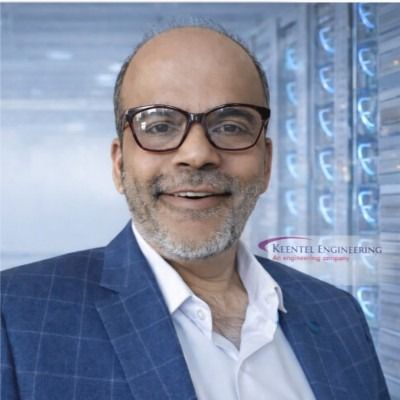
About the Author:
Sonny Patel P.E. EC
IEEE Senior Member
In 1995, Sandip (Sonny) R. Patel earned his Electrical Engineering degree from the University of Illinois, specializing in Electrical Engineering . But degrees don’t build legacies—action does. For three decades, he’s been shaping the future of engineering, not just as a licensed Professional Engineer across multiple states (Florida, California, New York, West Virginia, and Minnesota), but as a doer. A builder. A leader. Not just an engineer. A Licensed Electrical Contractor in Florida with an Unlimited EC license. Not just an executive. The founder and CEO of KEENTEL LLC—where expertise meets execution. Three decades. Multiple states. Endless impact.
Services

Let's Discuss Your Project
Let's book a call to discuss your electrical engineering project that we can help you with.
About the Author:
Sonny Patel P.E. EC
IEEE Senior Member
In 1995, Sandip (Sonny) R. Patel earned his Electrical Engineering degree from the University of Illinois, specializing in Electrical Engineering . But degrees don’t build legacies—action does. For three decades, he’s been shaping the future of engineering, not just as a licensed Professional Engineer across multiple states (Florida, California, New York, West Virginia, and Minnesota), but as a doer. A builder. A leader. Not just an engineer. A Licensed Electrical Contractor in Florida with an Unlimited EC license. Not just an executive. The founder and CEO of KEENTEL LLC—where expertise meets execution. Three decades. Multiple states. Endless impact.
Leave a Comment
We will get back to you as soon as possible.
Please try again later.
Related Posts