

A Coordinated Electric System Interconnection Review—the utility’s deep-dive on technical and cost impacts of your project.
Challenge: Frequent false tripping using conventional electromechanical relays
Solution: SEL-487E integration with multi-terminal differential protection and dynamic inrush restraint
Result: 90% reduction in false trips, saving over $250,000 in downtime
| Category | Metric |
|---|---|
| VPP capacity (Lunar Energy) | 650 MW |
| Lunar funding raised | US$232 million |
| Data center BESS example | 31 MW / 62 MWh |
| ERCOT grid-scale batteries | 15+ GW |
| LDES tenders (H1 2026) | Up to 9.3 GW |
| Lithium-ion share of LDES by 2030 | 77% |
| FEOC initial threshold | 55% |
| BESS tariff rate (2026) | ~55% |
| Capacity gain from analytics | 5–15% |
What is T&D Co-Simulation?
Confusing Physical Connections with Logical Nodes in IEC 61850
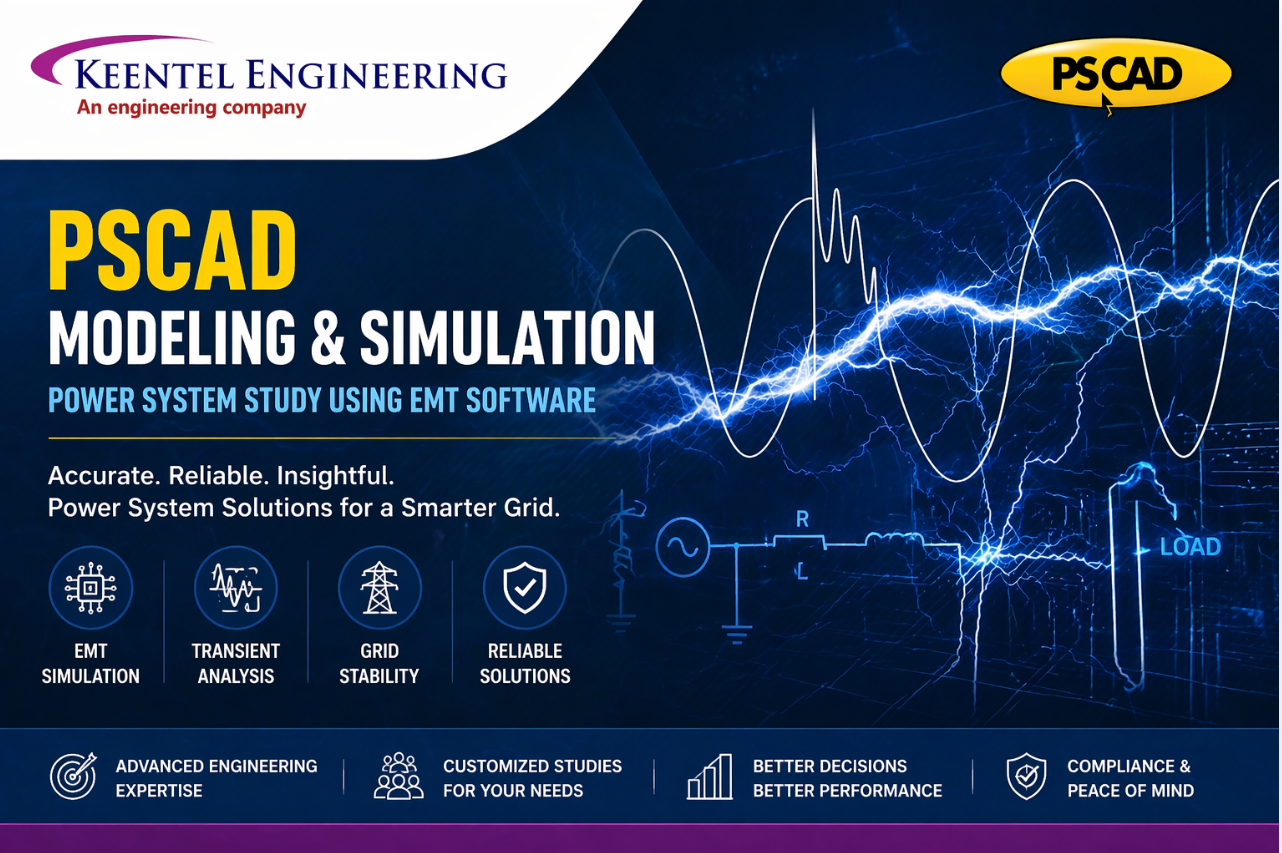
Advanced PSCAD Modeling and EMT Simulation for Power System Studies A Practical Guide with Engineering Insights by Keentel Engineering
Apr 22, 2022 | blog
Introduction
In modern power systems especially with increasing penetration of inverter-based resources (IBRs), renewable energy, and complex grid dynamics Electromagnetic Transient (EMT) simulation tools such as PSCAD have become indispensable.
This Blog demonstrates a fundamental PSCAD modeling workflow, including:
- Grid source modeling
- Line impedance calculation
- Load representation
- Measurement of voltage, current, active power, and reactive power
- Waveform visualization and analysis
While the example is simple, the engineering principles scale directly to real-world utility-grade studies, which is where Keentel Engineering delivers high-value services.
1. Fundamentals of PSCAD Modeling
1.1 Power System Representation in EMT Tools
PSCAD allows engineers to model systems in:
- Single-line representation (simplified)
- Three-phase detailed modeling (for transient accuracy)
In this blog:
- A 230 kV ideal voltage source is used
- Frequency: 50/60 Hz
- System is initially modeled in single-line form
This approach is common in early-stage
feasibility studies .
1.2 Transmission Line Parameter Development
A key engineering step shown is the calculation of inductance:
- Given:
- Resistance (R) = 5 Ω
- X/R ratio = 20
- Reactance (X) = 100 Ω
The inductance is calculated using:
X=2πfL
Which leads to:
L=X2πf
Result:
- L ≈ 0.318 H
This step is critical in ensuring accurate
transient response in EMT simulations.
1.3 Load Modeling
The system uses:
- Resistive load: 5 Ω
- Grounded configuration
This is a simplified representation, but in real projects:
- Loads include dynamic models (motors, converters, etc.)
- Time-varying characteristics are considered
2. Measurement and Simulation Outputs
The PSCAD model captures four key parameters:
2.1 Voltage Waveform
- Peak value observed: ~187 kV
- Derived from line-to-line voltage conversion:
- Phase voltage = V_LL / √3
- RMS-to-peak conversion applied
2.2 Current Measurement
- Approximate current: 1.87 kA
2.3 Active Power (P)
- ~52 kW
2.4 Reactive Power (Q)
- ~523 kVAR
Engineering Insight
This high reactive power relative to real power indicates:
- Strong inductive behavior
- Poor power factor
- Need for compensation (capacitors, FACTS, etc.)
3. Why EMT Simulation Matters Today
Traditional RMS simulations are no longer sufficient for:
- Inverter-based resources (IBRs)
- HVDC systems
- Weak grid conditions
- Protection system misoperations
EMT simulations enable:
- Sub-cycle transient analysis
- Accurate switching behavior
- Harmonic and resonance studies
- Grid stability validation
4. How Keentel Engineering Adds Value
Keentel Engineering brings 30+ years of expertise in:
4.1 Advanced PSCAD & EMT Modeling Services
- Utility-scale solar and BESS modeling
- Wind farm EMT studies
- Grid-forming inverter simulations
- Black start and islanding analysis
4.2 NERC & ISO Compliance Support
- PRC, MOD, TPL compliance
- TSAT + PSCAD hybrid studies
- Dynamic model validation
4.3 Protection & Control Integration
- Relay coordination in EMT environment
- Transient-based protection schemes
- Fault ride-through (FRT) verification
4.4 Grid Interconnection Studies
- ERCOT, PJM, CAISO, WECC compliance
- Weak grid and SCR analysis
- Harmonic resonance studies
5. Real-World Engineering Considerations
The simple model in the attached file evolves into complex systems including:
- Multi-terminal networks
- Renewable integration
- Converter control dynamics
- Frequency and voltage stability
Keentel Engineering transforms basic models into:
- Bankable studies
- Utility-approved simulations
- Regulatory-compliant reports
Frequently Asked Questions (FAQs)
1. What is PSCAD used for in power systems?
PSCAD is used for electromagnetic transient simulations, allowing engineers to analyze fast dynamic events such as faults, switching, and inverter behavior.
2. Why is EMT simulation important for renewable energy projects?
Because inverter-based resources operate with fast controls that RMS tools cannot accurately capture, especially during faults and disturbances.
3. What is the significance of X/R ratio?
It defines the relationship between resistance and reactance, impacting:
- Fault current magnitude
- Decay characteristics
- Protection system performance
4. How is inductance calculated in PSCAD modeling?
Using:
L=X2πf
This ensures accurate representation of system impedance.
5. Why is reactive power high in the example?
Due to inductive elements dominating the system, leading to:
- Low power factor
- Increased losses
6. Can PSCAD model inverter-based resources?
Yes, PSCAD is one of the best tools for:
- Detailed inverter control modeling
- Grid-forming and grid-following behavior
7. What is the difference between RMS and EMT simulation?
- RMS: steady-state and slow dynamics
- EMT: fast transients and switching events
8. How does Keentel Engineering support PSCAD studies?
By providing:
- Custom model development
- Validation against ISO requirements
- Full interconnection study support
9. What industries require EMT studies?
Utilities
- Renewable developers
- Transmission operators
- Industrial power systems
10. What are common outputs analyzed in PSCAD?
- Voltage
- Current
- Active power
- Reactive power
- Harmonics
Case Studies (Confidential Projects – Keentel Engineering)
Case Study 1: Utility-Scale Solar + BESS Integration (ERCOT)
Scope
- 250 MW solar + 150 MW BESS
- Weak grid interconnection
Challenges
- Low short circuit ratio (SCR < 2)
- Voltage instability during faults
Solution
- Developed detailed PSCAD EMT model
- Simulated inverter control response
- Optimized reactive power support
Result
- Achieved ERCOT compliance
- Eliminated voltage oscillations
- Reduced study iteration time by 30%
Case Study 2: Wind Farm Harmonic Resonance Study (WECC Region)
Scope
- 300 MW wind farm
- Collector system harmonic issues
Challenges
- Resonance at 3rd and 5th harmonics
- Equipment overheating
Solution
- EMT-based harmonic analysis
- Filter design optimization
Result
- Eliminated resonance conditions
- Improved system reliability
- Passed utility interconnection review
Case Study 3: Transmission Substation Fault Analysis (PJM)
Scope
- 500 kV substation
- Protection coordination validation
Challenges
- Relay misoperation during high-speed faults
- Inadequate transient response modeling
Solution
- PSCAD-based fault simulations
- Relay model integration
Result
- Corrected protection settings
- Prevented nuisance tripping
- Improved system stability
Conclusion
The attached PSCAD example demonstrates core modeling principles, but real-world
applications require:
- Advanced modeling expertise
- Compliance knowledge
- Deep understanding of grid behavior
Keentel Engineering bridges that gap.
From basic EMT modeling to complex grid compliance studies, Keentel delivers:
- Accurate simulations
- Regulatory compliance
- Bankable engineering solutions

About the Author:
Sonny Patel P.E. EC
IEEE Senior Member
In 1995, Sandip (Sonny) R. Patel earned his Electrical Engineering degree from the University of Illinois, specializing in Electrical Engineering . But degrees don’t build legacies—action does. For three decades, he’s been shaping the future of engineering, not just as a licensed Professional Engineer across multiple states (Florida, California, New York, West Virginia, and Minnesota), but as a doer. A builder. A leader. Not just an engineer. A Licensed Electrical Contractor in Florida with an Unlimited EC license. Not just an executive. The founder and CEO of KEENTEL LLC—where expertise meets execution. Three decades. Multiple states. Endless impact.
Services

Let's Discuss Your Project
Let's book a call to discuss your electrical engineering project that we can help you with.

About the Author:
Sonny Patel P.E. EC
IEEE Senior Member
In 1995, Sandip (Sonny) R. Patel earned his Electrical Engineering degree from the University of Illinois, specializing in Electrical Engineering . But degrees don’t build legacies—action does. For three decades, he’s been shaping the future of engineering, not just as a licensed Professional Engineer across multiple states (Florida, California, New York, West Virginia, and Minnesota), but as a doer. A builder. A leader. Not just an engineer. A Licensed Electrical Contractor in Florida with an Unlimited EC license. Not just an executive. The founder and CEO of KEENTEL LLC—where expertise meets execution. Three decades. Multiple states. Endless impact.
Leave a Comment
We will get back to you as soon as possible.
Please try again later.