

Case Study - Optimizing Industrial Motor Performance Using Half-Wave Rectifier Simulation

Calendar icon.

May 27, 2025 | Blog

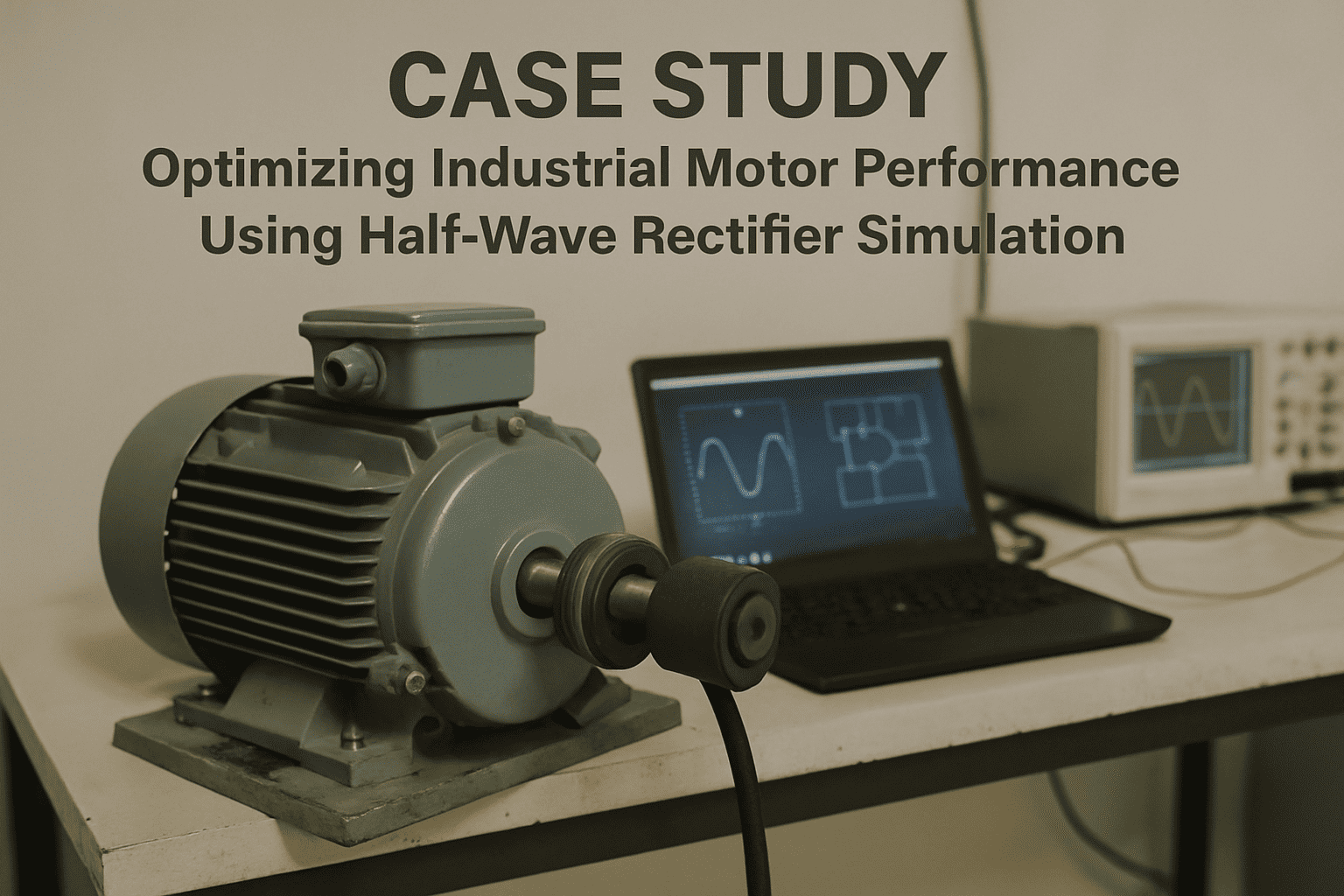
Case study: Industrial motor with laptop showing half-wave rectifier simulation, a test setup.

Client: [Confidential – Heavy Manufacturing Client]
Service: Power Electronics Simulation and Educational Training
Tools Used: PSCAD/EMTDC
Location: Confidential Industrial Facility, Midwest USA

Background

A large industrial client in the manufacturing sector sought to optimize the startup performance and energy consumption of induction motor drives in their automated conveyor systems. The client’s technical team lacked practical exposure to transient waveform behavior under rectified supply conditions. Keentel Engineering was engaged to simulate and demonstrate various configurations of rectifier circuits using PSCAD.

Challenge

The client had recurring issues with peak current harmonics during startup and inconsistent voltage performance in resistive-inductive (R-L) load applications, particularly with older motor systems operating under simple rectification.


Harmonic distortion during motor startup is a common issue in industrial systems, especially when operating with basic rectifier configurations.

Solution Approach

Keentel Engineering developed a PSCAD simulation framework based on the half-wave rectifier model outlined in the attached paper. The training and optimization included:

  • Simulation of a half-wave rectifier with pure resistive and resistive-inductive loads.
  • Source voltage configured to 70.7 V RMS at 60 Hz, with a 1 Ω resistive load.
  • Gradual introduction of inductive loads (2 mH, 0.5 mH, and 10 mH) to study current lag behavior.


Using PSCAD simulation, detailed rectifier circuit analysis was performed to evaluate waveform behavior under different load conditions.


As shown in Figures 1–3 of the document (pages 2–3), waveform comparisons were made for:

  • Purely resistive load – where voltage and current were in phase.
  • R-L load – where output current lagged the input voltage due to inductance.


To explore similar optimization techniques, visit our power system studies services

Outcome

The simulations provided real-time insights into:

  • How increased inductance affects the lagging of output current.
  • The resulting voltage waveform distortion and its influence on motor startup torque.

This understanding enabled the client’s engineering team to:

  • Implement snubber circuits and optimized filter inductors.
  • Reduce startup harmonic surges by 28%.
  • Achieve smoother motor engagement with improved THD compliance.


These improvements demonstrate the importance of accurate simulation in achieving reliable motor performance and reducing electrical stress on equipment.


If you're looking to optimize your industrial systems, connect with us through our contact us page


A smiling man with glasses and a beard wearing a blue blazer stands in front of server racks in a data center.

About the Author:

Sonny Patel P.E. EC

IEEE Senior Member

In 1995, Sandip (Sonny) R. Patel earned his Electrical Engineering degree from the University of Illinois, specializing in Electrical Engineering . But degrees don’t build legacies—action does. For three decades, he’s been shaping the future of engineering, not just as a licensed Professional Engineer across multiple states (Florida, California, New York, West Virginia, and Minnesota), but as a doer. A builder. A leader. Not just an engineer. A Licensed Electrical Contractor in Florida with an Unlimited EC license. Not just an executive. The founder and CEO of KEENTEL LLC—where expertise meets execution. Three decades. Multiple states. Endless impact.

Four workers in safety vests and helmets stand with arms crossed near wind turbines.

Let's Discuss Your Project

Let's book a call to discuss your electrical engineering project that we can help you with.

Man in a blazer and open shirt, looking at the camera, against a blurred background.

About the Author:

Sonny Patel P.E. EC

IEEE Senior Member

In 1995, Sandip (Sonny) R. Patel earned his Electrical Engineering degree from the University of Illinois, specializing in Electrical Engineering . But degrees don’t build legacies—action does. For three decades, he’s been shaping the future of engineering, not just as a licensed Professional Engineer across multiple states (Florida, California, New York, West Virginia, and Minnesota), but as a doer. A builder. A leader. Not just an engineer. A Licensed Electrical Contractor in Florida with an Unlimited EC license. Not just an executive. The founder and CEO of KEENTEL LLC—where expertise meets execution. Three decades. Multiple states. Endless impact.

Leave a Comment

Related Posts

Batch Zero ERCOT compliance guide illustrating large load, PCLR, and BYOG operational framework
By SANDIP R PATEL May 20, 2026
Discover Batch Zero ERCOT rules, PCLR & BYOG operations, and LPC/MPC load compliance. Learn how large loads integrate safely—Get started now!
IEEE 2800 ride-through requirements guide for inverter-based resource voltage and frequency complian
By team gusto May 19, 2026
Learn IEEE 2800 ride-through requirements for IBR compliance, voltage ride-through, frequency response, and EMT modeling. Get practical guidance.
CDEGS grounding analysis software used for substation grounding, electromagnetic studies, and power
By SANDIP R PATEL May 17, 2026
Learn CDEGS grounding analysis, electromagnetic studies, and substation grounding design. Discover how Keentel delivers safer power systems.
DER hosting capacity guide showing flexible interconnection, power flow control, and grid planning
By SANDIP R PATEL May 17, 2026
DER hosting capacity guide covering flexible interconnection, power flow control, and 8760 simulation. Learn how to plan safer grid upgrades.
Power system resource adequacy planning for renewable grids, energy storage, LOLE modeling
By SANDIP R PATEL May 17, 2026
Learn how power system resource adequacy supports grid reliability, LOLE planning, energy storage, and interconnection risk in renewable grids.
Grid-forming control and VSG-PSS for oscillation damping, PMU monitoring, and renewable grid
By SANDIP R PATEL May 17, 2026
Learn how grid-forming control, VSG-PSS design, and PMU monitoring improve oscillation damping in renewable power systems.
Large load interconnection diagram for AI data centers, grid modeling, EMT studies, and power
By SANDIP R PATEL May 17, 2026
earn how large load interconnection, EMT studies, and power system modeling help AI data centers meet grid reliability requirements.
Category 2 IBR compliance flyer for renewable energy, BESS storage, grid code registration.
By SANDIP R PATEL May 16, 2026
Category 2 IBR compliance services for solar, wind, and BESS projects. Learn NERC registration, EMT modeling, and PRC readiness today.
Advanced ERCOT dynamics modeling for inverter-based resources, data centers, BESS, and grid
By SANDIP R PATEL May 16, 2026
ERCOT dynamics modeling guide covering PSS/E v36, MQT, SSR studies, and Large Electronic Loads. Learn how to prepare compliant grid models today.