A Coordinated Electric System Interconnection Review—the utility’s deep-dive on technical and cost impacts of your project.
Challenge: Frequent false tripping using conventional electromechanical relays
Solution: SEL-487E integration with multi-terminal differential protection and dynamic inrush restraint
Result: 90% reduction in false trips, saving over $250,000 in downtime
ERCOT enforces all of the above through simulation, which means your model is your compliance case. The bar is now high:
- Whole-facility scope. The model must represent everything the IT load, the UPS and power conversion, the cooling plant, the protection and control systems in formats compatible with ERCOT's study platforms (PSS/E, PSCAD, TSAT).
- Real control loops, not approximations. Generic textbook representations are unacceptable. The model must capture the actual inner control behavior of your power electronics.
- Hardware-validated converter models. For electronic loads, the PSCAD model must be benchmarked against actual hardware testing including voltage ride-through and subsynchronous response. A model assembled from standard PSCAD library blocks fails by definition, because a generic block has never been tested against your vendor's hardware. The good news: validation is a hardware-type test, so results for a given converter product are reusable across every facility that uses it.
- Format migration. Facilities that previously submitted the older composite load model (CMLD) format must transition to EPRI's PERC1 format.
- Three checkpoints. Models are reviewed before the stability study begins (no model, no study), before each quarterly stability assessment, and for electronic loads one final time before energization, when you must submit as-built models with a documented comparison against the previously studied data and a sworn attestation that the model matches actual field settings. ERCOT's review takes 10 business days, extendable by 20 put it on your critical path.
- A living obligation. Change your technology, controls, or relay settings in a way that affects ride-through including converting a crypto mining site to an AI data center — and you've triggered a new interconnection study, even if your megawatts don't change.
| Parameter | Detail |
|---|---|
| System | 230 kV / 138 kV transmission corridors, wind and wet-snow icing exposure |
| Data basis | 15 years of minute-resolution forced-outage records + regional weather observations |
| Core methods | Event grouping, MVA performance curves, time-to-95%-restore, area outage rate curves, fragility modeling, rerun-history benefits, exceedance and log-domain risk metrics |
| Headline result | ≈85% of maximum resilience benefit at 60% of original capital; worst-event restoration window cut from 11 days to 5 in rerun-history terms |
| Decision supported | Capital portfolio selection; resilience plan filing; post-investment verification framework |
| System / Topic | Governing Standard(s) | What It Controls |
|---|---|---|
| Overall plant electrical distribution | IEEE 141 (Red Book); IEEE 666 | Distribution architecture, voltage selection, design of generating station auxiliary service systems |
| Power system studies | IEEE 399 (Brown Book); IEEE 551 | Load flow, symmetrical/asymmetrical short circuit, motor starting methodologies down to the lowest LV panelboard |
| Protection & coordination | IEEE 242 (Buff Book); IEEE 3004.5; IEEE C37 series | Generator relaying (21, 59N, 87G), time-current coordination, selective clearing between LV and MV tiers |
| GSU / UAT / SST transformers | IEEE C57.12.00 and C57 family | Transformer ratings, impedance, testing, loading |
| HV switchyard breakers | IEEE C37.06 | AC high-voltage circuit breaker preferred ratings |
| MV switchgear (13.8 kV) | IEEE C37.20.2; IEEE C37.20.7 | Metal-clad construction, compartmentalization, vacuum breakers; arc-resistant design with plenum venting |
| MV cable | UL 1072; ICEA S-93-639 (NEMA WC 74) | Type MV-105 shielded cable, 133% insulation level for HRG systems |
| LV switchgear (480 V) | IEEE C37.13; UL 1558 | Metal-enclosed LV power circuit breaker switchgear to 635 V, draw-out ACBs with electronic trip units |
| Motor control centers | UL 845; NEMA ICS 18 | LV-MCC construction, MCCB/MCP protection for motors under ~200 HP |
| Motors | NEMA MG-1 | Motor performance, starting characteristics, service factors |
| DC & battery systems | IEEE 485; IEEE 946 | Lead-acid battery sizing (125/250 VDC), DC auxiliary system design |
| Grounding | IEEE 80; IEEE 142 (Green Book) | Ground grid step/touch potential limits; system grounding including high-resistance grounding |
| Lightning protection | IEEE 998 | Direct-stroke shielding of switchyard and outdoor generator structures |
| Arc flash & electrical safety | IEEE 1584; NFPA 70E | Incident energy calculation; worker safety boundaries and PPE |
| Fire protection | NFPA 850 | Fire protection and risk management for combustion turbine generating plants |
| Installation code | NEC (NFPA 70); NESC | Wiring methods inside the plant fence; overhead/outdoor clearances at the switchyard |
| Interconnection & compliance | FERC LGIP; NERC MOD-025/026/027, PRC-019/024/029, FAC-008 | Interconnection process, model validation, protection/ride-through coordination, facility ratings |
| IFC / Construction Deliverable | Purpose |
|---|---|
| Stamped IFC packages | Legal basis for construction; P.E. responsible charge |
| Final relay settings & TCCs | Protection as-installed matches the coordination study |
| Calculation archive | Owner records; NERC audit evidence trail |
| Commissioning procedures | Safe, sequenced energization; MOD field testing |
| Construction support | RFIs, field changes, FAT/SAT witness |
| As-builts & model handoff | Operating baseline; future study currency |
| Metric | Outcome |
|---|---|
| Defects found pre-occupancy | Three topology defects and one settings-mismatch family corrected before load migration; the shared-switchboard defect alone would have invalidated the concurrently-maintainable claim on day one |
| IST findings | Fourteen additional discrepancies surfaced under scenario testing (control logic, alarm mapping, one generator sequencing fault) — all closed before handover instead of during operations |
| Black-building test | Passed on second execution; the first attempt exposed the generator sequencing fault under true block load, exactly the failure the compressed plan would never have found |
| Handover quality | Operations team certified on the actual failure scenarios; corrected EOPs and settings documentation delivered as controlled documents |
| Business outcome | Occupancy proceeded three weeks behind the original date — against an independent estimate that the uncorrected sequencing fault carried a high probability of a full facility outage within the first year |
Part 2 — Frequently Asked Questions: Large Load Interconnection
| Contact | Details |
|---|---|
| Headquarters | 400 N Ashley Dr STE 2600, Tampa, FL 33602 |
| Phone | (813) 389-7871 |
| contact@keentelengineering.com | |
| Florida Firm Registration | No. 36853 |
| Additional Offices | Austin, TX • Sacramento, CA • Baltimore, MD |
| Who | Acronym | Plain-English Role |
|---|---|---|
| ERCOT | — | The grid's air traffic controller. It doesn't own power lines or plants; it directs the flow of electricity across most of Texas and referees the admission process for new generators. |
| Interconnecting Entity | IE | You — the developer or owner trying to connect a new plant (or significantly modify an existing one). You file the application and drive the process. |
| Resource Entity | RE | The registered owner/operator of the generator once it becomes an official market participant. Often the same company as the IE, wearing a different hat. |
| Qualified Scheduling Entity | QSE | Your plant's voice on the grid. The QSE handles round-the-clock communications with ERCOT — telemetry, schedules, dispatch instructions. Every generator must have one. |
| Transmission Service Provider | TSP | The utility that owns the wires and substation you'll connect to. The TSP runs your detailed study, builds the connection facilities, and signs your interconnection contract. |
| RIOO-IS | — | ERCOT's online portal where the whole process lives — applications, documents, status tracking, and checklists all flow through it. |
| Who | Acronym | Plain-English Role |
|---|---|---|
| ERCOT | — | The grid's air traffic controller. It doesn't own power lines or plants; it directs the flow of electricity across most of Texas and referees the admission process for new generators. |
| Interconnecting Entity | IE | You — the developer or owner trying to connect a new plant (or significantly modify an existing one). You file the application and drive the process. |
| Resource Entity | RE | The registered owner/operator of the generator once it becomes an official market participant. Often the same company as the IE, wearing a different hat. |
| Qualified Scheduling Entity | QSE | Your plant's voice on the grid. The QSE handles round-the-clock communications with ERCOT — telemetry, schedules, dispatch instructions. Every generator must have one. |
| Transmission Service Provider | TSP | The utility that owns the wires and substation you'll connect to. The TSP runs your detailed study, builds the connection facilities, and signs your interconnection contract. |
| RIOO-IS | — | ERCOT's online portal where the whole process lives — applications, documents, status tracking, and checklists all flow through it. |
| Who | Acronym | Plain-English Role |
|---|---|---|
| ERCOT | — | The grid's air traffic controller. It doesn't own power lines or plants; it directs the flow of electricity across most of Texas and referees the admission process for new generators. |
| Interconnecting Entity | IE | You — the developer or owner trying to connect a new plant (or significantly modify an existing one). You file the application and drive the process. |
| Resource Entity | RE | The registered owner/operator of the generator once it becomes an official market participant. Often the same company as the IE, wearing a different hat. |
| Qualified Scheduling Entity | QSE | Your plant's voice on the grid. The QSE handles round-the-clock communications with ERCOT — telemetry, schedules, dispatch instructions. Every generator must have one. |
| Transmission Service Provider | TSP | The utility that owns the wires and substation you'll connect to. The TSP runs your detailed study, builds the connection facilities, and signs your interconnection contract. |
| RIOO-IS | — | ERCOT's online portal where the whole process lives — applications, documents, status tracking, and checklists all flow through it. |
| Who | Acronym | Plain-English Role |
|---|---|---|
| ERCOT | — | The grid's air traffic controller. It doesn't own power lines or plants; it directs the flow of electricity across most of Texas and referees the admission process for new generators. |
| Interconnecting Entity | IE | You — the developer or owner trying to connect a new plant (or significantly modify an existing one). You file the application and drive the process. |
| Resource Entity | RE | The registered owner/operator of the generator once it becomes an official market participant. Often the same company as the IE, wearing a different hat. |
| Qualified Scheduling Entity | QSE | Your plant's voice on the grid. The QSE handles round-the-clock communications with ERCOT — telemetry, schedules, dispatch instructions. Every generator must have one. |
| Transmission Service Provider | TSP | The utility that owns the wires and substation you'll connect to. The TSP runs your detailed study, builds the connection facilities, and signs your interconnection contract. |
| RIOO-IS | — | ERCOT's online portal where the whole process lives — applications, documents, status tracking, and checklists all flow through it. |
| Who | Acronym | Plain-English Role |
|---|---|---|
| ERCOT | — | The grid's air traffic controller. It doesn't own power lines or plants; it directs the flow of electricity across most of Texas and referees the admission process for new generators. |
| Interconnecting Entity | IE | You — the developer or owner trying to connect a new plant (or significantly modify an existing one). You file the application and drive the process. |
| Resource Entity | RE | The registered owner/operator of the generator once it becomes an official market participant. Often the same company as the IE, wearing a different hat. |
| Qualified Scheduling Entity | QSE | Your plant's voice on the grid. The QSE handles round-the-clock communications with ERCOT — telemetry, schedules, dispatch instructions. Every generator must have one. |
| Transmission Service Provider | TSP | The utility that owns the wires and substation you'll connect to. The TSP runs your detailed study, builds the connection facilities, and signs your interconnection contract. |
| RIOO-IS | — | ERCOT's online portal where the whole process lives — applications, documents, status tracking, and checklists all flow through it. |
| Who | Acronym | Plain-English Role |
|---|---|---|
| ERCOT | — | The grid's air traffic controller. It doesn't own power lines or plants; it directs the flow of electricity across most of Texas and referees the admission process for new generators. |
| Interconnecting Entity | IE | You — the developer or owner trying to connect a new plant (or significantly modify an existing one). You file the application and drive the process. |
| Resource Entity | RE | The registered owner/operator of the generator once it becomes an official market participant. Often the same company as the IE, wearing a different hat. |
| Qualified Scheduling Entity | QSE | Your plant's voice on the grid. The QSE handles round-the-clock communications with ERCOT — telemetry, schedules, dispatch instructions. Every generator must have one. |
| Transmission Service Provider | TSP | The utility that owns the wires and substation you'll connect to. The TSP runs your detailed study, builds the connection facilities, and signs your interconnection contract. |
| RIOO-IS | — | ERCOT's online portal where the whole process lives — applications, documents, status tracking, and checklists all flow through it. |
| Who | Acronym | Plain-English Role |
|---|---|---|
| ERCOT | — | The grid's air traffic controller. It doesn't own power lines or plants; it directs the flow of electricity across most of Texas and referees the admission process for new generators. |
| Interconnecting Entity | IE | You — the developer or owner trying to connect a new plant (or significantly modify an existing one). You file the application and drive the process. |
| Resource Entity | RE | The registered owner/operator of the generator once it becomes an official market participant. Often the same company as the IE, wearing a different hat. |
| Qualified Scheduling Entity | QSE | Your plant's voice on the grid. The QSE handles round-the-clock communications with ERCOT — telemetry, schedules, dispatch instructions. Every generator must have one. |
| Transmission Service Provider | TSP | The utility that owns the wires and substation you'll connect to. The TSP runs your detailed study, builds the connection facilities, and signs your interconnection contract. |
| RIOO-IS | — | ERCOT's online portal where the whole process lives — applications, documents, status tracking, and checklists all flow through it. |
Protection Design
PCLR Explained: How ERCOT Turned the Bitcoin Miner Playbook Into an Official Grid Connection Pathway
Jul 28, 2026 | Blog
Of everything in ERCOT's new Batch Zero framework, the Provisional Controllable Load Resource — the PCLR — is the piece with the most interesting origin story. It didn't come from a planning textbook. It came from a decade of Texas bitcoin miners proving, megawatt by megawatt, that a gigawatt-scale computing facility can be one of the most flexible resources on a power grid — and that flexibility is worth real money and real grid capacity.
This article explains the PCLR pathway in depth: how it works, how ERCOT's dynamic bid caps control it in real time, why it exists (the bitcoin mining heritage), the obligations that come with it, and how to decide whether it belongs in your project's strategy.
The Problem PCLR Solves: The Gap Between Firm and Full
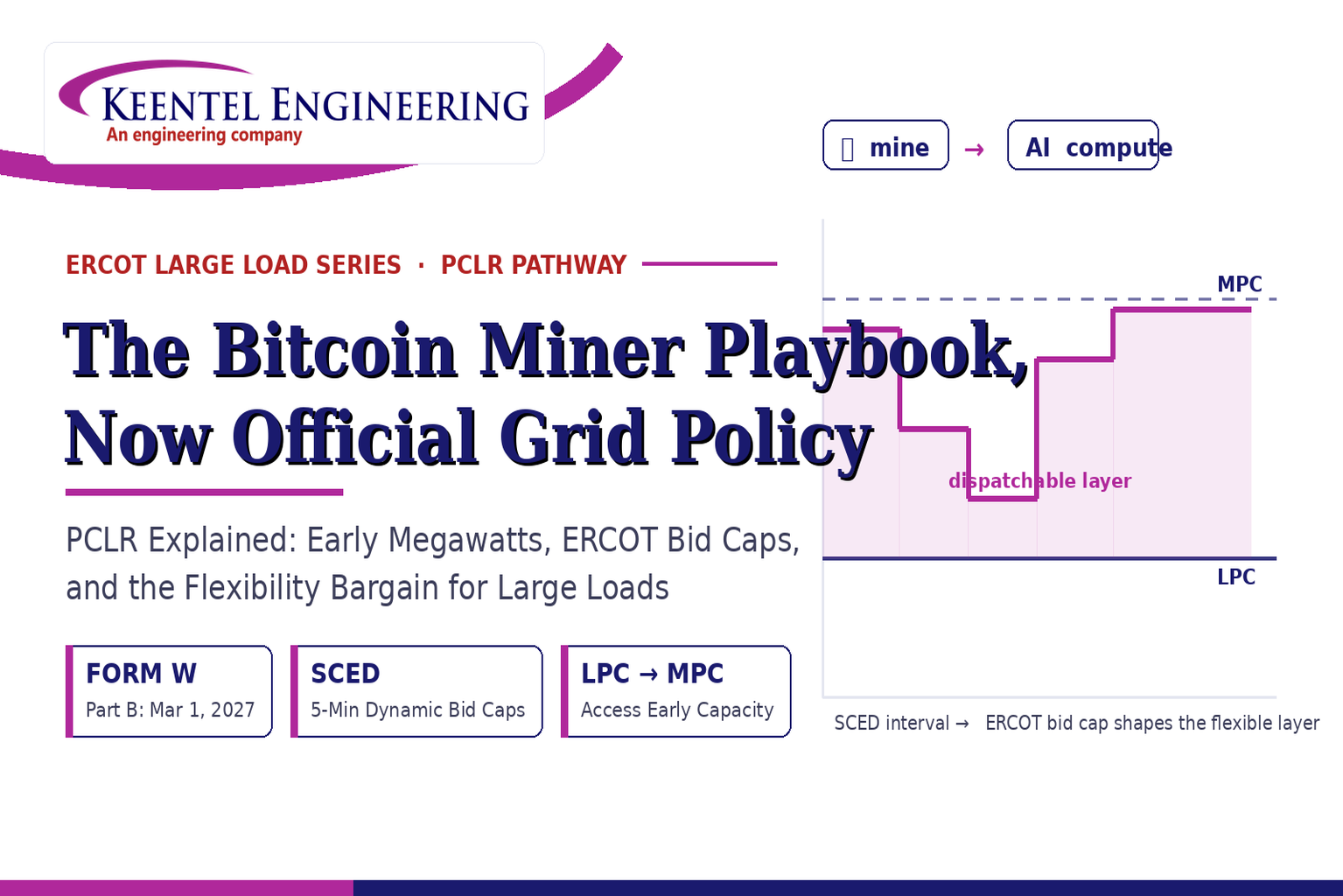
Every Studied Load in Batch Zero receives two numbers from ERCOT's system-wide study. The LPC (Low Power Consumption) is the firm amount — megawatts the grid can serve reliably today, with no strings attached. The MPC (Maximum Power Consumption) is your full requested peak. Between them lies capacity that the transmission system can deliver most of the time — real megawatts that exist except during the constrained hours that reliability planning is built around.
Without an election, a Studied Load is capped at its LPC until transmission catches up — potentially years. The PCLR is one of two ways to access the gap (the other, WLPUN, pairs your load with on-site generation). The PCLR bargain, in one sentence: you may consume above your firm allocation, all the way to your full request, in exchange for placing that above-firm consumption under ERCOT's real-time control.
ERCOT describes it, aptly, as a reliability partnership: the customer consumes more power during hours when the local grid is moving freely, and ERCOT gains a new tool to automatically reduce that draw when localized congestion appears.
How PCLR Actually Works: The Mechanics
Registration and dispatch
A PCLR must register as a Controllable Load Resource — meaning real-time telemetry, dispatch systems, and a qualified scheduling entity — and must follow ERCOT's dispatch instructions through SCED (Security-Constrained Economic Dispatch, the five-minute engine that runs the ERCOT market) at all times. This is not a demand-response program you opt into on hot afternoons. The controllable load is embedded in ERCOT's dispatching system, full stop.
The bid cap mechanism how ERCOT holds the dimmer switch
Here is the piece that makes PCLR work operationally. In each SCED run, ERCOT may dynamically cap the PCLR's energy bids to whatever consumption level the transmission constraints in its area can accommodate at that moment. When the local grid is unconstrained, the cap sits at or near the facility's MPC and the load runs free. When a constraint binds — a line loading up, an outage reducing transfer capability — ERCOT lowers the cap, and the facility's consumption above its firm LPC is curtailed down accordingly. The firm LPC itself is never at risk; only the provisional layer above it flexes. In effect, the PCLR's consumption between LPC and MPC becomes a dispatchable quantity that ERCOT can shape every five minutes — which is precisely why ERCOT can responsibly let the load energize years before the wires that would make it all firm.
The exit date
PCLR status is provisional by design. The Batch Zero study establishes an Exit Date — the point at which planned transmission upgrades make the capacity firm — and the facility must remain registered and dispatchable until then. After the exit date, the training wheels come off and the load converts to conventional firm service.
What you give up
Two things. First, curtailment exposure: during constrained periods, your above-LPC megawatts can be dispatched down, and your operations must tolerate that commercially and technically. Second, ancillary services: a PCLR may not sell ancillary services during its provisional period — its flexibility is already spoken for by the interconnection bargain. Miners accustomed to stacking curtailment programs and AS revenue should model this restriction carefully; the PCLR trades AS income for early megawatts.
The paperwork
The election runs on Form W, in two acts, both notarized. Part A — the Declaration of Intent, including minimum LPC levels for each study year — was due with the
Batch Zero eligibility package (July 10, 2026) and is a binding commitment. Part B — accepting the study's actual LPC amounts and exit date, alongside the executed interconnection agreement — is due March 1, 2027. Missing Part B is treated as withdrawal. For future applicants, expect the Batch 1 process to carry the same two-step structure
The Bitcoin Heritage: Why This Pathway Exists
None of this was invented on a whiteboard. The PCLR is the formalization of an operating model that Texas bitcoin miners built in the field over the past half-decade.
Mining had three properties that made it the perfect pioneer species for flexible load. Its economics tolerate interruption — a miner that shuts down loses revenue for those minutes but suffers no process damage, no scrap, no restart penalty worth mentioning. Its consumption is granular and fast — rigs can shed load in seconds, in increments as fine as the operator likes. And its margins made flexibility profitable — when power prices spiked, the most profitable thing a miner could do was stop mining and either sell curtailment or simply avoid the price.
So miners became the grid's shock absorbers, largely voluntarily: registering as Controllable Load Resources, responding to conservative operations appeals, riding the four-coincident-peak (4CP) transmission-charge avoidance game, and demonstrating during winter storms and summer scarcity events that a gigawatt of computing could vanish from the demand curve in minutes when the grid needed it. ERCOT's operators noticed. Its planners noticed harder: here was a class of large load that reduced rather than amplified system stress — and the queue was filling with its cousins.
The PCLR takes that voluntary, market-opportunistic behavior and converts it into an interconnection currency: flexibility is no longer just a revenue strategy; it is now a way to jump years ahead in the connection queue. That is a profound repricing of what a curtailment-tolerant load is worth in Texas.
A note on the market context
The conversation has evolved because the miners themselves have evolved. A large share of the Texas mining fleet is now evaluating or executing conversions to AI/HPC hosting, where the revenue per megawatt-hour is higher but the tolerance for interruption is lower — AI training jobs checkpoint and pause far less gracefully than a mining rig power cycles. That migration is happening just as the PCLR arrives, which creates a strategic irony: the pathway built on mining's flexibility is most valuable to the loads keeping that flexibility. (And remember the regulatory tripwire our PGRR144 coverage flagged: a crypto-to-AI conversion is a named example of a material change requiring a new interconnection study — same megawatts or not.)
Who Should Elect PCLR A Decision Framework
The election reduces to one honest question:
can the megawatts above your firm allocation tolerate being dispatched down, and is having them early worth that tolerance?
Strong fits:
bitcoin and other compute whose workloads checkpoint or pause cleanly; AI training campuses with checkpointing discipline and workload schedulers that can chase the bid cap; facilities with on-site batteries that can ride through short curtailments; phased campuses whose early revenue depends on energizing beyond LPC quickly.
Weak fits:
AI inference and cloud-serving loads with customer-facing SLAs; facilities whose above-LPC capacity would carry mission-critical tenant load; operators whose financial model depends on ancillary services revenue during the provisional years; and anyone whose curtailment risk analysis consists of hoping constraints won't bind. Constraint exposure is locational — the same PCLR election that curtails rarely in one part of the grid can curtail chronically in a congested pocket, so the analysis must be done against your POI, not against averages.
The default is respectable:
elect nothing, take the firm LPC, and grow into the MPC as transmission arrives. PCLR is for projects whose business case cannot wait — and who can prove, with real curtailment modeling, that the flexible layer pays for itself.
What PCLR Demands From Your Engineering
This is where the pathway stops being a commercial election and becomes an engineering program — because a PCLR is, functionally, a dispatchable resource, and ERCOT treats it like one:
Controls and telemetry
CLR registration requires real-time telemetry to ERCOT, dispatch-following control capability at SCED speed, and a qualified scheduling entity. The facility's power management system must translate a five-minute bid cap into orderly load reduction — which workloads shed, in what order, how fast — without tripping anything.
Dynamic models that show it
your PSS®E and PSCAD models must represent the controllable-load behavior ERCOT will rely on — the load's response to dispatch, its ride-through performance during the disturbances that often accompany the constrained conditions triggering curtailment, and its recovery when the cap lifts. A PCLR whose model says "constant load" has a model problem.
Ride-through still applies
PCLR status is an operating arrangement, not a ride-through exemption. A computational load's NOGRR282 obligations — stay connected through voltage sags and frequency events, recover consumption within a second of voltage recovery — run in parallel with dispatch obligations, and the controls must serve both masters without conflict.
The WLPUN comparison belongs in the same study
for projects with generation options, the
PCLR-versus-WLPUN decision deserves side-by-side modeling — curtailment-risk-adjusted energy economics against the capital cost of on-site generation — before either notarized form is signed, because both elections bind.
Frequently Asked Questions — Detailed Answers
1. What exactly is a PCLR, in plain terms?
A Provisional Controllable Load Resource is a large load that has made a deal with ERCOT: it may consume electricity above its firm allocation (its LPC) all the way up to its full requested amount (its MPC), years before the transmission upgrades that would normally be required — and in exchange, it registers that above-firm consumption as a controllable resource inside ERCOT's real-time dispatch system, meaning ERCOT can turn it down whenever local transmission constraints require. The status is temporary by design: it lasts until an "Exit Date" set by the Batch Zero study, the point at which planned transmission makes the capacity firm and the special obligations end.
2. Is PCLR the same thing as demand response?
No, and the difference matters operationally and contractually. Demand response programs are episodic and largely voluntary — you enroll, you respond to events or price signals when they occur, and non-performance typically costs you payments rather than your grid access. A PCLR is embedded in ERCOT's Security-Constrained Economic Dispatch (SCED) — the five-minute engine that runs the entire ERCOT market — and must follow dispatch instructions at all times during its provisional period. It is closer to being a power plant that consumes than a customer with a curtailment program: telemetry streaming to ERCOT continuously, a qualified scheduling entity managing your market interface, and dispatch compliance as a standing obligation rather than an event response.
3. How does the bid cap mechanism actually work, five minutes at a time?
In every SCED run, ERCOT evaluates the transmission constraints in your area and may cap the energy bids of your PCLR at whatever consumption level those constraints can accommodate right then. Practically: when the lines around your point of interconnection have headroom, the cap sits at or near your MPC and your facility runs as it likes. When a constraint starts to bind — heavy regional flows, a line outage, a generation pattern that loads your corridor — ERCOT lowers your cap for that interval, and your consumption above the firm LPC must come down to match. When the constraint clears, the cap lifts. Your facility experiences this as a continuously updated ceiling on total consumption, changing as often as every five minutes, which your power management system must track and honor automatically. The firm LPC layer beneath is never subject to the cap.
4. Can ERCOT ever curtail me below my firm LPC?
Not through the PCLR mechanism — the entire structure of the bargain is that the LPC is firm and only the provisional layer above it flexes. The honest caveat is that extreme grid emergencies (energy emergency alerts, firm load shed events) affect all customers through separate mechanisms that exist independent of Batch Zero — but that exposure is identical for every load in ERCOT and is not increased by electing PCLR. In normal and even stressed operations, your LPC is yours.
5. How often should I expect to be curtailed?
This is the question that should drive the election, and it has no universal answer because curtailment exposure is entirely locational. A PCLR in a well-connected pocket with few binding constraints might see its cap bind a handful of hours a year; the same facility in a congested area — behind a heavily loaded interface, near large new generation additions, or sharing a pocket with other flexible loads — could see chronic curtailment during whole seasons. The exposure is also dynamic: it improves as the Batch Zero transmission plan builds out (your Exit Date is the formal endpoint) and can worsen temporarily during transmission outage seasons. The right analysis before signing Form W is a locational curtailment study: historical constraint binding around your specific POI, projected flows with the batch's other loads modeled, and outage sensitivity — producing an expected curtailment duty (hours and depth per year, by year) that your revenue model can actually consume. If a proposed PCLR election has not been through that analysis, it is not a decision yet; it is a hope.
6. What does the ancillary services prohibition really cost me?
During the provisional period, a PCLR may not provide Ancillary Services — no ECRS, no non-spin, no responsive reserve participation from the controllable capacity. For operators from the mining world, where AS revenue stacking is a core part of the flexible-load business model, this is the hidden price of the pathway: the same flexibility you would have sold to the AS markets is what you are spending to buy early interconnection. The comparison worth running: projected AS revenue on the flexible layer over the provisional years versus the value of energizing that layer years earlier. For loads with high revenue per megawatt-hour (AI hosting), early megawatts usually win decisively; for pure mining economics, the answer is closer and deserves real modeling. After the Exit Date, conventional Controllable Load Resource AS participation becomes available again.
7. What are the Form W mechanics and deadlines I cannot miss?
Two acts, both notarized, both binding. Part A — the Declaration of Intent — was due with the Batch Zero eligibility package by July 10, 2026, and had to specify your minimum LPC limits for each study year; filing it committed you to the pathway (though projects seeking base load classification were allowed to file it conditionally, as a fallback in case they were classified as studied load instead). Part B is due by March 1, 2027: you accept the study's actual LPC amounts and your Exit Date, and execute the interconnection agreement. Missing Part B is treated as withdrawal from Batch Zero — not a delay, a withdrawal — with energization deferred to a future batch. For Batch 1 applicants (window expected to open Summer 2027), expect the same two-step architecture under the ongoing batch rule.
8. What equipment and controls does PCLR registration actually require?
Functionally, what ERCOT requires of any Controllable Load Resource: real-time telemetry of your consumption and status to ERCOT; control capability that translates a SCED basepoint or bid cap into actual load reduction within dispatch timeframes; a qualified scheduling entity (QSE) representing you in the market; and the metering, communications, and cybersecurity infrastructure that come with market participation. Inside the fence, the harder engineering is workload orchestration: deciding which loads shed, in what order, how fast, and how they recover — without tripping UPS transfers, violating ride-through obligations, or damaging processes. A facility that plans PCLR at design time builds this into its power management and workload scheduling architecture; a facility that bolts it on later pays more and performs worse.
9. How does PCLR interact with the ride-through rules (NOGRR282)?
They run in parallel, and your controls must serve both without conflict. Ride-through obligations — stay connected through defined voltage sags and frequency excursions, hold consumption, recover to at least 90% of pre-disturbance consumption within one second of voltage recovery — apply to a covered computational load regardless of PCLR status. The interaction is subtle: the constrained conditions that trigger bid caps are often correlated with the disturbed conditions that test ride-through, so your facility may be asked to reduce consumption (dispatch) and to stay connected and recover consumption (ride-through) in the same operating window. Control logic that confuses a dispatch instruction with a disturbance response — or sheds load by tripping to backup rather than by orchestrated reduction — will fail one obligation while honoring the other. The dynamic models you submit must demonstrate both behaviors coexisting.
10. Bitcoin miners invented this playbook — does a miner converting to AI keep the advantage?
Only partially, and it must be planned. Commercially: the PCLR advantage belongs to loads with genuine curtailment tolerance. AI training with disciplined checkpointing preserves much of it; AI inference and cloud serving with customer SLAs generally do not. A converted facility whose new tenants cannot tolerate the bid cap has bought early megawatts it cannot actually flex — the worst of both worlds. Regulatorily: the conversion itself is a named example of a material change requiring a new interconnection study under the PGRR144 framework, even at identical megawatts, because mining rigs and AI clusters are entirely different electrical machines during disturbances. The right sequence is: conversion regulatory assessment first, new equipment models second, PCLR suitability re-evaluation third — before the tenant contracts are signed.
11. PCLR or WLPUN — how do I choose between the two pathways?
They solve the same problem (the LPC-to-MPC gap) from opposite sides: PCLR spends flexibility, WLPUN spends capital. Choose PCLR when your marginal workloads genuinely tolerate dispatch, your location's curtailment exposure is modeled and acceptable, and you would rather not finance on-site generation. Choose WLPUN when you are building generation anyway (bridge power, resilience, energy cost hedging), when your loads cannot tolerate curtailment, or when your location's constraint profile makes PCLR exposure chronic. Projects with both attributes — flexible workloads and planned generation — should model both elections side by side: curtailment-risk-adjusted energy economics for PCLR against the capital and operating cost of the WLPUN generation, at your specific POI, before either notarized form is executed. And remember the default is respectable: no election, firm LPC now, MPC when the wires arrive.
12. What happens at the Exit Date — and can it move?
The Exit Date is established by the Batch Zero study as the point at which the transmission plan makes your capacity firm. At that date, the CLR registration obligation ends, the bid cap regime over your above-LPC layer lifts, the ancillary services prohibition expires, and the facility operates as conventional firm load — free to pursue AS revenue or any other market strategy. Between commitment and exit, the practical risks to watch are transmission project schedule slippage (the upgrades that justify your exit date are construction projects with construction-project risks) and evolving rules — the ongoing batch process rule and future revisions could refine PCLR mechanics. A standing regulatory watch on your transmission dependencies belongs in every PCLR holder's compliance calendar.
How Keentel Engineering Can Help
The PCLR election is a commercial decision wrapped around an engineering problem: curtailment-risk modeling against your actual POI, controllable-load control architecture, CLR telemetry and registration support, dynamic models that faithfully represent dispatchable behavior, ride-through compliance that coexists with dispatch response, and the PCLR-versus-WLPUN comparison studies that should precede any notarized election. Keentel Engineering does this work daily for ERCOT large loads — from Form W strategy through the models that make it real.

About the Author:
Sandip "Sonny" R. Patel, P.E.
IEEE Senior Member · Founder & CEO, Keentel Engineering
In 1995, Sonny Patel earned his Electrical Engineering degree from the University of Illinois. But degrees don't build legacies — action does.
For three decades, he has worked the power industry from every side of the table: 16 years as a utility engineer at Exelon/Commonwealth Edison; generation leadership across hydroelectric, industrial steam turbine, and a 9 GW renewable fleet; NERC Regional Entity Senior Compliance Engineer and Audit Team Lead, auditing some of the nation's largest utilities; and testing and commissioning lead on equipment up to 765 kV — the very top of the North American grid.Utility. Generator. Regulator. Consultant. Few engineers have seen all four seats. Fewer still have sat in them.
His experience spans nuclear, hydro, conventional generation, renewables, oil and gas, mining — and today's data centers, where he is authoring a three-book series on data center design. He is a Licensed Professional Engineer in six states and a Licensed Electrical Contractor in Florida (Unlimited EC) — he doesn't just design the work; he's qualified to stand behind its execution.Today, as Founder and CEO of Keentel Engineering, Sonny leads a nationwide team of engineers delivering substation design, power system studies, NERC compliance, and commissioning — done right, coast to coast.Three decades. Every side of the table. One standard: accountable engineering.
Services

Let's Discuss Your Project
Let's book a call to discuss your electrical engineering project that we can help you with.
About the Author:
Sandip "Sonny" R. Patel, P.E.
IEEE Senior Member · Founder & CEO, Keentel Engineering
In 1995, Sonny Patel earned his Electrical Engineering degree from the University of Illinois. But degrees don't build legacies — action does.
For three decades, he has worked the power industry from every side of the table: 16 years as a utility engineer at Exelon/Commonwealth Edison; generation leadership across hydroelectric, industrial steam turbine, and a 9 GW renewable fleet; NERC Regional Entity Senior Compliance Engineer and Audit Team Lead, auditing some of the nation's largest utilities; and testing and commissioning lead on equipment up to 765 kV — the very top of the North American grid.
Utility. Generator. Regulator. Consultant. Few engineers have seen all four seats. Fewer still have sat in them.
His experience spans nuclear, hydro, conventional generation, renewables, oil and gas, mining — and today's data centers, where he is authoring a three-book series on data center design. He is a Licensed Professional Engineer in six states and a Licensed Electrical Contractor in Florida (Unlimited EC) — he doesn't just design the work; he's qualified to stand behind its execution.
Today, as Founder and CEO of Keentel Engineering, Sonny leads a nationwide team of engineers delivering substation design, power system studies, NERC compliance, and commissioning — done right, coast to coast.Three decades. Every side of the table. One standard: accountable engineering.
Leave a Comment
Thank you for contacting us.
We will get back to you as soon as possible.
We will get back to you as soon as possible.
Oops, there was an error sending your message.
Please try again later.
Please try again later.
Related Posts
By SANDIP R PATEL
•
October 11, 2026
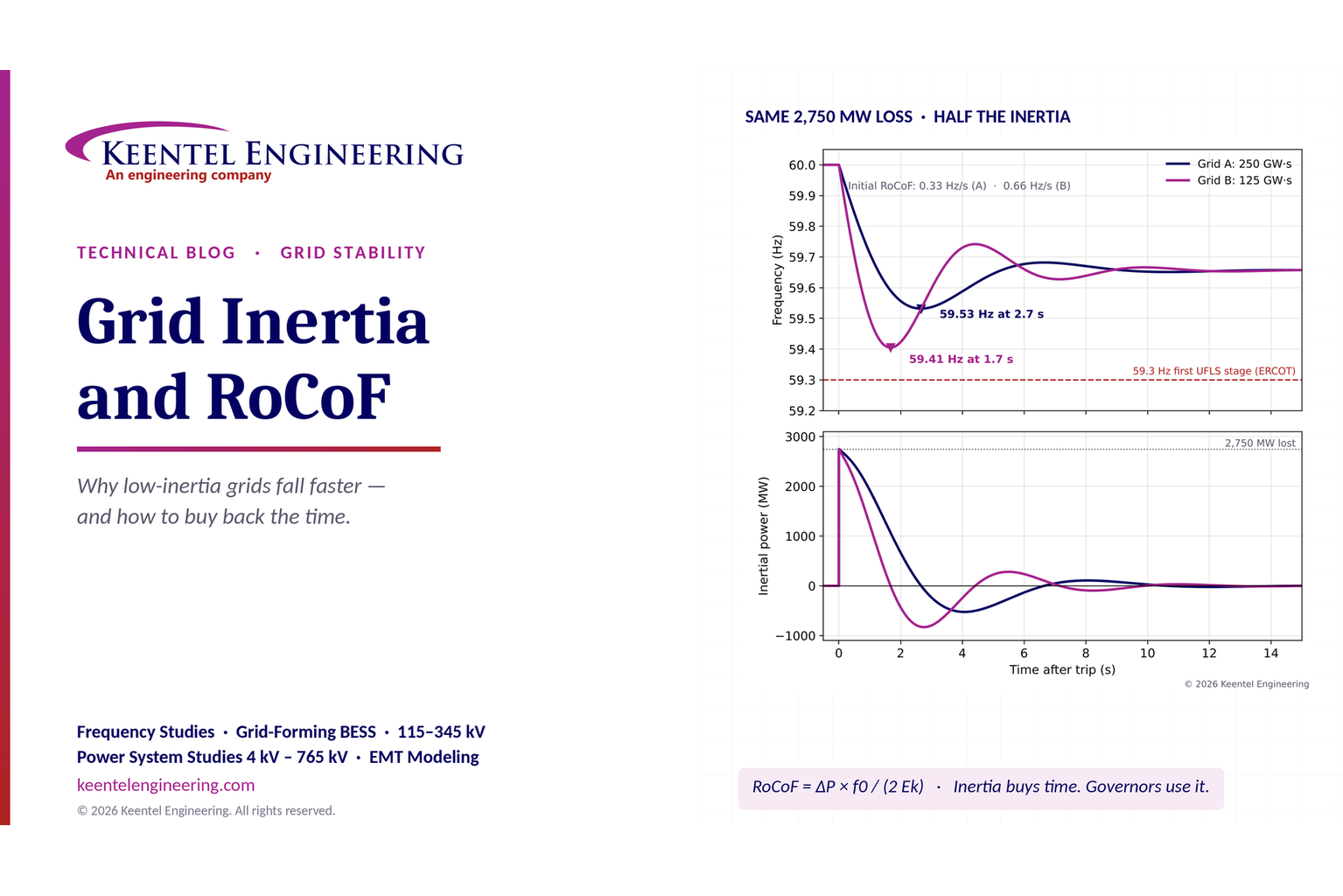
Explore grid inertia, RoCoF and frequency response, with swing equation calculations, frequency nadir analysis and US power system simulation examples.
By SANDIP R PATEL
•
October 11, 2026
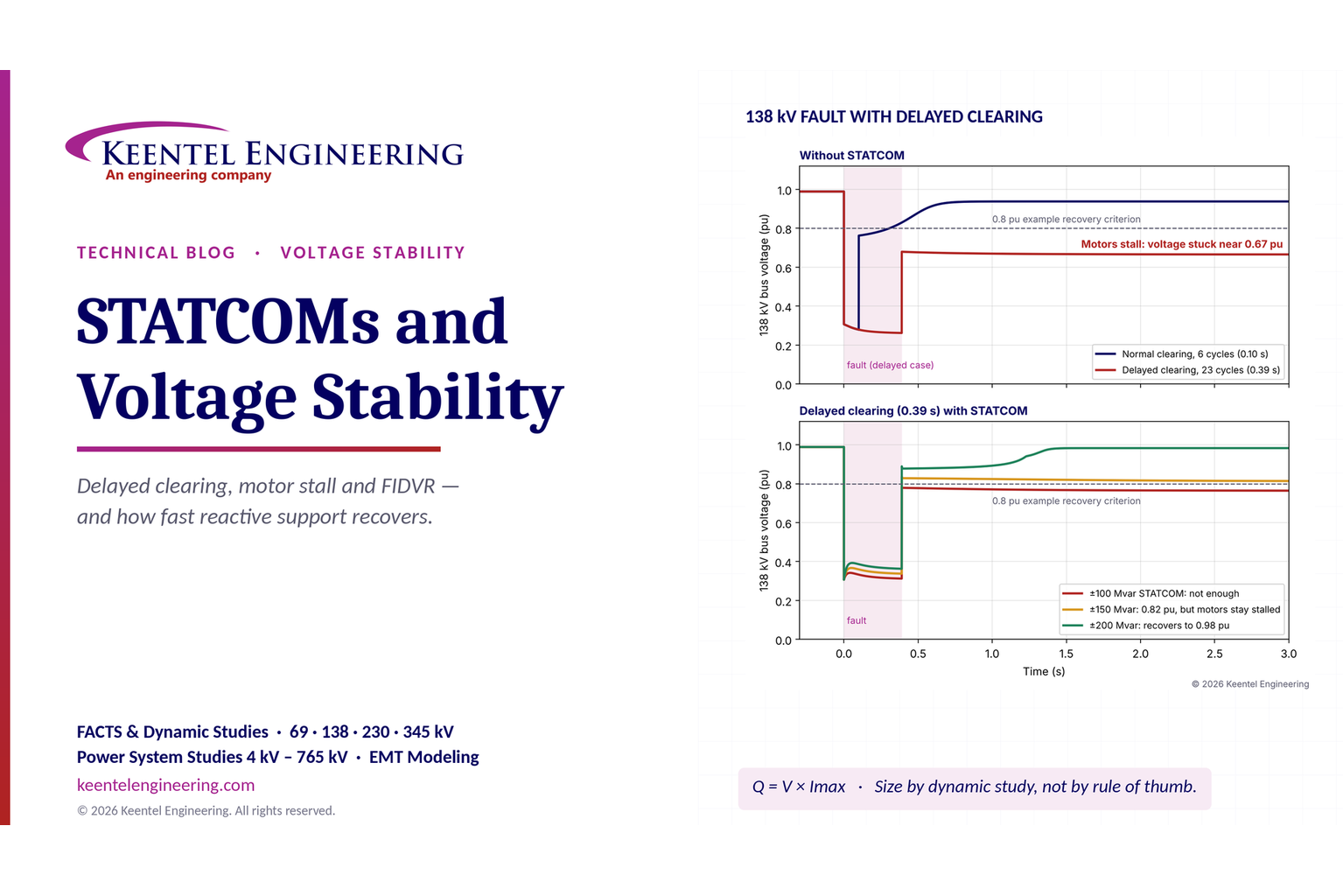
Learn how STATCOMs improve voltage stability and prevent FIDVR. Explore reactive power sizing, delayed fault clearing, NERC criteria and 138 kV simulation results.
By SANDIP R PATEL
•
October 10, 2026
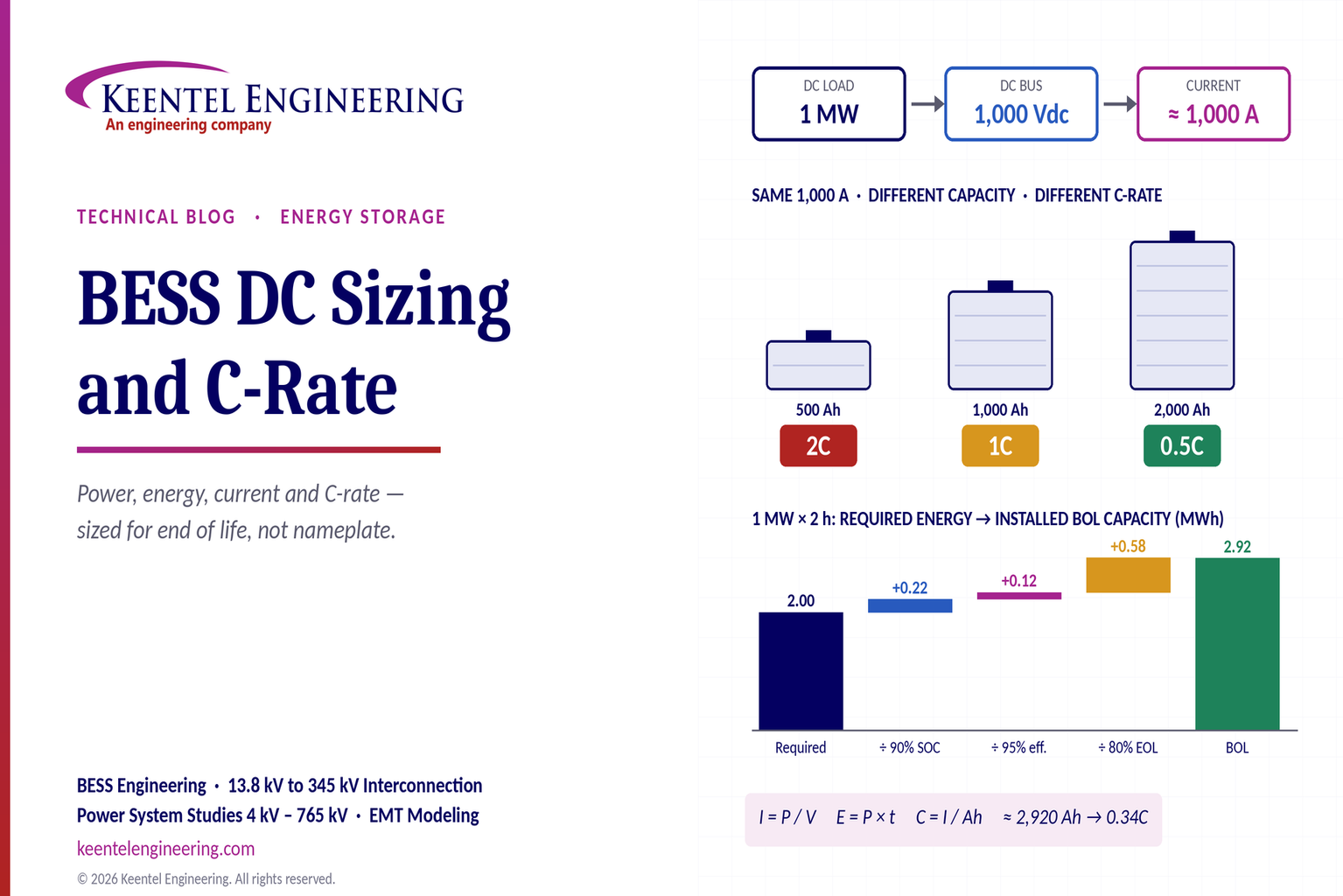
Learn BESS DC sizing with power, energy, current and C-rate calculations, battery losses, degradation and a 100 MW/400 MWh utility-scale example.
By SANDIP R PATEL
•
October 10, 2026
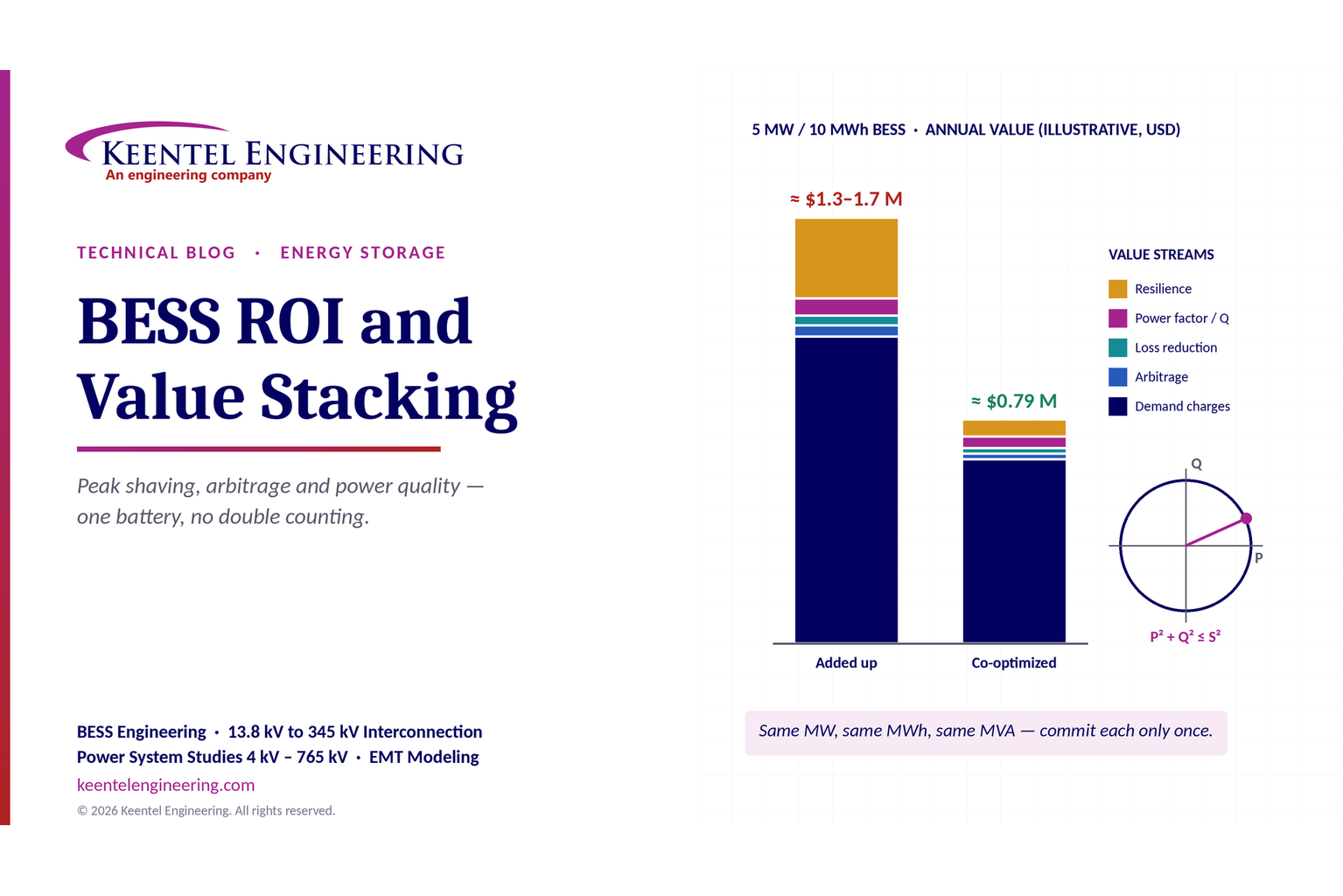
Learn how BESS ROI is calculated using peak shaving, energy arbitrage, power quality and battery storage economics, with a practical 5 MW/10 MWh example.
By SANDIP R PATEL
•
October 10, 2026
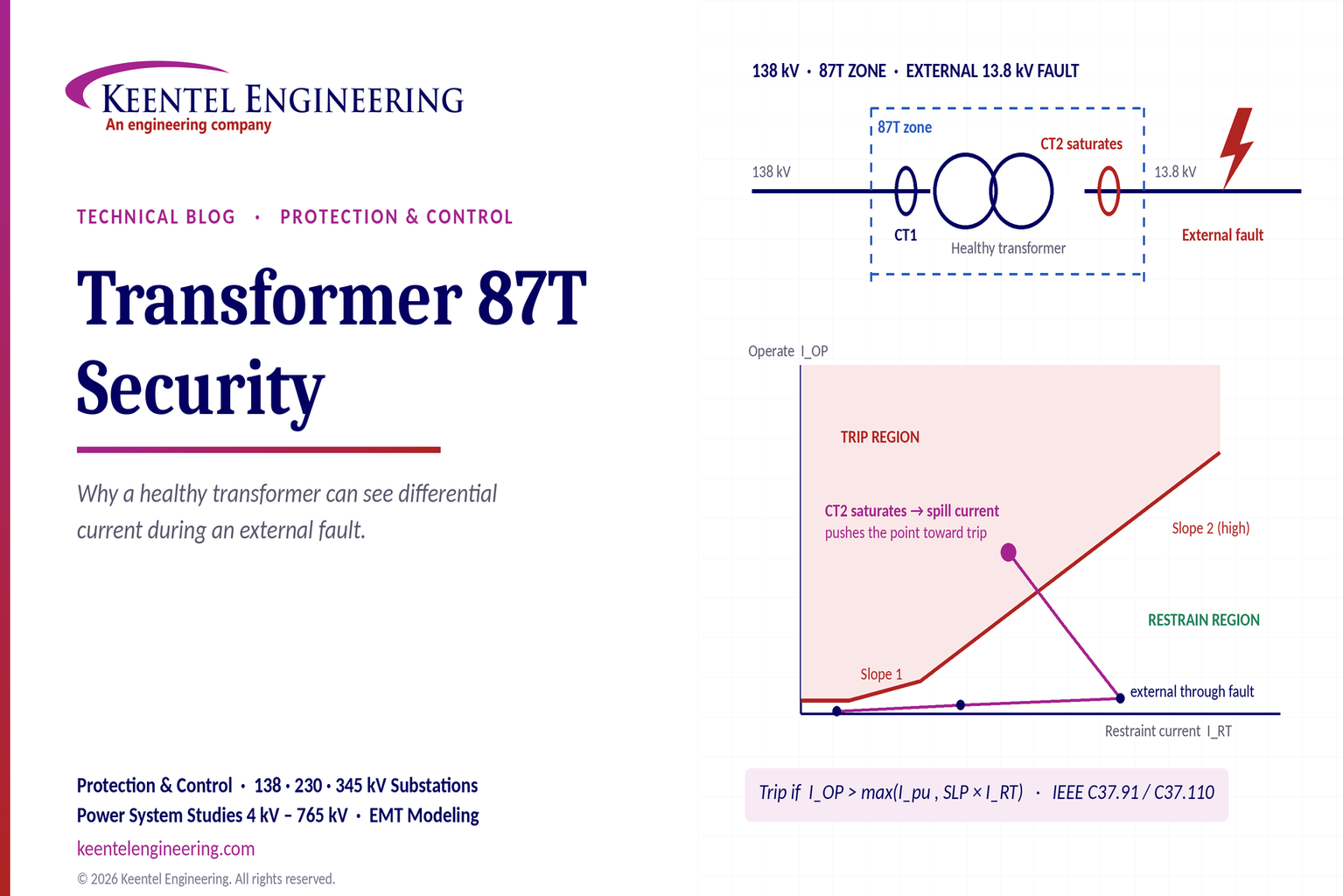
Learn why transformer differential relays detect current during external faults, how CT saturation causes spill current, and how secure 87T protection prevents trips.
By SANDIP R PATEL
•
October 10, 2026
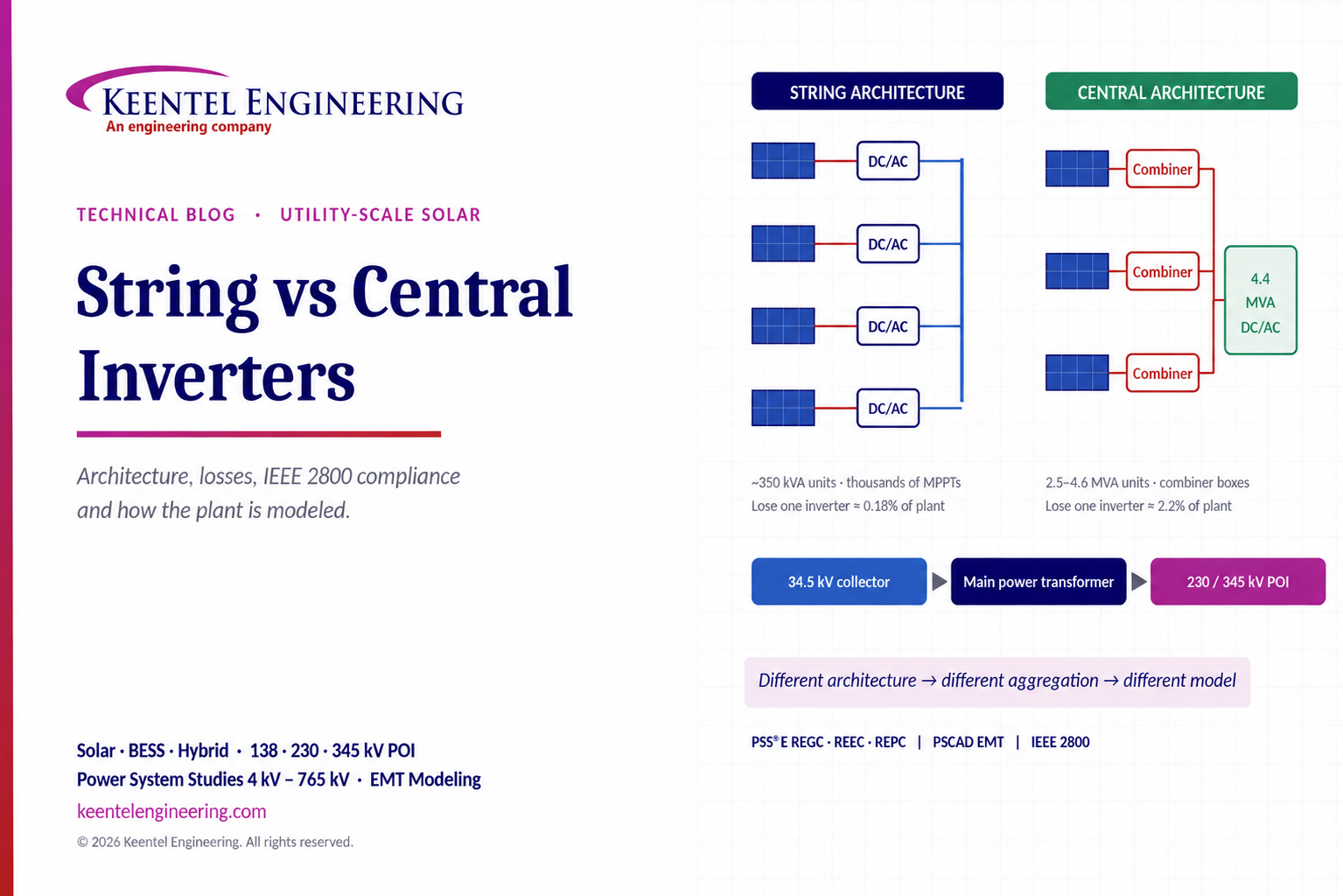
Compare string vs central inverters for utility-scale solar, including efficiency, maintenance, grid compliance, reactive power and interconnection studies.
By SANDIP R PATEL
•
October 9, 2026
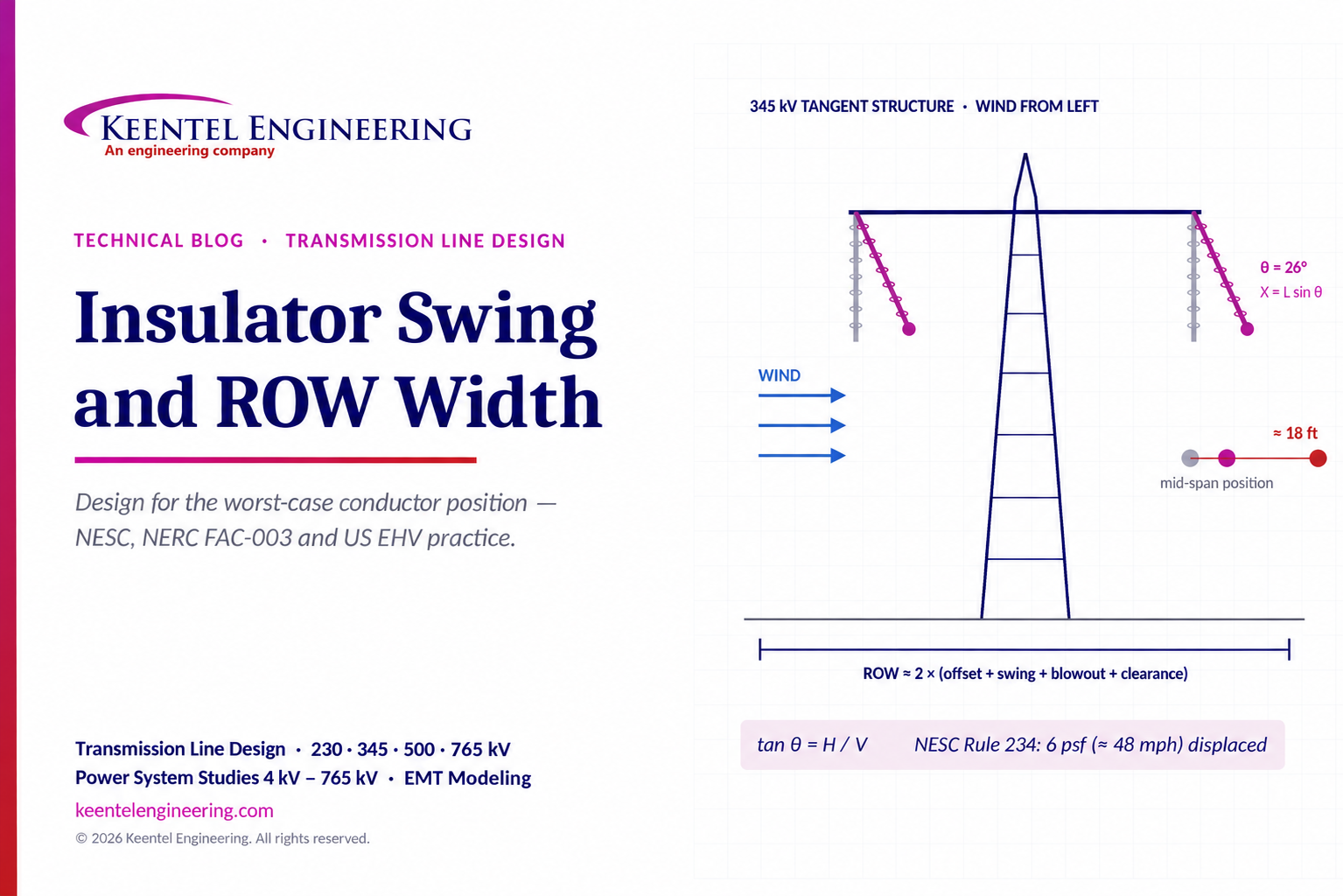
Learn how insulator swing angle and conductor blowout affect transmission line ROW width, with NESC clearances, NERC FAC-003 guidance, and a 345 kV example.
Copy
By SANDIP R PATEL
•
October 3, 2026
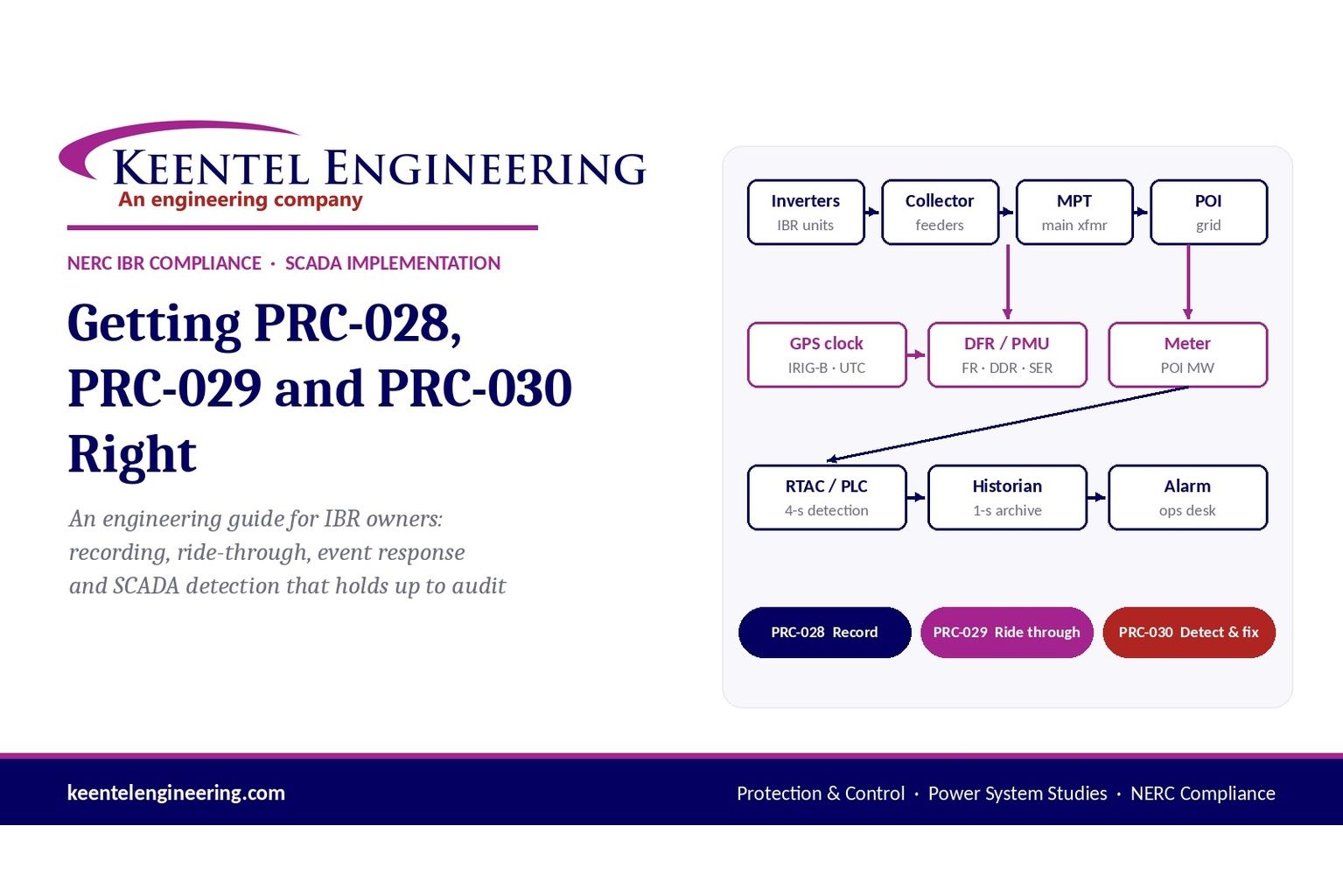
Engineering guide to PRC-028 disturbance recording, PRC-029 ride-through and PRC-030 event detection for inverter-based resources.
By SANDIP R PATEL
•
October 3, 2026
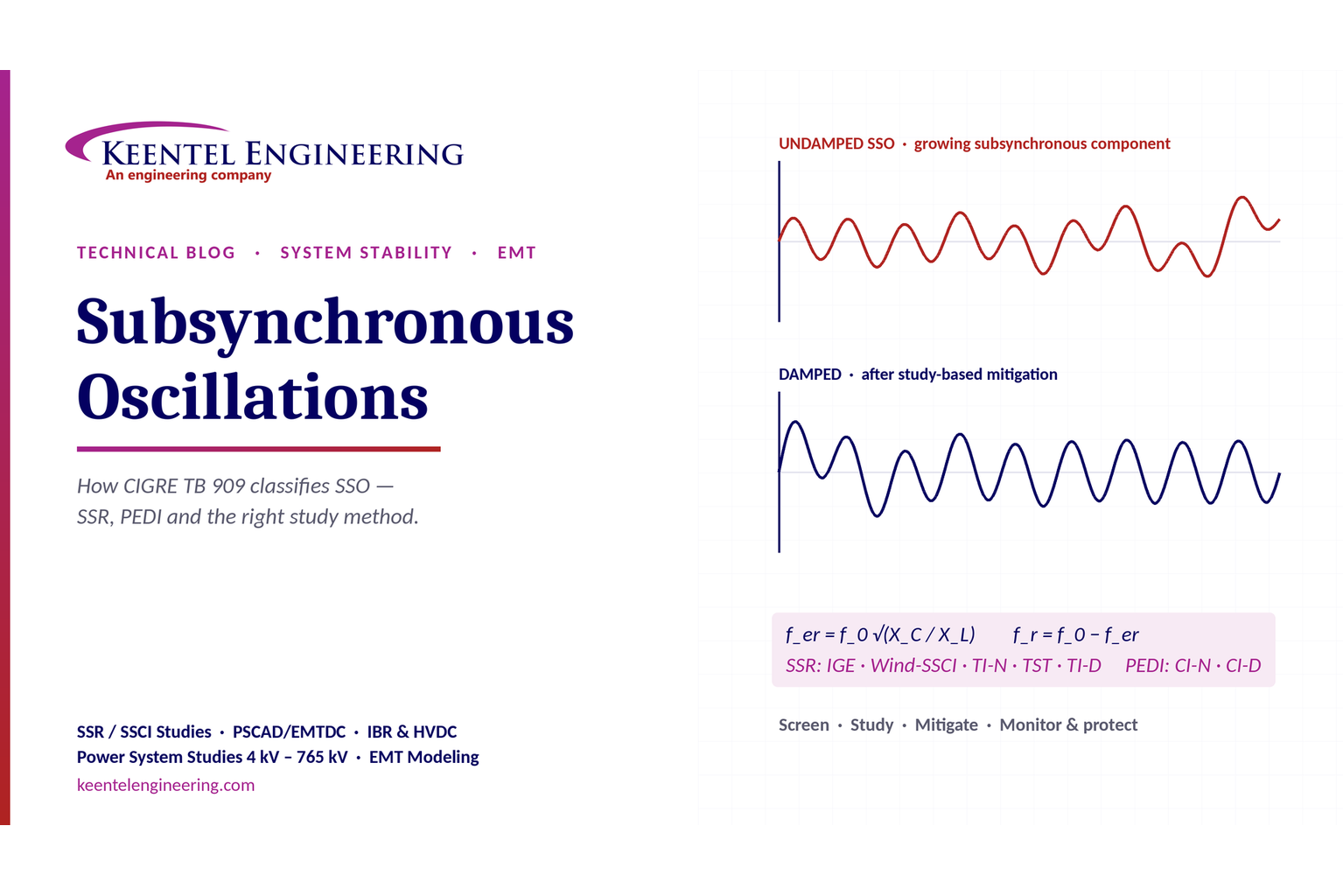
A practical guide to SSO classification, SSR, PEDI, Wind-SSCI, EMT analysis, mitigation and protection based on CIGRE TB 909.