
A Coordinated Electric System Interconnection Review—the utility’s deep-dive on technical and cost impacts of your project.

Challenge: Frequent false tripping using conventional electromechanical relays
Solution: SEL-487E integration with multi-terminal differential protection and dynamic inrush restraint
Result: 90% reduction in false trips, saving over $250,000 in downtime

Category Metric
VPP capacity (Lunar Energy) 650 MW
Lunar funding raised US$232 million
Data center BESS example 31 MW / 62 MWh
ERCOT grid-scale batteries 15+ GW
LDES tenders (H1 2026) Up to 9.3 GW
Lithium-ion share of LDES by 2030 77%
FEOC initial threshold 55%
BESS tariff rate (2026) ~55%
Capacity gain from analytics 5–15%

Flexible Grid-Interactive Efficient Buildings (FlexGEB): The Future of Grid Resilience and Smart Energy Systems

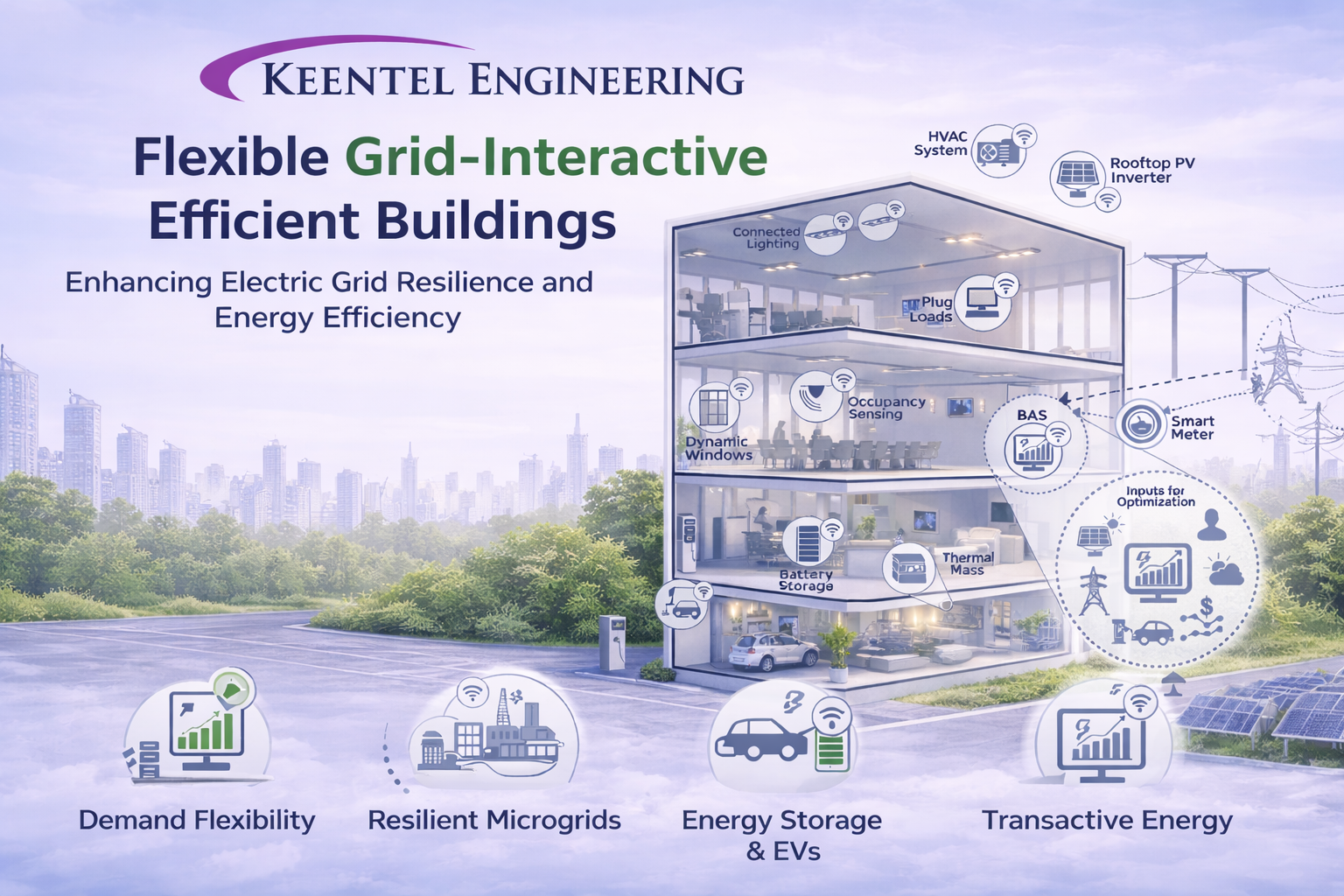
FlexGEB smart building with solar, HVAC, battery storage, and grid-connected energy systems.
Calendar icon. D

Apr 6, 2026  | blog

Introduction: Why Grid Resilience Needs a New Approach

The global power system is entering a new era—one defined by extreme weather events, cyber threats, renewable integration, and electrification of buildings. Traditional grid resilience strategies focused on transmission and distribution infrastructure are no longer sufficient.


The IEEE PES TR-138 report introduces a transformative concept:


  • Flexible Grid-Interactive Efficient Buildings (FlexGEB)


These buildings are not just energy consumers they are active participants in grid stability, resilience, and energy markets.


What Are Grid-Interactive Efficient Buildings (GEBs)?

A Grid-Interactive Efficient Building (GEB) is an advanced building that integrates:


  • Distributed Energy Resources (DERs) (solar PV, batteries, EVs) 
  • Smart sensors and IoT systems 
  • Building Automation and Control Systems (BACS) 
  • Demand response capabilities 
  • Real-time communication with the grid 


These systems allow buildings to:


  • Optimize energy consumption
  • Provide demand flexibility
  • Support grid operations
  • Enhance resilience during outages


Buildings today consume ~75% of electricity in the U.S., making them a massive untapped resource for grid support .


Why FlexGEB Matters: The Growing Need for Resilience

1. Extreme Weather Events

Events like hurricanes, wildfires, ice storms and heatwaves are increasing in frequency and severity.


  • Texas Winter Storm (2021): >20,000 MW load shedding 
  • Wildfires and floods causing widespread outages 
  • Economic losses reaching billions annually

2. Cybersecurity Threats

Modern buildings are interconnected and vulnerable:


  • HVAC systems hacked (e.g., Target breach) 
  • False data injection (FDI) and denial-of-service (DoS) attacks 
  • Smart buildings acting as entry points into the grid 

3. Renewable Integration Challenges

Renewables introduce:


  • Intermittency 
  • Reduced grid inertia 
  • Increased need for flexible demand-side resources 


Conclusion:


  • The grid must evolve and buildings are the missing link.

FlexGEB Architecture: How It Works

FlexGEB systems operate through a hierarchical and coordinated structure:

Inside the Building:


  • HVAC systems 
  • Lighting and plug loads 
  • Envelope (thermal efficiency) 
  • DERs (PV, battery, EV) 


All are controlled via:


  • Building Automation and Control System (BACS)


Outside the Building:


  • Communication with grid operators 
  • Coordination with other buildings 
  • Participation in markets (pricing signals) 


This enables real-time optimization and coordinated energy management .


Three Levels of Resilience Enabled by FlexGEB

1. Building-to-Customer Resilience

  • Backup power via batteries and EVs 
  • HVAC thermal storage 
  • Load prioritization 


Example:


  • Buildings can maintain critical operations during outages using embedded storage.

2. Building-to-Community Resilience

Energy sharing via transactive energy systems 


  • Peer-to-peer (P2P) energy trading 
  • Microgrid participation 


Benefits:


  • Reduced outages
  • Lower costs
  • Increased energy independence

3. Building-to-Grid Resilience

  • Demand response (load shedding, shifting) 
  • Frequency regulation 
  • Voltage support 


Large-scale impact:


  • Aggregated buildings can act as Virtual Power Plants (VPPs) 

Key Technologies Driving FlexGEB

1. Energy Storage Integration

  • Battery Energy Storage Systems (BESS) 
  • EV charging/discharging (V2G) 
  • Thermal storage (HVAC, ice storage)


Buildings can act as massive virtual storage systems.

2. Advanced Load Control Strategies

Temperature-Controlled Loads (TCLs)


  • ~50% of electricity usage in buildings 
  • Controlled via: 


  • Direct Load Control (DLC) 
  • Model Predictive Control (MPC) 
  • Reinforcement Learning 


Plug Load & Lighting Control


  • Smart automation reduces waste 
  • Adaptive lighting using sensors 

3. Transactive Energy Systems

  • Dynamic pricing and energy trading 
  • Aggregators coordinate buildings 
  • Enables decentralized grid management

4. Communication & IoT Infrastructure

  • BACnet, OpenADR protocols 
  • Real-time sensor networks 
  • Secure data exchange 

5. 5G/6G and Edge Computing

  • Ultra-low latency control 
  • Massive IoT connectivity 
  • Real-time grid interaction

6. AI & Machine Learning

  • Load forecasting 
  • Optimization of energy usage 
  • Autonomous control systems 

Major Engineering Challenges Identified in TR-138

1. Cybersecurity Risks

  • Vulnerabilities in BAS and IoT networks 
  • Need for encryption, authentication, and secure protocols 

2. Protection & Reverse Power Flow

  • DERs cause bidirectional flows 
  • Requires updated relay coordination and protection schemes

3. Cold Load Pickup (CLPU)

  • Post-outage surge loads (200–300% of normal) 
  • Risk to system stability 

4. Interoperability Issues

  • Lack of standard data models 
  • Integration challenges across vendors 

5. Market & Regulatory Barriers

  • Need for new business models 
  • Policy support for energy trading and flexibility markets 

Real-World Use Cases Highlighted

1. Campus Microgrids

  • IIT and UC San Diego deployments 
  • Real-time control and resilience testing

2. Virtual Power Plants (VPPs)

  • Aggregation of buildings for grid services 

3. Demand Response Programs

  • Price-based load control 
  • Automated grid interaction 

Role of Keentel Engineering

At Keentel Engineering we are uniquely positioned to help clients implement FlexGEB solutions through:


Engineering Services


  • Grid interconnection studies (PSSE, PSCAD, TSAT) 
  • Protection coordination & relay design 
  • DER integration studies 
  • Microgrid and BESS design 


Compliance & Standards


  • NERC PRC, TPL, and MOD compliance 
  • IEEE 1547 and IEEE 2800 implementation 
  • Cybersecurity and communication standards 


Advanced Modeling & Simulation


  • Digital twin modeling of buildings and grids 
  • EMT and dynamic simulations 
  • Load flexibility and demand response modeling 


Turnkey Solutions


  • Building-to-grid integration strategies 
  • Virtual power plant (VPP) design 
  • Transactive energy system consulting 

Future Outlook: The Rise of Intelligent Energy Ecosystems

FlexGEB represents a shift from:


  • Passive energy consumption
  • Active, intelligent energy participation


Future grids will be:


  • Decentralized 
  • Digitized 
  • Resilient 
  • Market-driven 


Buildings will become:


  • Energy hubs, storage systems, and grid assets

Frequently Asked Questions (FAQs)

  • 1. What is a FlexGEB?

    A FlexGEB is a smart building that can dynamically interact with the grid using DERs, automation, and demand response to improve efficiency and resilience.


  • 2. How do buildings improve grid resilience?

    Buildings provide flexibility through load control, energy storage, and demand response, helping stabilize the grid during disturbances.


  • 3. What is demand flexibility?

    The ability of a building to adjust its energy usage (increase, decrease, or shift) in response to grid conditions.


  • 4. What role do EVs play in GEBs?

    EVs act as mobile energy storage systems that can charge and discharge power to support the grid.


  • 5. What is transactive energy?

    A system where energy is traded dynamically between consumers and producers using market mechanisms.


  • 6. What is a Virtual Power Plant (VPP)?

    An aggregation of distributed resources (like buildings) that operate collectively as a single power plant.


  • 7. How do GEBs handle outages?

    They can form microgrids or operate in island mode using local generation and storage.


  • 8. What are the cybersecurity risks in smart buildings?

    Risks include data manipulation, system control attacks, and unauthorized access to building automation systems.


  • 9. What is reverse power flow?

    When a building exports excess generation (e.g., solar) back to the grid, potentially affecting voltage and protection systems.


  • 10. What is cold load pickup (CLPU)?

    A surge in demand when power is restored after an outage, which can overload systems.


  • 11. Why is HVAC important in GEBs?

    HVAC systems account for a large portion of building load and offer significant flexibility for demand response.


  • 12. How does AI improve GEB performance?

    AI enables predictive control, load forecasting, and autonomous optimization of building systems.


  • 13. What communication protocols are used?

    Common protocols include BACnet, OpenADR, TCP/IP, and secure communication layers like SSL/TLS.


  • 14. What is edge computing in GEBs?

    Processing data locally at the building level for faster response and reduced communication latency.


  • 15. How does 5G help smart buildings?

    It enables real-time communication, massive device connectivity, and ultra-low latency control.


  • 16. Can buildings participate in energy markets?

    Yes, through aggregators or VPPs, buildings can buy/sell energy and provide grid services.

  • 17. What are the main barriers to GEB adoption?

    • High initial costs 
    • Lack of standards 
    • Regulatory challenges 
    • Cybersecurity concerns 

  • 18. How does Keentel Engineering support FlexGEB projects?

    Through system studies, design, compliance, modeling, and full integration of building and grid systems.


  • 19. What industries benefit most from FlexGEB?

    • Commercial real estate 
    • Industrial facilities 
    • Data centers 
    • Campuses and microgrids 

  • 20. What is the future of grid-interactive buildings?

    They will become central to grid operation, acting as distributed energy hubs supporting resilience and sustainability.


Man in a blazer and open shirt, looking at the camera, against a blurred background.

About the Author:

Sonny Patel P.E. EC

IEEE Senior Member

In 1995, Sandip (Sonny) R. Patel earned his Electrical Engineering degree from the University of Illinois, specializing in Electrical Engineering . But degrees don’t build legacies—action does. For three decades, he’s been shaping the future of engineering, not just as a licensed Professional Engineer across multiple states (Florida, California, New York, West Virginia, and Minnesota), but as a doer. A builder. A leader. Not just an engineer. A Licensed Electrical Contractor in Florida with an Unlimited EC license. Not just an executive. The founder and CEO of KEENTEL LLC—where expertise meets execution. Three decades. Multiple states. Endless impact.

Four workers in safety vests and helmets stand with arms crossed near wind turbines.

Let's Discuss Your Project

Let's book a call to discuss your electrical engineering project that we can help you with.

Man in a blazer and open shirt, looking at the camera, against a blurred background.

About the Author:

Sonny Patel P.E. EC

IEEE Senior Member

In 1995, Sandip (Sonny) R. Patel earned his Electrical Engineering degree from the University of Illinois, specializing in Electrical Engineering . But degrees don’t build legacies—action does. For three decades, he’s been shaping the future of engineering, not just as a licensed Professional Engineer across multiple states (Florida, California, New York, West Virginia, and Minnesota), but as a doer. A builder. A leader. Not just an engineer. A Licensed Electrical Contractor in Florida with an Unlimited EC license. Not just an executive. The founder and CEO of KEENTEL LLC—where expertise meets execution. Three decades. Multiple states. Endless impact.

Leave a Comment

Related Posts

Digital substation with switchyard, relay room, and grid control for smart grid infrastructure.
By SANDIP R PATEL April 6, 2026
Explore the hidden challenges of digital substations including IEC 61850 interoperability, cybersecurity risks network overload, and timing failures. Learn how expert engineering ensures reliable future ready power systems.
NERC BAL-007-1 Explained banner with power lines and April 1, 2027 effective date.
By SANDIP R PATEL April 3, 2026
Learn how NERC BAL-007-1 ensures energy adequacy, ERA methods, and proactive grid reliability strategies for utilities, developers & BAs.
Future NERC reliability standards for power grid and cybersecurity by Keentel Engineering
By SANDIP R PATEL April 1, 2026
Explore upcoming NERC Reliability Standards (2026–2029), including BAL-007 energy assessments, IBR ride-through rules, cybersecurity (CIP-003-9), and extreme weather planning. Learn compliance strategies, risks, and real-world case studies.
Substation equipment testing and validation process with electrical panels and FAT inspection
By SANDIP R PATEL March 31, 2026
Learn the complete substation testing lifecycle including Type Testing, FAT, and SAT. Discover how to reduce risks, improve reliability, and ensure NERC compliance.
Internal inspection engineers identifying root causes in industrial equipment at Keentel Engineering
By SANDIP R PATEL March 31, 2026
Explore advanced transformer failure analysis methods, diagnostics, and prevention strategies used by power system engineers.
Power system engineering services for data centers and industrial large load integration
By SANDIP R PATEL March 28, 2026
Explore SEL PMU devices, IEEE-compliant synchrophasor tech, and grid monitoring solutions for real-time visibility, stability, and renewable integration.
Phasor Measurement Unit (PMU) and WAMS system architecture for real-time power grid
By SANDIP R PATEL March 28, 2026
Explore how PMU and synchrophasor technology with WAMS improves grid visibility, detects oscillations, and ensures stability in modern power systems.
Power system engineering services for data centers and industrial large load integration
By SANDIP R PATEL March 19, 2026
Large load integration solutions for grid reliability, data centers, and industrial power systems with advanced engineering and compliance support.
Large load grid reliability solutions for AI data centers and industrial power systems
By SANDIP R PATEL March 19, 2026
Large loads are reshaping grid behavior. Discover risks, interconnection challenges, and engineering solutions for reliable power system integration.