

A Coordinated Electric System Interconnection Review—the utility’s deep-dive on technical and cost impacts of your project.

Challenge: Frequent false tripping using conventional electromechanical relays
Solution: SEL-487E integration with multi-terminal differential protection and dynamic inrush restraint
Result: 90% reduction in false trips, saving over $250,000 in downtime

Category Metric
VPP capacity (Lunar Energy) 650 MW
Lunar funding raised US$232 million
Data center BESS example 31 MW / 62 MWh
ERCOT grid-scale batteries 15+ GW
LDES tenders (H1 2026) Up to 9.3 GW
Lithium-ion share of LDES by 2030 77%
FEOC initial threshold 55%
BESS tariff rate (2026) ~55%
Capacity gain from analytics 5–15%

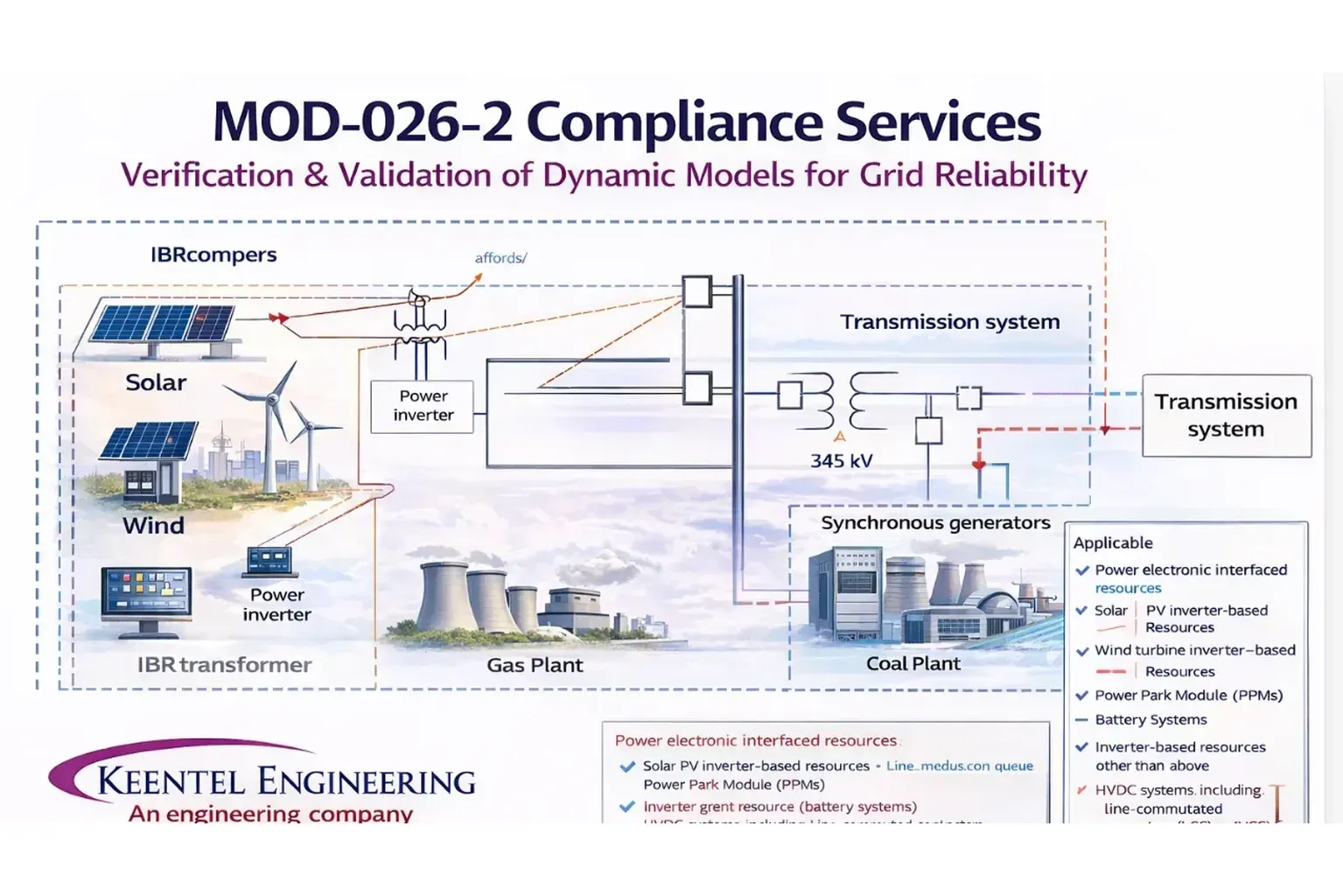
MOD-026-2 Compliance Services: Verification & Validation of Dynamic Models for Grid Reliability

MOD-026-2 compliance diagram for dynamic model validation of inverter-based resources in power systems
Calendar icon. D

Apr 7, 2026  | blog

A Complete Guide for Generator Owners, Developers, and Utilities (2026–2030 Compliance Roadmap)

Introduction: Why MOD-026-2 Is a Game-Changer for the Power Industry

The North American power grid is undergoing its most significant transformation in decades. The rapid integration of inverter-based resources (IBRs)—solar, wind, and battery energy storage systems—has exposed critical gaps in traditional power system modeling practices.


In response, NERC, under FERC Order No. 901, has introduced MOD-026-2 – Verification and Validation of Dynamic Models and Data, a new reliability standard that fundamentally changes how dynamic models are developed, validated, and maintained.


Unlike previous standards, MOD-026-2 is not just about submitting models—it is about proving that models accurately represent real-world system behavior under disturbances.


At Keentel Engineering, we provide end-to-end MOD-026-2 compliance services, helping Generator Owners, Transmission Owners, and Developers navigate this complex regulatory shift with confidence.


Key Compliance Timeline You Must Know

Milestone Date
FERC Order Issued Feb 19, 2026
Standard Effective Date April 1, 2026
R1 & R7 Compliance April 2027
R2–R6 Compliance April 2029
Full Industry Implementation January 1, 2030

 MOD-026-2 introduces a phased compliance approach, but organizations that delay preparation risk major compliance gaps.


What Is MOD-026-2?

MOD-026-2 is a NERC Reliability Standard designed to:


  • Ensure dynamic models accurately represent in-service equipment 
  • Require verification of model parameters 
  • Mandate validation using real-world disturbance data 
  • Introduce EMT modeling requirements for IBRs, HVDC, and FACTS devices 


As defined in the standard, its purpose is to ensure models used in planning studies reflect actual system behavior for Bulk Electric System (BES) reliability 


Why MOD-026-2 Was Developed

Real Grid Events Exposed Major Issues


Industry disturbance events revealed that:


  • Solar and wind plants were tripping unexpectedly 
  • Models failed to capture control interactions and protection behavior 
  • Positive sequence models could not simulate fast inverter dynamics 


These issues led to the development of MOD-026-2 as part of a broader initiative to improve grid reliability.


The Biggest Shift: From Model Submission → Model Accuracy

Under previous standards (MOD-026-1 and MOD-027-1):


  • Entities submitted models
  • Limited validation was required


Under MOD-026-2:


  • Models must be verified against actual settings 
  • Models must be validated using real disturbance data 
  • Models must be continuously maintained 


This transforms compliance into a lifecycle process, not a one-time submission.


Key Requirements Explained (R1–R7 Simplified)

R1 – Model Requirements Definition


  • Transmission Planner (TP) + Planning Coordinator (PC) define modeling standards 
  • Includes: 


  • Model formats 
  • Software compatibility 
  • Required functions


R2 – Positive Sequence Models


Generator Owners must provide:


  • Dynamic models representing actual equipment 
  • Parameter verification (settings match field) 
  • Validation using:


  • Voltage/reactive disturbances 
  • Frequency/active power disturbances 


R3 – EMT Models (Critical for IBRs)


Applies to:


  • Solar, wind, BESS 
  • HVDC systems 
  • FACTS devices 


Requires:


  • High-fidelity EMT models 
  • Validation using large disturbance events 
  • Benchmarking vs positive sequence models 


This is one of the most technically demanding requirements.


R4 – Model Updates


  • Required within 180 days after system changes 
  • Includes: 


  • Control changes 
  • Firmware updates 
  • Equipment modifications 


R5–R6 – Review & Response Cycle


  • TP reviews models (within ~120 days) 
  • Entities must respond: 


  • Updated model OR 
  • Technical justification 


R7 – Model Access


  • TP must provide current models upon request 

EMT vs Positive Sequence Models (Why It Matters)

Positive Sequence Models (RMS)


  • Used for planning studies 
  • Limited in capturing:


  • Fast inverter controls 
  • Unbalanced faults 


EMT Models


  • Capture: 


  • Real control behavior 
  • Protection logic 
  • Sub-cycle dynamics 


MOD-026-2 requires EMT models because:


  • RMS models cannot accurately simulate IBR behavior in weak grids 


EMT models are essential for large disturbance analysis


What Are “Large Signal Disturbances”?

These include:


  • Transmission faults 
  • Loss of generation 
  • Switching events 
  • Frequency excursions 


These events trigger:


  • Control nonlinearities 
  • Protection trips 
  • Mode switching 


MOD-026-2 requires models to accurately replicate these events.

Continuous Compliance Lifecycle

MOD-026-2 introduces a long-term compliance cycle:


  • Initial model submission 
  • Validation using real events 
  • Updates after changes 
  • Revalidation every 10 years 


This creates ongoing compliance obligations not one-time work.


Who Must Comply?

  • Generator Owners 
  • Transmission Owners 
  • Planning Coordinators 
  • Transmission Planners 


Applies to:


  • Synchronous generators 
  • Solar, wind, BESS (IBRs) 
  • HVDC systems 
  • FACTS devices 

Industry Impact

Renewable Developers


  • Must provide EMT models 
  • Increased interconnection complexity 


Utilities


  • Increased model review workload 
  • Need for validation frameworks 


Generator Owners


  • Ongoing compliance responsibility 
  • Data collection & validation required 

How Keentel Engineering Supports MOD-026-2 Compliance

Keentel Engineering provides end-to-end compliance solutions, including:


Model Development


  • PSSE / PSLF / PowerFactory models 
  • EMT models (PSCAD, RTDS, HYPERSIM) 


Model Verification


  • Parameter validation vs field settings 
  • Control logic review 


Model Validation


  • Disturbance-based validation 
  • Event playback analysis 


EMT Benchmarking


  • RMS vs EMT comparison 
  • Large-signal testing 


Compliance Documentation


  • Audit-ready reports 
  • NERC evidence packages 


Ongoing Support


  • Model updates (R4 compliance) 
  • Periodic revalidation 

Why Choose Keentel Engineering?

  • 30+ years of power system expertise 
  • Deep experience with: 


  • IBR modeling 
  • NERC compliance 
  • Grid interconnection studies 


  • Expertise in: 


  • PSSE + TSAT 
  • PSCAD / EMT modeling 
  • Dynamic model validation 

Get MOD-026-2 Compliance Support Today

MOD-026-2 is one of the most technically demanding NERC standards to date.


Don’t wait until deadlines approach.


Keentel Engineering can help you:


  • Achieve compliance 
  • Reduce risk 
  • Ensure accurate modeling 


Contact us today to discuss your project.


 Frequently Asked Questions (MOD-026-2)

  • 1. What is the main objective of MOD-026-2?

    MOD-026-2 ensures that dynamic models used in power system studies accurately represent real-world equipment behavior, improving grid reliability and preventing unexpected system disturbances.


  • 2. How is MOD-026-2 different from MOD-026-1?

    MOD-026-2:

    • Combines MOD-026-1 and MOD-027-1 
    • Expands scope to include IBRs, HVDC, and FACTS 
    • Requires both verification AND validation 

  • 3. What is model verification?

    Model verification ensures that:

    • Model parameters match actual equipment settings 
    • Control settings are correctly represented 

  • 4. What is model validation?

    Model validation compares:

    • Simulated model response 
    • Actual system behavior during disturbances 

  • 5. Why are EMT models required?

    Because:

    • Positive sequence models cannot capture fast inverter dynamics 
    • EMT models simulate real control behavior and protection interactions 

  • 6. Who needs EMT models under MOD-026-2?

    • Solar plants 
    • Wind farms 
    • Battery energy storage systems 
    • HVDC systems 
    • FACTS devices 

  • 7. What is a large signal disturbance?

    Events like:

    • Faults 
    • Generator trips 
    • Frequency excursions
    • These trigger nonlinear system behavior that must be accurately modeled. 

  • 8. When does compliance start?

    • Effective: April 1, 2026 
    • Full compliance: 2029 
    • Industry completion: 2030 

  • 9. How often must models be updated?

    • Within 180 days of system changes 
    • Revalidation every 10 years 

  • 10. What happens if models are inaccurate?

    • Non-compliance risk 
    • Potential reliability issues 
    • Increased audit exposure 

  • 11. Can disturbance data be used for validation?

    Yes. MOD-026-2 allows:

    • Staged testing 
    • Real system disturbance data 

  • 12. What tools are used for compliance?

    Common tools include:

    • PSSE 
    • PSLF 
    • PowerFactory 
    • PSCAD 
    • RTDS 

  • 13. What is EMT benchmarking?

    Comparing:

    • EMT model response 
    • Positive sequence model response
    • To ensure consistency. 

  • 14. Are legacy facilities exempt?

    Some legacy facilities may have limited EMT requirements depending on:

    • OEM support 
    • TP requirements 

  • 15. What are the biggest compliance challenges?

    • EMT model development 
    • Data collection 
    • Validation using disturbance data 
    • Documentation 
  • 16. What is the role of the Transmission Planner?

    • Define modeling requirements 
    • Review models 
    • Accept/reject submissions 

  • 17. What happens after model rejection?

    Entity must:

    • Submit updated model OR 
    • Provide technical justification 

  • 18. Does MOD-026-2 apply to BESS?

    Yes, battery systems are classified as IBRs and must comply.


  • 19. How does this impact interconnection studies?

    • Increased modeling requirements 
    • EMT studies often required 
    • More detailed validation 
  • 20. Why is this critical for grid reliability?

    Accurate models ensure:

    • Stable grid operation 
    • Correct planning decisions 
    • Prevention of cascading failures 


Man in a blazer and open shirt, looking at the camera, against a blurred background.

About the Author:

Sonny Patel P.E. EC

IEEE Senior Member

In 1995, Sandip (Sonny) R. Patel earned his Electrical Engineering degree from the University of Illinois, specializing in Electrical Engineering . But degrees don’t build legacies—action does. For three decades, he’s been shaping the future of engineering, not just as a licensed Professional Engineer across multiple states (Florida, California, New York, West Virginia, and Minnesota), but as a doer. A builder. A leader. Not just an engineer. A Licensed Electrical Contractor in Florida with an Unlimited EC license. Not just an executive. The founder and CEO of KEENTEL LLC—where expertise meets execution. Three decades. Multiple states. Endless impact.

Four workers in safety vests and helmets stand with arms crossed near wind turbines.

Let's Discuss Your Project

Let's book a call to discuss your electrical engineering project that we can help you with.

Man in a blazer and open shirt, looking at the camera, against a blurred background.

About the Author:

Sonny Patel P.E. EC

IEEE Senior Member

In 1995, Sandip (Sonny) R. Patel earned his Electrical Engineering degree from the University of Illinois, specializing in Electrical Engineering . But degrees don’t build legacies—action does. For three decades, he’s been shaping the future of engineering, not just as a licensed Professional Engineer across multiple states (Florida, California, New York, West Virginia, and Minnesota), but as a doer. A builder. A leader. Not just an engineer. A Licensed Electrical Contractor in Florida with an Unlimited EC license. Not just an executive. The founder and CEO of KEENTEL LLC—where expertise meets execution. Three decades. Multiple states. Endless impact.

Leave a Comment

Related Posts

PJM First Use rule elimination for DER interconnection under FERC Order 2222
By SANDIP R PATEL April 7, 2026
Explore PJM’s First Use rule reform, DER interconnection changes, and FERC Order 2222 impacts on solar, BESS, and distribution-level grid integration.
Advanced PSSE and PSCAD modeling services for solid-state transformers in data center power systems
By SANDIP R PATEL April 7, 2026
Advanced PSSE and PSCAD modeling for solid-state transformers in data centers. Ensure grid compliance, stability, and high-performance power systems.
FlexGEB smart building with solar, HVAC, battery storage, and grid-connected energy systems.
By SANDIP R PATEL April 6, 2026
Explore FlexGEB smart buildings using solar, storage, HVAC, and IoT to boost energy efficiency, demand flexibility, and grid resilience.
Keentel Engineering data center design services banner highlighting uptime, grid reliability
By SANDIP R PATEL April 6, 2026
Keentel Engineering delivers data center electrical design for uptime, grid stability, AI workloads, and utility-ready interconnection planning.
Centralized substation protection and control (CPC) system with LAN network, Ethernet switches.
By SANDIP R PATEL April 6, 2026
CPC centralizes substation protection using real-time data, improving reliability, reducing costs, and enabling smart grids.
Digital substation with switchyard, relay room, and grid control for smart grid infrastructure.
By SANDIP R PATEL April 6, 2026
Explore the hidden challenges of digital substations including IEC 61850 interoperability, cybersecurity risks network overload, and timing failures. Learn how expert engineering ensures reliable future ready power systems.
NERC BAL-007-1 Explained banner with power lines and April 1, 2027 effective date.
By SANDIP R PATEL April 3, 2026
Learn how NERC BAL-007-1 ensures energy adequacy, ERA methods, and proactive grid reliability strategies for utilities, developers & BAs.
Future NERC reliability standards for power grid and cybersecurity by Keentel Engineering
By SANDIP R PATEL April 1, 2026
Explore upcoming NERC Reliability Standards (2026–2029), including BAL-007 energy assessments, IBR ride-through rules, cybersecurity (CIP-003-9), and extreme weather planning. Learn compliance strategies, risks, and real-world case studies.
Substation equipment testing and validation process with electrical panels and FAT inspection
By SANDIP R PATEL March 31, 2026
Learn the complete substation testing lifecycle including Type Testing, FAT, and SAT. Discover how to reduce risks, improve reliability, and ensure NERC compliance.