A Coordinated Electric System Interconnection Review—the utility’s deep-dive on technical and cost impacts of your project.
Challenge: Frequent false tripping using conventional electromechanical relays
Solution: SEL-487E integration with multi-terminal differential protection and dynamic inrush restraint
Result: 90% reduction in false trips, saving over $250,000 in downtime
Achieving PRC-028-1 &
NOGRR255 Compliance with the
SEL-2240 Axion & SEL RTAC
Jul 05, 2026 | Blog
An in-depth technical guide from the Keentel Engineering substation services team on designing, installing, and commissioning a compliant Digital Fault Recorder (DFR) system for inverter-based resources using the SEL-2240 Axion distributed I/O platform and the SEL Real-Time Automation Controller (RTAC).
1. Why These Standards Exist: The IBR Visibility Gap
Over the past decade, several major grid disturbances including the Blue Cut Fire, Canyon 2 Fire, and the Odessa events in Texas revealed a systemic problem: when inverter-based resources (IBRs) such as solar, wind, and battery storage plants tripped or reduced output during grid faults, operators and engineers frequently had no high-resolution data to explain what happened. Protection relays at conventional plants had long provided oscillography, but IBR facilities were often built with minimal recording capability, no unit-level visibility, and inconsistent time synchronization. Event investigations stalled, models could not be validated, and the same failure modes repeated across the fleet.
Two regulatory instruments now close that gap. NERC PRC-028-1 Disturbance Monitoring and Reporting Requirements for Inverter-Based Resources became effective April 1, 2025 and establishes mandatory Sequence of Events Recording (SER), Fault Recording (FR), and Dynamic Disturbance Recording (DDR) for applicable IBRs across North America. In Texas, ERCOT NOGRR255 amended the Nodal Operating Guides effective August 1, 2024 with closely aligned disturbance monitoring equipment (DME) requirements, plus obligations for data retention, data provision to ERCOT, and ongoing maintenance and testing. Together with the ride-through requirements of NOGRR245 and the performance standards PRC-029 and PRC-030, these rules create a closed loop: high-resolution data captures what happened, ride-through criteria define what should have happened, and corrective-action processes fix the difference.
The practical question for asset owners is no longer
whether to install disturbance monitoring, but
how to do it economically at dozens of sites that were never designed for it. This guide presents the architecture Keentel Engineering deploys most often for brownfield and greenfield IBR facilities: the SEL RTAC + SEL-2240 Axion Digital Fault Recorder, a solution SEL documents as designed to exceed compliance with NERC PRC-002 and PRC-028.
2. Who Is In Scope, and When
| Framework | Already In Effect | Equipment / Compliance Milestones |
|---|---|---|
| NERC PRC-028-1 | Standard effective April 1, 2025. R8 (the 90-day restore-or-CAP obligation for failed recording capability) took effect January 1, 2026 for BES IBRs — it is already live — and applies to existing non-BES IBRs on April 1, 2027. | Existing BES IBRs: 50% of fleet compliant with R1–R7 by January 1, 2029; 100% by January 1, 2030. New BES IBRs (COD after April 1, 2025): R1–R7 by July 1, 2026 or COD, whichever is later. Existing non-BES IBRs: R1–R7 by January 1, 2030. New non-BES IBRs (COD after May 15, 2026): 15 months after the effective date or COD. |
| ERCOT NOGRR255 | Effective August 1, 2024. Data retention, data provision, and DME maintenance/testing obligations applied immediately — including to whatever recording capability a site already has. | New/modified DME: 50% installed within 2 years and 100% within 4 years of the effective date. |
Because the PRC-028-1 dates vary by facility category, here is the full matrix:
| Facility Type | COD | R8 Effective | R1–R7 Deadline | Practical Meaning |
|---|---|---|---|---|
| Existing BES IBR | On/before Apr 1, 2025 | Jan 1, 2026 | 50% by Jan 1, 2029; 100% by Jan 1, 2030 | Fleet sequencing decision needed now; R8 already applies |
| New BES IBR | Effective August 1, 2024. Data retention, data provision, and DME maintenance/testing obligations applied immediately — including to whatever recording capability a site already has. | New/modified DME: 50% installed within 2 years and 100% within 4 years of the effective date. | Jul 1, 2026 or COD, whichever is later | DME must be part of the commissioning scope |
| Existing Non-BES IBR | On/before May 15, 2026 | Apr 1, 2027 | Jan 1, 2030 | Longest runway — but ERCOT sites still face the NOGRR255 clock |
| New Non-BES IBR | After May 15, 2026 | Apr 1, 2027 | 15 months after effective date or COD | Design DME into the project from day one |
A point owners frequently miss: because the NOGRR255 retention and provision obligations are already live, a facility with
any existing recording capability (relay event reports, RTAC SER logs) must already be retaining that data and be able to deliver it to ERCOT on request. An interim-compliance configuration of the existing relays is therefore a standard first step in every Keentel deployment, protecting the owner during the construction window.
3. What the Standards Actually Require: SER, FR, and DDR
Both frameworks organize disturbance monitoring into three data categories, each with specified locations, trigger conditions, and performance minimums.
3.1 Sequence of Events Recording (SER)
SER is the time-stamped digital log of discrete events. PRC-028-1 R1 requires circuit breaker positions for breakers associated with the main power transformer(s), collector bus(es), and shunt reactive devices, and at the IBR unit level all fault codes, all fault alarms, and high/low voltage and frequency ride-through mode status, recorded when triggered by ride-through operation or tripping. An important nuance in the final standard: for IBR units already in commercial operation before the effective date, the unit-level data applies if the units are capable and acceptable evidence includes equipment specifications or a letter from the manufacturer documenting capability or the lack of it. Timing accuracy under R6 is ±1 millisecond of UTC for recording devices and ±100 milliseconds for IBR unit device clocks; ERCOT's NOGRR255 language is tighter still (GPS-based sub-microsecond timing for fault recording), so in Texas the design should be built to the ERCOT numbers.
3.2 Fault Recording (FR)
FR is triggered oscillography raw AC voltage and current waveforms captured around a disturbance at the main power transformer high side, the collector feeder breakers, and any shunt dynamic reactive devices. PRC-028-1 R2 requires phase-to-neutral voltages, phase and residual currents, and real and reactive power on a three-phase basis for each of those elements. The NERC performance floor in R3 is 64 samples per cycle but NOGRR255 raises it to 128 samples per cycle for any fault recording equipment installed or replaced after January 1, 2024 (legacy equipment set as close to 128 as it allows). Records must include at least 2 cycles of pre-trigger data, with a total record length of at least 2 seconds under PRC-028-1 and at least 5 seconds under NOGRR255 design to the ERCOT number. Mandatory triggers: neutral (residual) overcurrent (NOGRR255 sets the pickup at 0.2 p.u. of rated CT secondary or less), AC phase undervoltage (below 0.9 p.u. for two cycles or longer), AC phase overvoltage (above 1.1 p.u. for two cycles or longer), phase overcurrent at 1.5 p.u. or less or protective relay tripping for all protection groups (cross-triggering from relay operations), and under PRC-028-1 R3 over- and underfrequency at the main power transformer and collector feeders. A design note on unit-level oscillography: early PRC-028 drafts contained a 128 s/c fault-recording requirement at IBR units on the last 10% of each collector feeder, and that language circulated widely but the final adopted standard does not include unit-level fault recording; the final unit-level obligation is the SER-type data described in 3.1. Verify the corresponding ERCOT unit-level language against the final approved Operating Guide before scoping inverter-skid recording hardware.
3.3 Dynamic Disturbance Recording (DDR)
DDR captures the slower electromechanical and control-system dynamics continuously: per PRC-028-1 R4, for each main power transformer — one voltage, the corresponding current, real and reactive power on a three-phase basis, and frequency. R5 sets the performance: input sampling of at least 960 samples per second and an output recording rate of at least 60 times per second. Continuous recording with a rolling retention buffer is the cleanest way to satisfy it.
3.4 Retention, Format, Delivery, and the Obligations People Miss
PRC-028-1 R7 requires data retrievable for 20 calendar days and provided within 15 calendar days of a request; NOGRR255 goes further a rolling 30-calendar-day retention and delivery within 7 calendar days of a request unless the requestor grants an extension. Design to the ERCOT numbers and both are satisfied. Formats are fixed: SER in ASCII CSV per the standard's Attachment 1 field order (Date, Time, Local Time Code, Plant Name, Device, State), FR/DDR in IEEE C37.111 COMTRADE (1999 revision or later) or CSV, files named per IEEE C37.232 COMNAME (2011 or later). Three obligations owners routinely miss: (1) any data actually provided to ERCOT, the Regional Entity, or NERC must then be stored for at least three years; (2) NOGRR255 requires a current DME equipment database location, type, make/model, operational status, monitored equipment, and the complete monitored-points list deliverable within 30 days of request; and (3) under PRC-028-1 R8, a discovered failure of recording capability must be restored within 90 calendar days or covered by a Corrective Action Plan submitted to the Regional Entity, while NOGRR255 adds a 30-day data-availability verification cycle (or an automated failure-notification system) and 30-day failure reporting. These are operational programs, not hardware which is why the deliverable set must include a data-provision procedure and a maintenance & testing plan, not just a commissioned recorder.
4. The Solution Architecture: SEL RTAC + SEL-2240 Axion DFR
4.1 Why This Platform
A traditional standalone DFR is a single centralized chassis with every CT and PT circuit hauled back to one panel. That model works, but at an IBR collector substation it usually means long secondary cable runs, a large panel footprint, and the real killer on brownfield sites dependence on spare CT cores that often do not exist. The SEL Axion inverts the model: compact, modular acquisition nodes are placed close to the signals, and a deterministic EtherCAT network carries time-aligned samples back to a central SEL RTAC that performs all recording, triggering, retention, and file generation. Per SEL's published specifications, the platform scales to 192 analog channels or 1,728 digital channels, records triggered oscillography at up to 24 kHz with 24-bit resolution, continuously records at 3,000 samples per second for more than 20 days, streams synchrophasors at up to 120 messages per second, and stores as many as 500,000 SOE records with 1 ms accuracy with native IEEE C37.111 COMTRADE output and IEEE C37.232 COMNAME file naming.
Critically, every AC analog input module in an Axion system samples at precisely the same instant, with sub-microsecond alignment across nodes and when connected to IRIG top-of-second synchronization across geographically dispersed locations. For disturbance analysis, that means every voltage and current in the plant shares one time reference without post-processing.
4.2 The Hardware Building Blocks
| Component | Role in the DFR |
|---|---|
| SEL RTAC (SEL-3555, SEL-3560, SEL-3350, or SEL-2241-2) | System CPU: runs the SEL-5033 DFR Extension, trigger logic, Continuous Recording Groups, COMTRADE generation, retention management, SER aggregation from relays and inverters, and the web interface for retrieval. Firmware R153-V0 or later is required for the DFR extension. An SEL-3555 is required for systems above 96 analog channels. |
| SEL-3390E4 or SEL-3390T PCI card | Required when using SEL-3555/3560E hardware — provides the dedicated EtherCAT interface that connects the RTAC to the Axion I/O network. The 3390T variant adds precise timing I/O. |
| RTAC software licenses | FileIO, Dynamic Disturbance Recording (DDR), and Continuous Recorder licenses are required for DFR functionality, configured through ACSELERATOR RTAC SEL-5033 (v1.37.153.8000 or later). SEL-5601-2 Synchrowave Event software is used to view and analyze COMTRADE records. |
| SEL-2242 chassis / backplane | 10-slot, 4-slot, or dual 4-slot EtherCAT backplane housing up to nine modules per node; slots can be left empty for future expansion. Up to 60 modules across 6 nodes on one EtherCAT network. |
| SEL-2243 power coupler | Hot-pluggable power supply and EtherCAT link (RJ45 copper under 3 m, or LC fiber — roughly 2 km multimode / 15 km single-mode). Dual couplers provide load-sharing redundant power. |
| SEL-2245-42 AC Protection Module (3CT/3PT) | Direct-wired 3-phase CT/PT acquisition, 24 kHz / 24-bit triggered recording; supports impedance-based fault location (with 24 kHz records) and synchrophasors. The workhorse module for the POI and main power transformer position. |
| SEL-2245-43 12-channel analog input module | High-density current/LEA acquisition designed to pair with non-intrusive split-core CTs — eliminating secondary CT rewiring — with field calibration to compensate split-core gain and phase error. Ideal for multi-feeder collector buses. |
| SEL-2244 digital input modules (24 DI / 32 DI) | Breaker 52A positions, disconnect switch status, relay operations, and DFR status exchange with SCADA — every input SER time-stamped at 1 ms. |
| GPS clock (e.g., SEL-2407) + IRIG-B / PTP | Common UTC time base for the RTAC, Axion nodes, relays, and meters. The platform supports IRIG-B and PTP with optional redundant time sources; a redundant clock removes the DME's single point of failure. |
4.3 Storage Sizing Do the Math Before You Order
Continuous Recording Groups are storage-hungry: each voltage or current channel configured for continuous recording consumes roughly 600–700 MB per day at 3 kHz. A typical single-transformer collector substation lands around 30 analog channels — call it 20 GB per day — so the 20-day regulatory minimum needs about 400 GB, and a comfortable 45-day design target lands near 900 GB. A 2 TB SSD covers that with margin; SEL offers drives up to 8 TB for the SEL-3555, SEL-3560E, and SEL-3350 where multi-transformer stations push channel counts higher.
5. Installing an Axion Node per Transformer: Step-by-Step
The design pattern Keentel applies most often is one Axion node per main power transformer position (covering the high-voltage interconnection and the transformer itself) plus one node per collector bus (covering the medium-voltage bus and its feeders), all reporting to a central SEL-3555 RTAC in the control house. At a single-transformer collector substation that is two nodes; at a two-transformer station, three to four. Here is the full workflow, from paper to energized recorder.
Step 1 Define the monitored areas from the single-line diagram
Start with the SLD and mark every location the standards require: the high-voltage line/POI, the main power transformer high and low sides, the collector bus, each feeder breaker, any capacitor banks or dynamic reactive devices, and the IBR units on the last 10% of each feeder. Each marked location becomes a set of CT/PT signals and digital points, and every CT/PT group maps to an Axion analog module. Best practice: over-mark now and leave chassis slots empty a nine-slot SEL-2242 node rarely needs to ship full, and empty slots are free expansion for the future feeder positions most collector stations reserve.
Step 2 Verify the RTAC and order the right parts
Four hard gates decide the bill of materials check them before anything is purchased:
- Firmware: the DFR extension requires RTAC firmware R153-V0 or later (Continuous Recording Groups arrived at R152). Older firmware means a planned upgrade, coordinated around the RTAC's existing SCADA and gateway duties.
- EtherCAT interface: an SEL-3555 needs a free PCI slot for the SEL-3390E4 Network Adapter Card (or SEL-3390T Time and Ethernet Adapter Card) — this card is the dedicated EtherCAT port to the Axion network.
- Licenses: confirm FileIO, DDR, and Continuous Recorder licenses; add ACSELERATOR RTAC SEL-5033 v1.37.153.8000+ and SEL-5601-2 Synchrowave Event on the engineering workstation.
- Storage: size the SSD from the channel count (600–700 MB/day/channel at 3 kHz continuous) against your retention target 30 days is the ERCOT floor (20 under NERC alone), 45 days is a comfortable design point.
Step 3 Plan the CT/PT connections (and decide conventional vs. split-core)
At the transformer node, the SEL-2245-42 (3CT/3PT) module takes conventional 1 A/5 A CT secondaries and up to 300 V PT inputs with two-wire connections the standard approach where spare CT cores or shared circuits with verified burden exist. Where they do not most commonly at feeder positions on brownfield sites specify the SEL-2245-43 with non-intrusive split-core CTs: the clamp-on CTs install around existing conductors without breaking a single secondary circuit, and field calibration compensates the gain and phase error the split-core introduces. This one design decision routinely eliminates the largest outage and rewiring cost in a retrofit. Perform a CT burden check on every shared circuit, and land all new wiring through test switches with shorting provisions for safe future maintenance.
Step 4 Mount the nodes and build the EtherCAT network
Each node is a SEL-2242 chassis (rack, panel, or surface mount, modules vertical with 0.5 in clearance) fitted with an SEL-2243 power coupler (dual couplers for redundant AC + DC station supplies), the analog modules, and a digital input module. The network rules are strict and worth memorizing: EtherCAT is non-routable the connection from the RTAC's EtherCAT port to the first node's power coupler Port 1 must be direct, with no Ethernet switches, and subsequent nodes daisy-chain coupler-to-coupler. Copper RJ45 links are limited to under 3 meters (panel-internal only); LC fiber reaches roughly 2 km multimode or 15 km single-mode, and backplanes can be linked as far as 5 km apart which is also what makes remote nodes at inverter skids feasible over site fiber for the unit-level 128 s/c requirement.
Step 5 Wire the digital inputs
Bring every breaker 52A contact, disconnect switch status, relay trip/operate output, and station alarm into the SEL-2244 module at the nearest node. These become 1 ms SER points and for breakers falling-edge fault-record triggers, so a breaker opening captures a full waveform record even if no analog threshold tripped.
Step 6 Configure the DFR in SEL-5033 (no code required)
The DFR Extension turns configuration into a menu-driven workflow SEL documents configuration time dropping from days to under an hour. The sequence:
- Enable EtherCAT on one port of the SEL-3390E4 card via the RTAC web interface (the port becomes dedicated to EtherCAT).
- Create an RTAC project (firmware R153+) and insert the Digital Fault Recorder extension from the Extensions menu.
- Set General Settings: nominal frequency, phase rotation, station name, fault recording rate (24 kHz recommended), record length (e.g., 6 s with 2.5 s pre-trigger margin over the ERCOT 5-second total-record floor and the 2-cycle pre-trigger minimum), continuous-recording retention duration (e.g., 45 days), and enable the synchrophasor server.
- Define the Axion nodes: chassis size and the module in each slot, then enter every CT and PT ratio as X:1 (a 1200:5 CT is entered as 240; a wye-connected 700:1 PT as 700).
- Define substation assets and associate them with modules: the HV interconnection as a Transmission Line asset (voltage + current + impedance-based fault location), the transformer high and low sides as Generic assets (the asset type SEL lists for transformers, inverters, reactors, and capacitor banks), feeders as Transmission Line assets, and voltage-only points as Bus assets.
- Set triggers per asset: voltage triggers (a common pattern is 105% overvoltage / 95% undervoltage with a 16 ms pickup), overcurrent, sequence-component triggers (V1 low, I2/I0 high catch unbalance and ground events), and over/underfrequency triggers (with positive and negative ROCOF) on the main power transformer and feeder assets frequency triggering at the MPT and feeders is explicitly required by PRC-028-1 R3. Enable relay-trip cross-triggering from all protection groups via the digital inputs.
- Configure digital inputs (channel names appear in the event records name them properly), enable falling-edge triggers on breaker inputs, and map inverter fault codes, operating-mode changes, and HVRT/LVRT/HFRT/LFRT ride-through flags as custom channels any tag already in the RTAC project (for example from the plant controller or inverter SCADA) can be embedded directly into the DFR records.
- Toggle Build DFR to True and save: the extension automatically generates every recording device, Continuous Recording Group, PMU, channel, calculation, and all IEC 61131-3 logic. The finished project must compile with 0 errors and 0 warnings.
Step 7 Commission and prove it end-to-end
A compliant recorder is one you can demonstrate, not just install. The Keentel commissioning sequence:
- Time synchronization validation: GPS startup report, IRIG-B signal verification at every device, and timestamp comparison of all IEDs against UTC. The DFR's Synchronized status indication confirms high-quality IRIG-B or PTP at the RTAC and all connected analog modules.
- Secondary injection trigger tests at each asset: prove every voltage, overcurrent, sequence, frequency, and digital trigger produces a correctly named COMTRADE record with intact pre-trigger data.
- Retrieval demonstration: generate an on-demand Continuous Recording Group file from the RTAC web interface (select date, time, duration, and channels — 3 kHz, PMU, and digital) and download fault records from Event Collection; export SOE and fault-location CSVs from the file manager. This same workflow becomes the documented ERCOT 15-day data provision procedure.
- Retention validation: verify storage headroom and the rolling-buffer behavior against the retention target; confirm the DFR Alarm logic (EtherCAT abnormal, CPU burden over 75%, storage under 10%/4 GB, RAM under 10%) is mapped to SCADA.
- Documentation closeout: as-left RTAC project backup, settings files, channel schedule, trigger settings document, test reports, and the maintenance & testing plan — the audit evidence package.
6. Compliance Mapping: Requirement to Platform Capability
| Requirement (design-to-strictest of PRC-028-1 / NOGRR255) | Platform Capability | Typical Design Setting |
|---|---|---|
| FR at MPT high side, feeder breakers, reactive devices — 64 s/c (NERC) / 128 s/c for equipment installed after 1/1/2024 (ERCOT) | Triggered recording at 1/2/4/8/24 kHz, 24-bit | 24 kHz (400 s/c) |
| FR quantities incl. real & reactive power (3-phase basis) per element | Auto-generated P3/Q3/S3 custom channels per asset; derivable from COMTRADE | P/Q channels enabled on every asset |
| ≥ 2 cycles pre-trigger; total record ≥ 2 s (NERC) / ≥ 5 s (ERCOT) | Pre-trigger 0.05 s to (length − 0.05 s); records to 24 s @ 24 kHz | 2.5 s pre-trigger / 6 s records (margin over the 5 s floor) |
| Triggers: residual OC (≤0.2 pu), UV <0.9 pu / OV >1.1 pu (2 cyc), phase OC ≤1.5 pu or relay trip (all protection groups), over/underfrequency at MPT & feeders | Voltage, overcurrent, sequence, frequency/ROCOF triggers per asset; digital-input and cross-triggering from relay operations | 105%/95% voltage (more sensitive than 1.1/0.9), freq triggers on MPT + feeders, relay-trip cross-triggers |
| Continuous DDR: input ≥960 sps, output ≥60/s | Continuous 3 ksps oscillography >20 days; PMU streaming to 120 msg/s | CRG on all station channels; PMU at 60 msg/s |
| SER: breakers, fault codes, alarms, ride-through mode status (existing units: if capable — OEM evidence path) | 500,000 SOE records at 1 ms; custom channels embed any RTAC tag | All 52A + relay ops + inverter flags; OEM capability letters archived |
| Retention 20 days (NERC) / rolling 30 days (ERCOT); delivery within 15 days (NERC) / 7 days (ERCOT); SER CSV per Attachment 1; COMTRADE/COMNAME; 3-year storage of provided data | On-demand CRG web retrieval; CSV SOE export; IEEE C37.111 / C37.232 native | 45-day retention; 7-day provision procedure; Attachment 1 CSV field order |
| Time sync: ±1 ms devices / ±100 ms IBR unit clocks (NERC); GPS sub-µs FR sync (ERCOT) | IRIG-B and PTP with redundant sources; sub-microsecond sample alignment; 500 ns demodulated IRIG accuracy | GPS clock + redundant source; validated at SAT |
| R8 failure response (90-day restore or CAP); ERCOT 30-day verification or automated notification; DME equipment database on 30-day request | DFR Alarm logic (EtherCAT abnormal, storage low, recording stopped) mapped to SCADA = automated notification | M&T plan with R8 process; equipment database maintained from the channel schedule |
7. Beyond the Checkbox: What Owners Actually Gain
Treating this purely as a compliance cost misses the operational value. With a commissioned RTAC + Axion DFR, an Apparent Performance Failure investigation under ERCOT's ride-through rules with its 90-day plan and 180-day implementation clocks starts from complete, time-aligned data instead of guesswork. Impedance-based fault location on the interconnection line shortens patrols. Continuous PMU data feeds model validation and oscillation analysis. And because the entire configuration lives in one templated, no-code SEL-5033 project, the second site in a fleet deploys in a fraction of the engineering hours of the first. Keentel Engineering provides the full lifecycle gap analysis, design, procurement, installation, commissioning, and the audit-ready evidence book as a turnkey
substation service.
Case Studies
Case Study 1 Brownfield 100 MW Solar Facility: DFR Retrofit Without Rewiring a Single Feeder CT
Background
A 100 MW-class utility-scale solar facility in the ERCOT region interconnected at 138 kV through a single collector substation: one three-winding main power transformer, a 34.5 kV collector bus, and four medium-voltage feeder circuits. The site had been built several years earlier with a strong protection and automation backbone SEL line, transformer, bus, and feeder relays, an SEL-3555 RTAC serving as SCADA gateway, a GPS clock with IRIG-B distribution, and a fiber LAN but no dedicated disturbance recording device of any kind. A third-party compliance review had flagged the disturbance recording methodology as undefined and the largest outstanding gap against PRC-028-1 and NOGRR255, with time-synchronization commissioning evidence also missing.
Challenge
- No spare CT cores existed at any of the four feeder positions — a conventional centralized DFR would have required breaking in-service secondary circuits, extended outages, and significant rewiring cost.
- The existing SEL-3555 was mission-critical for SCADA and plant control interfaces; any DFR duty added to it could not jeopardize those functions.
- NOGRR255 retention and data-provision obligations were already legally in effect while the project was still in design — the owner had exposure during the construction window.
- The owner needed audit-grade evidence, not just hardware: settings files, commissioning records, and procedures were all absent from the site records.
Solution
Keentel designed a two-node SEL-2240 Axion DFR reporting to the existing SEL-3555. Node 1, in the control house, carried SEL-2245-42 AC Protection Modules wired conventionally to the 138 kV line PTs and transformer high-side CTs (where spare secondaries existed) plus an SEL-2244-2 digital input module for breaker positions. Node 2, at the medium-voltage switchgear lineup, used an SEL-2245-43 12-channel module paired with non-intrusive split-core CTs clamped around all four feeder circuits and the bus PTs — zero secondary rewiring, with field calibration compensating split-core gain and phase error. The nodes daisy-chained on LC fiber back to an SEL-3390E4 EtherCAT card added to the RTAC, which was upgraded to R153 firmware with FileIO, DDR, and Continuous Recorder licenses and a 2 TB SSD. Fault recording was set at 24 kHz — above both the 64 samples-per-cycle NERC floor and the 128 s/c NOGRR255 requirement for equipment installed after January 1, 2024 — with a 2.5-second pre-trigger and 6-second records for margin over the ERCOT 5-second total-record floor. Continuous Recording Groups ran on all station channels with a 45-day retention target, comfortably above the rolling 30-calendar-day ERCOT requirement. Trigger settings followed the verified floors: voltage more sensitive than the 1.1/0.9 p.u. thresholds, residual overcurrent, over/underfrequency at the transformer and feeder assets per PRC-028-1 R3, and relay-trip cross-triggering from all protection groups. Inverter fault codes, mode changes, and ride-through flags already flowing through the RTAC from the plant controller were mapped as DFR custom channels — embedding the SER content requirements directly into the COMTRADE records. As an interim measure delivered in week two, Keentel configured and documented the existing relays' event recording and retention so the site met the already-effective NOGRR255 obligations during construction.
Implementation Highlights
- Total on-site outage exposure: one four-hour window at the transformer position; the four feeder circuits required no outage at all thanks to the split-core approach.
- DFR configuration through the SEL-5033 menu-driven asset model — line asset with impedance fault location, transformer generic assets, four feeder line assets with voltage (105%/95%), sequence-component, and frequency/ROCOF triggers — compiled at 0 errors / 0 warnings.
- Commissioning proved the full chain: secondary-injection triggers to COMTRADE, on-demand CRG web retrieval, timestamp verification of every IED against UTC, and a live demonstration of the ERCOT data provision workflow against the 7-calendar-day NOGRR255 clock, including SER export in the Attachment 1 CSV field order. The closeout package also delivered the DME Equipment Reporting Database and a maintenance & testing plan built around the PRC-028-1 R8 process (restore within 90 days or file a Corrective Action Plan) with the 30-day data-availability verification implemented through automated DFR-alarm-to-SCADA notification.
Results
| Metric | Outcome |
|---|---|
| Feeder secondary circuits modified | 0 of 4 (split-core CT design) |
| Fault recording rate achieved vs. required | 400 samples/cycle vs. 64 s/c NERC floor / 128 s/c ERCOT requirement |
| Continuous retention achieved vs. required | 45 days vs. rolling 30-day ERCOT floor (20-day NERC) |
| Schedule, notice-to-proceed to SAT | 22 weeks |
| Compliance evidence package | Complete audit book: design basis, channel schedule, as-left settings, time-sync records, SAT report, 7-day data-provision procedure, M&T plan with R8 process, DME equipment database |
Lessons Learned
Treat the first site as a product, not a project: every hour invested in templating the asset model and test plans pays back multiplied across the fleet. Confirm legacy RTAC capability early discovering mid-project that an installed controller cannot host the DFR extension wrecks both budget and milestone sequencing. And read the final standard, not the draft: the unit-level requirement changed materially between the circulated drafts and the adopted PRC-028-1, and re-baselining to the final language cut meaningful hardware cost from the program.
Case Study 3 Greenfield Solar + Storage Hybrid: Compliance Designed In, Not Bolted On
Background
A developer building a solar-plus-battery hybrid facility in the 200 MW class solar PV and a co-located BESS sharing a collector substation with two main power transformers and a 34.5 kV bus with six feeder positions plus dedicated storage feeders engaged Keentel during detailed design, before the substation package was released for construction. As a new BES IBR with commercial operation after April 1, 2025, the facility fell under the accelerated new-resource schedule R1 through R7 compliant by July 1, 2026 or commercial operation, whichever is later, with R8 already in effect since January 1, 2026 so disturbance monitoring had to be operational at COD, and the interconnection agreement's ride-through obligations referenced IEEE 2800-aligned ERCOT requirements from synchronization.
Challenge
- Two transformers and mixed solar/storage feeders pushed the channel count well beyond a small retrofit the DFR had to be sized, not assumed.
- BESS inverters introduce bidirectional flows and fast mode transitions (charge/discharge/idle, grid-support functions); SER had to capture mode changes and ride-through flags with enough fidelity to defend performance during commissioning-era grid events.
- The construction schedule offered no room for DFR rework: CT/PT allocations, panel space, fiber routes, and the EtherCAT topology had to be right on the IFC drawings the first time.
Solution
Because the facility was still on paper, compliance was engineered into the base design. Each main power transformer received its own Axion node the one-node-per-transformer pattern with SEL-2245-42 modules on dedicated DFR CT cores and PT windings specified into the equipment procurement (no split-core compromise needed on a greenfield). A third node covered the collector bus and all feeder positions, with slots reserved in each SEL-2242 chassis for the expansion feeders in the site's later phase. The central SEL-3555 was specified from day one with the SEL-3390T time-and-Ethernet card, DFR licensing, and storage sized by calculation: roughly 45 analog channels at 600–700 MB/day each set the SSD requirement, with the platform's 192-analog-channel ceiling and the above-96-channel SEL-3555 requirement both checked against the phase-two build-out. The EtherCAT fiber topology direct RTAC-to-node, no switches, node-to-node daisy chain was drawn onto the raceway and fiber schedules before construction. BESS and PV inverter fault codes, fault alarms, and HVRT/LVRT/HFRT/LFRT ride-through mode status were mapped as DFR custom channels from the plant controller integration — and because these were new units, the “if capable” relief available to existing fleets did not apply: unit-level SER capability per PRC-028-1 R1 was made a factory-acceptance requirement with both inverter OEMs during procurement rather than discovered after energization. Fault recording was configured at 24 kHz with 6-second records, and retention at 45 days against the rolling 30-day ERCOT floor. Redundant time sources (GPS primary with a second source under the platform's PTP/IRIG redundancy support) eliminated the single-point time-base failure.
Implementation Highlights
- Zero DFR-driven change orders during construction the CT/PT, panel, and fiber provisions were on the IFC set from the start.
- DFR commissioning ran inside the substation commissioning window; the end-to-end trigger-to-COMTRADE-to-retrieval demonstration including Attachment 1 SER CSV export and the 7-calendar-day ERCOT provision workflow was witnessed as part of energization testing, and the data-provision procedure, R8-ready maintenance & testing plan, and DME Equipment Reporting Database were in the operator's hands at COD.
- During an area grid disturbance in the first months of operation, the recorder captured time-aligned 24 kHz records and inverter mode flags across both transformers — the facility demonstrated compliant ride-through from its own data, closing the inquiry without a corrective-action process.
Results
| Milestone | Outcome |
|---|---|
| DFR-related change orders during construction | 0 |
| Compliance status at commercial operation | Fully commissioned DME with complete evidence book at COD — ahead of the Jul 1, 2026/COD new-BES deadline |
| First real grid event | Ride-through performance demonstrated from the facility's own 24 kHz records; no corrective action required |
| Expansion readiness | Reserved chassis slots and verified channel headroom for the phase-two feeders — no new nodes required |
Lessons Learned
On a greenfield, the cheapest disturbance monitoring program is the one specified before steel is ordered: dedicated CT cores cost almost nothing at procurement and a fortune after energization. Engage the inverter OEMs on unit-level SER capability during factory coordination new units get no “if capable” relief and let the DFR channel math, not habit, size the RTAC hardware and storage.
Frequently Asked Questions
Q: Does my facility fall under PRC-028-1 and NOGRR255?
If your solar, wind, battery storage, or hybrid IBR facility has an aggregate nameplate rating of 20 MVA or greater and interconnects at 60 kV or above, yes — including qualifying non-BES resources. In ERCOT, both frameworks apply simultaneously; a single well-designed DME installation satisfies both, but the evidence must trace to each rulebook's citations separately.
Q: What are the deadlines I should be planning around?
PRC-028-1 became effective April 1, 2025, and the dates split by facility category. R8 — the obligation to restore failed recording capability within 90 days or submit a Corrective Action Plan — took effect January 1, 2026 for BES IBRs (it is already live) and applies to existing non-BES IBRs on April 1, 2027. For R1–R7: existing BES IBR fleets must be 50% compliant by January 1, 2029 and 100% by January 1, 2030; new BES IBRs (COD after April 1, 2025) must comply by July 1, 2026 or commercial operation, whichever is later; existing non-BES IBRs have until January 1, 2030; and new non-BES IBRs (COD after May 15, 2026) comply within 15 months of the effective date or by COD. NOGRR255 became effective August 1, 2024 — its data retention, provision, and maintenance/testing obligations applied immediately, and equipment installation runs on a 50%-in-2-years / 100%-in-4-years clock. In ERCOT, plan to the NOGRR255 dates; they arrive first.
Q: Is the RTAC + Axion combination really a DFR, or just a data concentrator?
It is a DFR by SEL's own product definition: SEL documents the RTAC and modular SEL-2240 Axion as a scalable digital fault recorder supporting up to 192 analog or 1,728 digital channels, and states the solution is designed to exceed compliance with NERC PRC-002 and PRC-028. It performs triggered fault recording, continuous dynamic disturbance recording, sequence of events recording, synchrophasor streaming, and impedance-based fault location in one platform.
Q: What sample rates does the platform actually deliver against the 64 and 128 samples-per-cycle requirements?
Triggered recording rates are software-selectable at 1, 2, 4, 8, or 24 kHz. The NERC floor is 64 samples per cycle (3.84 kHz at 60 Hz); NOGRR255 raises it to 128 samples per cycle (7.68 kHz) for fault recording equipment installed or replaced after January 1, 2024. An 8 kHz setting passes both with margin, and the 24 kHz setting we typically deploy delivers 400 s/c — which also enables impedance-based fault location. Note the distinction from continuous recording, which runs at 3,000 samples per second: the high-rate requirement applies to triggered fault records, and both functions run simultaneously.
Q: How does the system meet the 20-day retention requirement?
The RTAC's Continuous Recording Groups maintain a rolling buffer — SEL specifies continuous 3 ksps oscillography for more than 20 days on SEL-3555/3350 hardware. Sizing is arithmetic: 600–700 MB per day per channel at 3 kHz, so a 30-channel station consumes roughly 20 GB per day; a 2 TB SSD supports a 45-day design target with margin over the 30-day floor, and drives to 8 TB are available for larger stations.
Q: What exactly do I need to add to an existing SEL-3555 RTAC?
Four things: (1) firmware R153-V0 or later; (2) an SEL-3390E4 or SEL-3390T PCI card to provide the dedicated EtherCAT interface; (3) FileIO, DDR, and Continuous Recorder licenses; and (4) sufficient SSD storage for your retention target. On the engineering side you need ACSELERATOR RTAC SEL-5033 v1.37.153.8000 or later and SEL-5601-2 Synchrowave Event for COMTRADE analysis.
Q: Can I use my existing protection relays instead of adding Axion hardware?
Partially. Modern SEL relays contribute high-quality SER and event reports, and the RTAC aggregates them — that is part of the architecture. But relay oscillography alone rarely satisfies the full picture: sample rates and record lengths vary by model and settings, feeder relays may lack voltage inputs, continuous DDR is absent, and retention is limited by relay memory. The Axion nodes supply the guaranteed-rate, continuously retained, centrally managed recording layer; the relays remain valuable SER contributors.
Q: We have no spare CT cores at our feeder positions. Is that a project killer?
No — it is the exact problem the SEL-2245-43 module solves. It pairs with non-intrusive split-core CTs that clamp around existing conductors, eliminating any modification of in-service secondary circuits, with field calibration compensating the split-core gain and phase errors. In brownfield retrofits this is routinely the difference between a short, low-risk outage window and a major rewiring campaign.
Q: What are the EtherCAT network rules I have to respect?
Three: the link from the RTAC's EtherCAT port to the first Axion power coupler must be direct — EtherCAT is non-routable and no Ethernet switches are allowed; subsequent nodes daisy-chain through their power couplers; and media limits are under 3 meters on copper RJ45, roughly 2 km on multimode fiber, and roughly 15 km on single-mode, with backplanes linkable up to about 5 km apart. Up to 60 modules across 6 nodes can share one network with no loss of determinism.
Q: How do inverter ride-through flags and fault codes get into the DFR records?
Through custom channels. Any tag in the RTAC project — including inverter fault codes, operating-mode states, and HVRT/LVRT/HFRT/LFRT flags arriving via the plant controller or inverter SCADA protocols — can be mapped as a custom digital or analog channel in the DFR, so it appears inside the COMTRADE records and SER logs alongside the waveforms. That satisfies the SER content requirements without running a single new wire.
Q: How is the unit-level 128 s/c requirement on the last 10% of each feeder handled?
Carefully — because the final adopted PRC-028-1 changed this. Early drafts required 128 s/c fault recording at IBR units on the last 10% of each collector feeder, but the final standard contains no unit-level fault recording requirement: the unit-level obligation is SER-type data (fault codes, fault alarms, and ride-through mode status) recorded when triggered by ride-through operation or tripping. For units already in commercial operation before the effective date, even that applies only if the units are capable — an OEM letter or equipment specification documenting capability (or the lack of it) is acceptable compliance evidence. Where recording hardware is still warranted, the path is straightforward: compact Axion nodes at selected inverter skids over the site's existing fiber (well within EtherCAT reach), recording at 24 kHz. Treat that hardware as a verify-then-scope item against ERCOT's final approved unit-level language — not a default line item — and integrate the ride-through flags as DFR custom channels via the plant controller either way.
Q: What does the ERCOT 15-day data provision obligation mean in practice?
Design the procedure to seven days, not fifteen: PRC-028-1 R7 allows 15 calendar days, but NOGRR255 requires delivery within 7 calendar days of a request unless the requestor grants an extension — one 7-day procedure satisfies both. SER goes out as ASCII CSV in the Attachment 1 field order (Date, Time, Local Time Code, Plant Name, Device, State); FR/DDR as COMTRADE with COMNAME file names. Technically the platform makes this trivial — on-demand Continuous Recording Group extraction and fault-record download through the RTAC web interface. Operationally it requires a documented procedure naming who retrieves, how files are named, and how they are submitted — demonstrated during commissioning, not written after the first request arrives. And remember: any data actually provided to ERCOT, the Regional Entity, or NERC must then be stored for at least three years.
Q: What time synchronization is required, and what happens if the GPS clock fails?
PRC-028-1 R6 requires UTC synchronization within ±1 millisecond for recording devices and ±100 milliseconds for IBR unit device clocks; NOGRR255 is tighter, calling for GPS-based sub-microsecond timing on fault recording — so design to the ERCOT values. The Axion delivers sub-microsecond sample alignment across modules, top-of-second synchronization under IRIG, and 1 ms SER stamping. The platform accepts IRIG-B and PTP with optional redundant time sources — and because PRC-028-1 R8 (restore within 90 days or file a Corrective Action Plan) and NOGRR255's 30-day verification obligations attach to failed recording capability, we recommend a redundant clock or second time source so a single GPS failure never takes the recorder out of compliance.
Q: How long does a retrofit actually take?
A single-transformer collector substation typically runs 20–26 weeks end-to-end: 4–6 weeks of gap analysis and design, hardware procurement in parallel, one to two short outage windows for CT/PT landings (or near-zero with split-core CTs), and 2–3 weeks of configuration and commissioning. The DFR extension's menu-driven build keeps the configuration itself to hours, not days — the schedule is driven by procurement and outage coordination, not software.
Q: What evidence should I have on the shelf for an audit?
A design basis identifying the recording methodology; the channel schedule and trigger settings document with dual citations to PRC-028-1 requirements and the Nodal Operating Guide sections; as-left RTAC project backup and relay settings files; time-sync commissioning records (GPS startup, IRIG-B validation, timestamp verification); end-to-end trigger-to-COMTRADE test records; retention validation; the data retrieval/provision procedure (7-day workflow); the DME maintenance & testing plan with its execution records, including the R8 90-day restore-or-CAP process and the ERCOT 30-day verification or automated-notification mechanism; and the current DME equipment database (location, type, make/model, operational status, monitored equipment, complete monitored-points list) that NOGRR255 requires within 30 days of request. Evidence must be retained for three calendar years. If any of those are missing, the gap will surface at exactly the wrong time.
Q: Our facility already had a performance event. Does this system help with the ERCOT corrective-action process?
Directly. Ride-through performance failures in ERCOT trigger investigation, model validation, and a corrective action plan on fixed clocks — typically 90 days to submit the plan and 180 days to implement. Time-aligned 24 kHz waveforms, continuous PMU data, and inverter mode/flag SER are precisely the inputs a credible root-cause analysis needs; owners without them lose weeks reconstructing events from fragments.
Q: Can one design be reused across a fleet?
Yes — and that is where the economics get attractive. The SEL-5033 asset model, trigger templates, panel drawings, and test plans are directly portable between sites; only CT/PT ratios, feeder counts, and channel schedules change. Fleet owners typically see engineering hours drop sharply from the second site onward, which matters when the NOGRR255 50% and 100% installation milestones apply at the fleet level.
Q: Where does Keentel Engineering fit in?
Keentel provides the complete lifecycle as a substation service: applicability and gap analysis, DME architecture and IFC design, CT/PT and split-core engineering, RTAC/Axion procurement and configuration, installation and outage management, commissioning with full time-sync and trigger validation, the ERCOT data-provision procedure, the DME maintenance & testing plan, and the consolidated audit evidence book — for single sites or multi-site fleet programs. Contact our substation services team through www.keentelengineering.com to schedule a compliance gap assessment.
Lessons Learned
The CT question decides the retrofit economics resolve conventional-versus-split-core per position during the gap analysis, before the BOM is priced. And treat the already-effective NOGRR255 obligations as day-one scope: the interim relay-recording configuration cost a few engineering hours and removed months of compliance exposure.
Case Study 2 Multi-Site Wind Fleet: Legacy RTAC Replacement and a Template That Scale
Background
A renewable owner-operator held a fleet of wind facilities in the 100–200 MW class across ERCOT and neighboring regions, most built in the early-to-mid 2010s. The sites shared a familiar vintage architecture: SEL feeder and transformer relays, capacitor banks with their own relays, and older-generation RTAC hardware — including SEL-3505 units at several sites — serving as SCADA gateways. Facing the PRC-028-1 fleet milestones (50% by January 1, 2029 and 100% by January 1, 2030 for existing BES IBRs) and NOGRR255's faster equipment clock at the Texas sites, the owner needed a repeatable program, not a series of one-off projects.
Challenge
- The legacy SEL-3505 RTACs could not perform the fault recording or dynamic disturbance recording functions the standards require — a hardware replacement was unavoidable at those sites, and existing SCADA logic had to migrate without disrupting operations.
- Wind turbine generators were distributed across kilometers of collector feeders, and unit-level obligations were a moving target: the owner had scoped its program against draft-era language requiring 128 s/c oscillography at units on the last 10% of each feeder, but the final adopted PRC-028-1 contains no unit-level fault recording — the final unit-level obligation is SER-type data (fault codes, alarms, and ride-through mode status), and for units in commercial operation before the effective date it applies only if the units are capable.
- Fleet-level milestone accounting: the owner had to sequence which sites counted toward the 50% tranche and prove progress to its compliance organization.
- Each site had different feeder counts, CT ratios, and cap-bank arrangements — but the owner's budget assumed template reuse, not bespoke engineering per site.
Solution
Keentel executed a pilot-then-template program. At the pilot site, the legacy RTAC was replaced with an SEL-3555 running R153+ firmware with the SEL-3390E4 EtherCAT card and DFR licensing; existing SCADA logic and protocol maps were converted into the new project so the gateway function carried over intact. A control-house Axion node (SEL-2245-42 modules) covered the main power transformer and 34.5 kV bus; a second node covered the feeder lineup and the capacitor bank — the cap bank defined as a Generic asset exactly as SEL's asset model intends for reactive devices. For the unit level, the program pivoted to the final standard's actual requirement: Keentel obtained OEM capability documentation for every turbine converter model in the fleet — manufacturer letters and equipment specifications that, under the “if capable” provision for existing units, are themselves acceptable compliance evidence — and integrated the available fault codes, alarms, and ride-through mode status tags from the turbine SCADA into the RTAC SER and DFR custom channels with no new field wiring. At two sites where the owner elected unit-level oscillography for its own ride-through analytics, compact remote Axion nodes at selected pad-mount locations were linked over existing single-mode fiber — comfortably within EtherCAT's roughly 15 km single-mode reach — recording at 24 kHz, with deterministic EtherCAT and IRIG top-of-second synchronization keeping the remote measurements time-aligned with the substation channels. Every design artifact — asset model, trigger templates (including ROCOF triggers tuned for the weak-grid corner of the system), channel schedule format, panel drawings, test plans — was built as a fleet template.
Implementation Highlights
- Pilot site: 26 weeks including the RTAC replacement and SCADA migration; template sites thereafter averaged 16–18 weeks.
- Engineering hours per site fell by roughly half from the pilot to the third deployment — the direct payoff of the SEL-5033 no-code asset model and template reuse.
- OEM capability letters closed the unit-level obligation for the majority of the fleet at documentation cost only; the elective remote turbine-pad nodes recorded at 24 kHz for the owner's own analytics. Because R8 took effect for BES IBRs on January 1, 2026, every site's DFR alarm logic (recording stopped, storage low, EtherCAT abnormal) was mapped to SCADA — the automated failure detection that both the 90-day restore-or-CAP process and NOGRR255's 30-day verification obligation assume.
- A fleet milestone tracker mapped each commissioned site against the NOGRR255 2-year/4-year and PRC-028-1 2029/2030 dates, giving the owner's compliance team defensible progress evidence.
Results
| Milestone | Outcome |
|---|---|
| Legacy RTAC sites migrated without SCADA disruption | 100% — gateway functions converted and validated at cutover |
| Engineering hours, pilot vs. third site | Reduced by approximately 50% |
| Unit-level compliance path | OEM capability letters for the full fleet; elective 24 kHz remote nodes at two sites |
| Fleet milestone position | First tranche commissioned ahead of the ERCOT 50% equipment milestone |
Ready to start your own compliance program?
Keentel Engineering's substation services team delivers gap analysis, DME design, procurement, installation, commissioning, and audit-ready documentation for PRC-028-1 and NOGRR255 for a single site or an entire fleet. Visit www.keentelengineering.com to schedule a consultation.

About the Author:
Sandip "Sonny" R. Patel, P.E.
IEEE Senior Member · Founder & CEO, Keentel Engineering
In 1995, Sonny Patel earned his Electrical Engineering degree from the University of Illinois. But degrees don't build legacies — action does.
For three decades, he has worked the power industry from every side of the table: 16 years as a utility engineer at Exelon/Commonwealth Edison; generation leadership across hydroelectric, industrial steam turbine, and a 9 GW renewable fleet; NERC Regional Entity Senior Compliance Engineer and Audit Team Lead, auditing some of the nation's largest utilities; and testing and commissioning lead on equipment up to 765 kV — the very top of the North American grid.Utility. Generator. Regulator. Consultant. Few engineers have seen all four seats. Fewer still have sat in them.
His experience spans nuclear, hydro, conventional generation, renewables, oil and gas, mining — and today's data centers, where he is authoring a three-book series on data center design. He is a Licensed Professional Engineer in six states and a Licensed Electrical Contractor in Florida (Unlimited EC) — he doesn't just design the work; he's qualified to stand behind its execution.Today, as Founder and CEO of Keentel Engineering, Sonny leads a nationwide team of engineers delivering substation design, power system studies, NERC compliance, and commissioning — done right, coast to coast.Three decades. Every side of the table. One standard: accountable engineering.
Services

Let's Discuss Your Project
Let's book a call to discuss your electrical engineering project that we can help you with.
About the Author:
Sandip "Sonny" R. Patel, P.E.
IEEE Senior Member · Founder & CEO, Keentel Engineering
In 1995, Sonny Patel earned his Electrical Engineering degree from the University of Illinois. But degrees don't build legacies — action does.
For three decades, he has worked the power industry from every side of the table: 16 years as a utility engineer at Exelon/Commonwealth Edison; generation leadership across hydroelectric, industrial steam turbine, and a 9 GW renewable fleet; NERC Regional Entity Senior Compliance Engineer and Audit Team Lead, auditing some of the nation's largest utilities; and testing and commissioning lead on equipment up to 765 kV — the very top of the North American grid.
Utility. Generator. Regulator. Consultant. Few engineers have seen all four seats. Fewer still have sat in them.
His experience spans nuclear, hydro, conventional generation, renewables, oil and gas, mining — and today's data centers, where he is authoring a three-book series on data center design. He is a Licensed Professional Engineer in six states and a Licensed Electrical Contractor in Florida (Unlimited EC) — he doesn't just design the work; he's qualified to stand behind its execution.
Today, as Founder and CEO of Keentel Engineering, Sonny leads a nationwide team of engineers delivering substation design, power system studies, NERC compliance, and commissioning — done right, coast to coast.Three decades. Every side of the table. One standard: accountable engineering.
Leave a Comment
Thank you for contacting us.
We will get back to you as soon as possible.
We will get back to you as soon as possible.
Oops, there was an error sending your message.
Please try again later.
Please try again later.
Related Posts
By SANDIP R PATEL
•
October 13, 2026
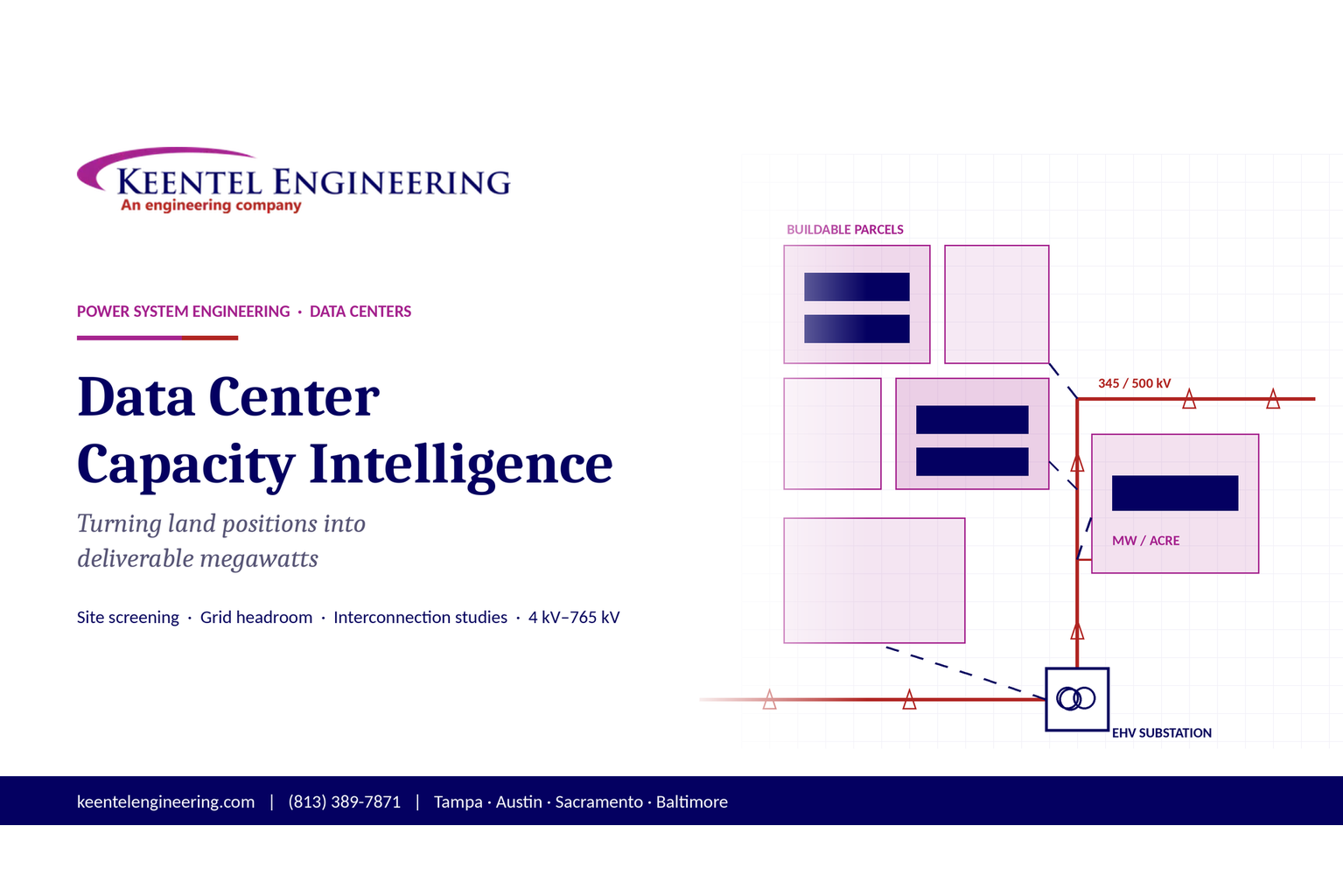
Plan data center capacity with land screening, MW-per-acre estimates, grid power availability and interconnection feasibility studies from Keentel Engineering.
By SANDIP R PATEL
•
October 11, 2026
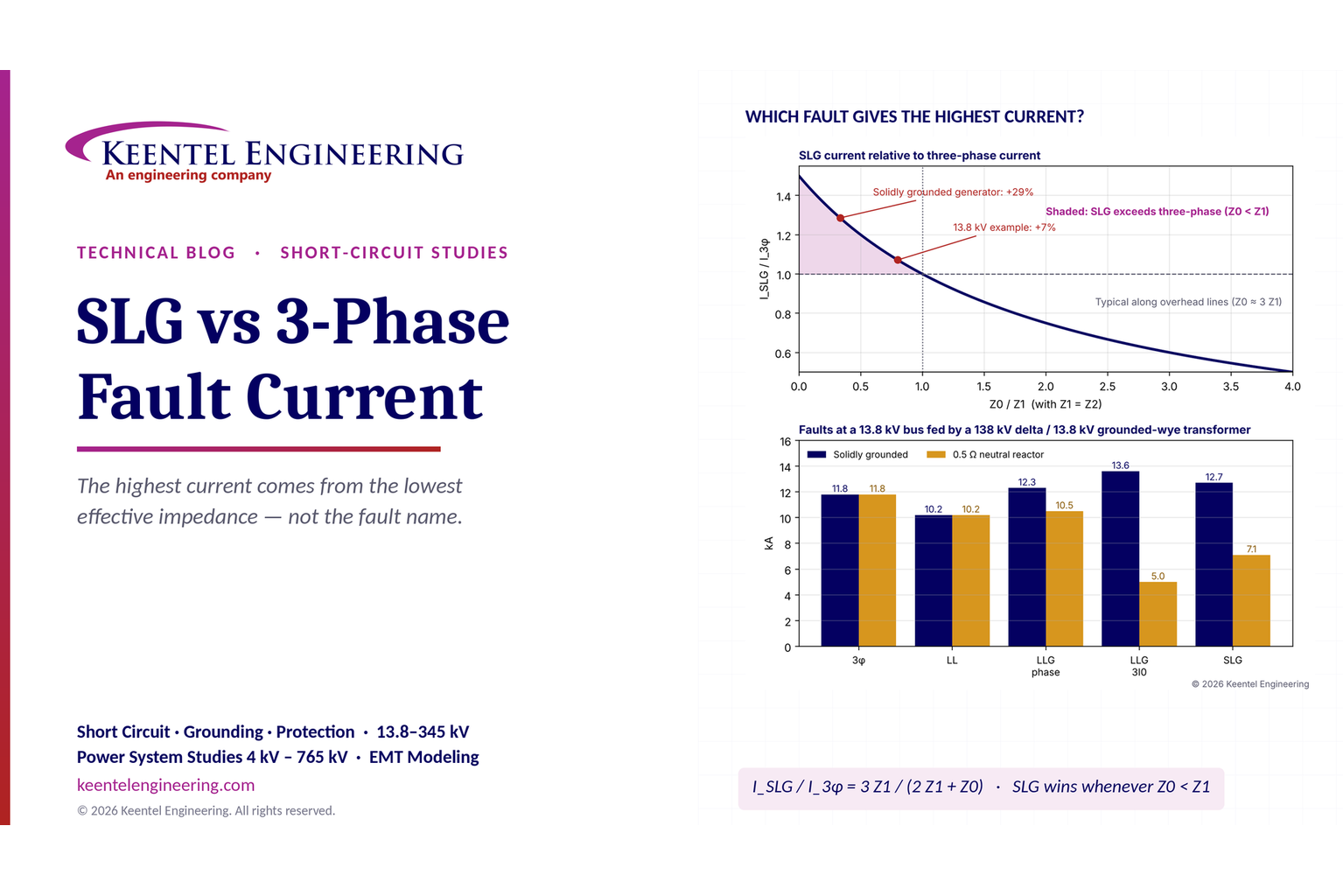
Learn which fault produces the highest current at a bus, why SLG faults can exceed three-phase faults, and how symmetrical components determine fault duty.
By SANDIP R PATEL
•
October 11, 2026
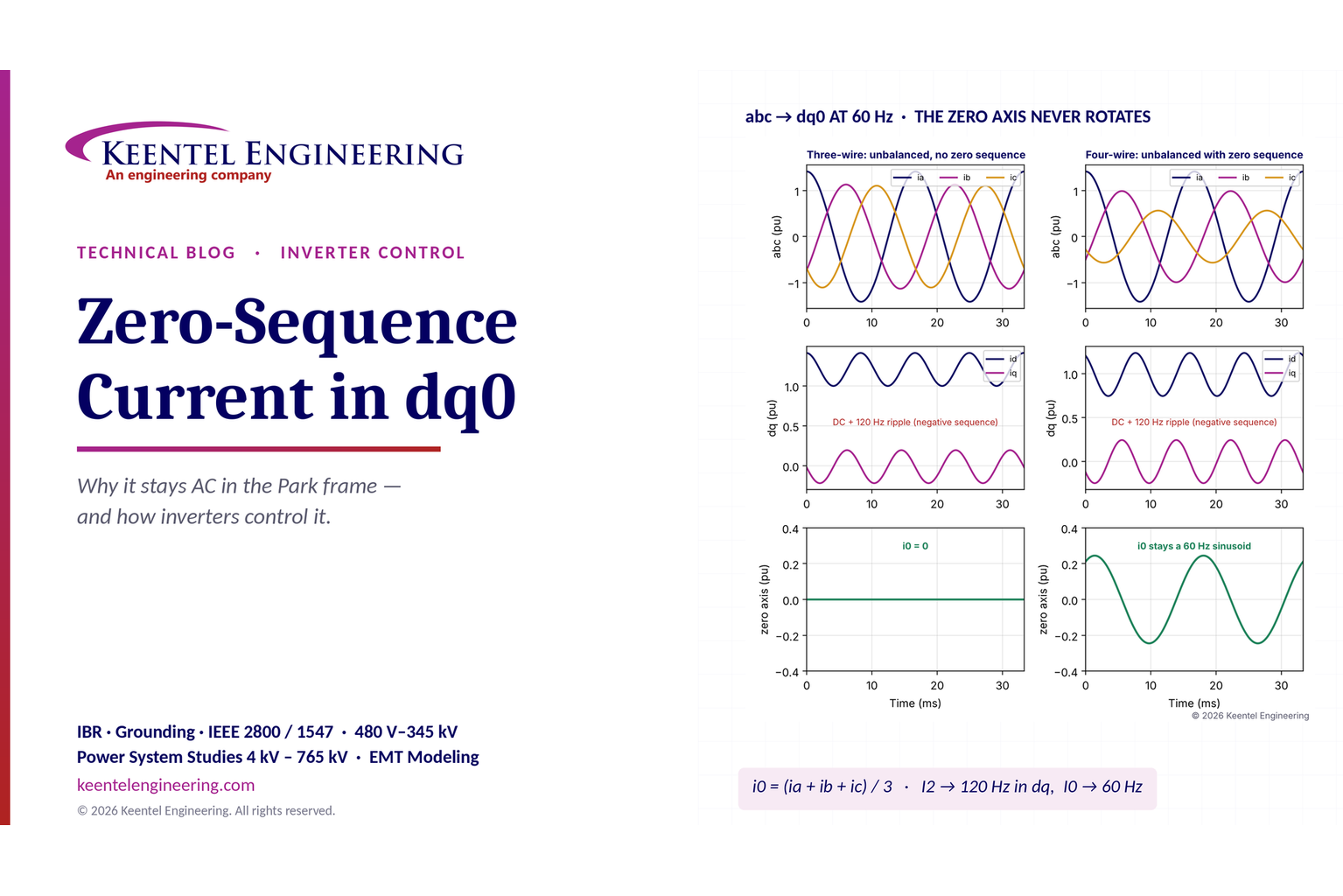
Learn why zero-sequence current pulsates in the dq0 frame, how Park's transformation works, and how inverter controls handle unbalance and ground faults.
By SANDIP R PATEL
•
October 11, 2026
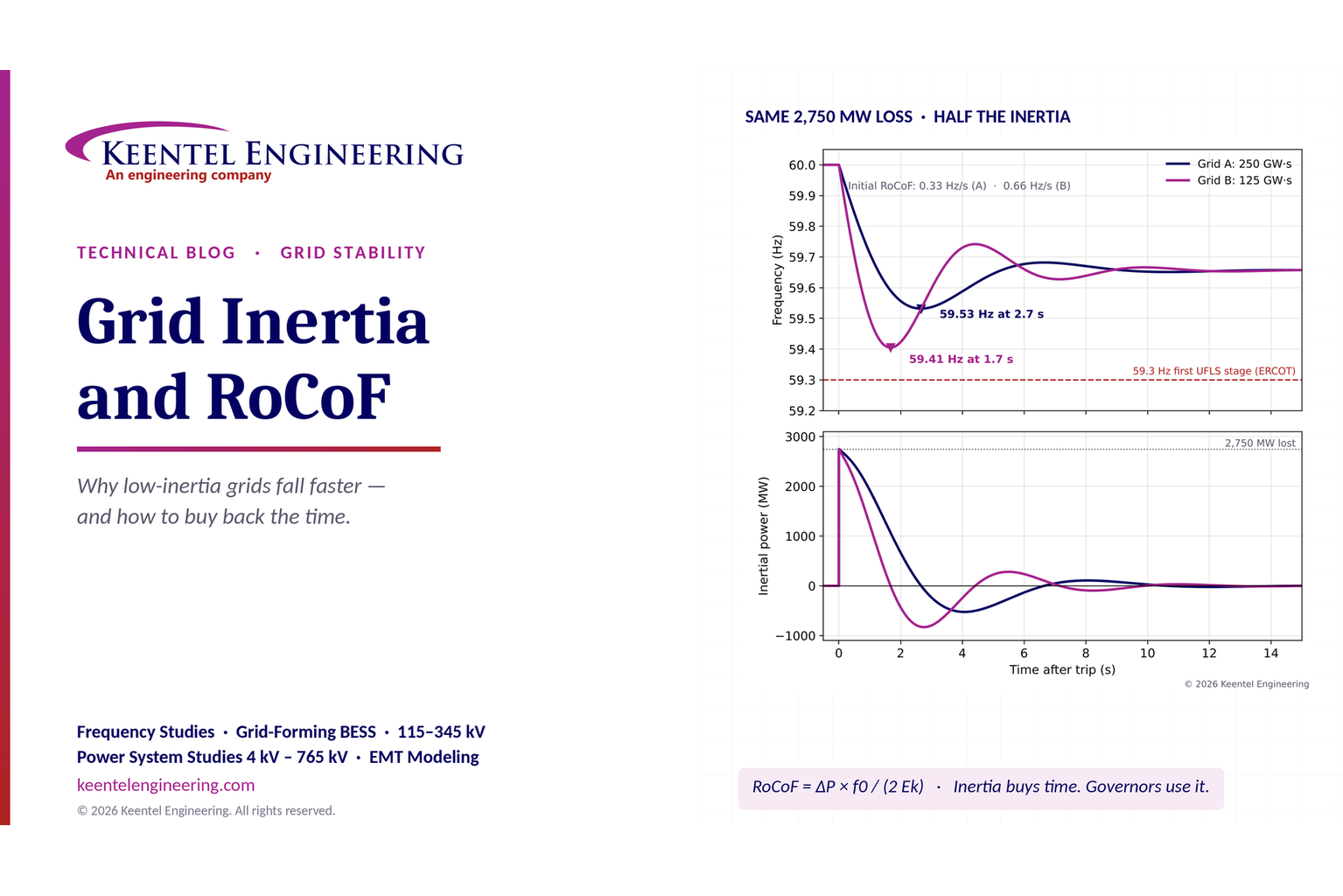
Explore grid inertia, RoCoF and frequency response, with swing equation calculations, frequency nadir analysis and US power system simulation examples.
By SANDIP R PATEL
•
October 11, 2026
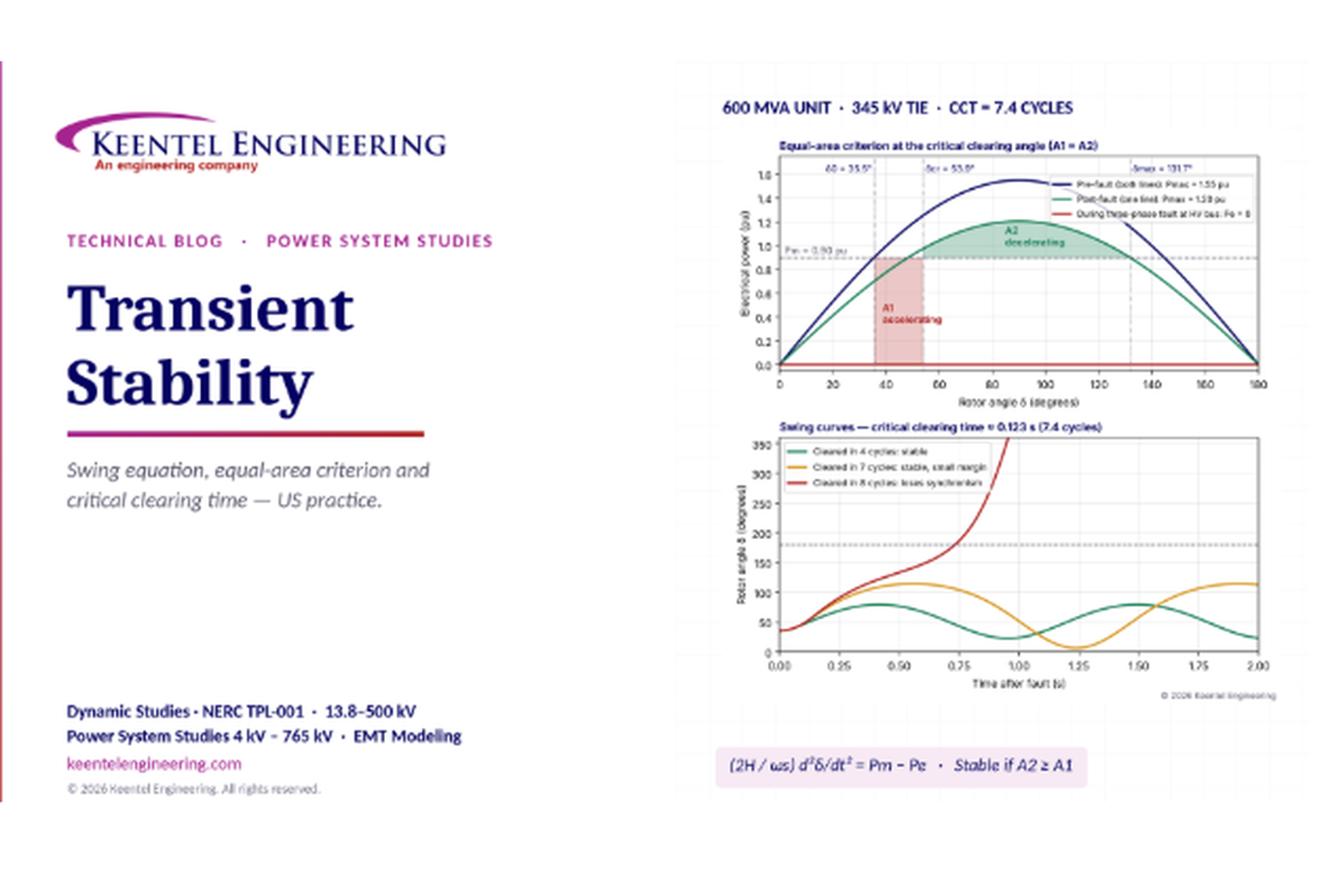
Learn transient stability analysis, swing equation, equal-area criterion and critical clearing time with a 345 kV worked example and NERC TPL-001 guidance.
By SANDIP R PATEL
•
October 11, 2026
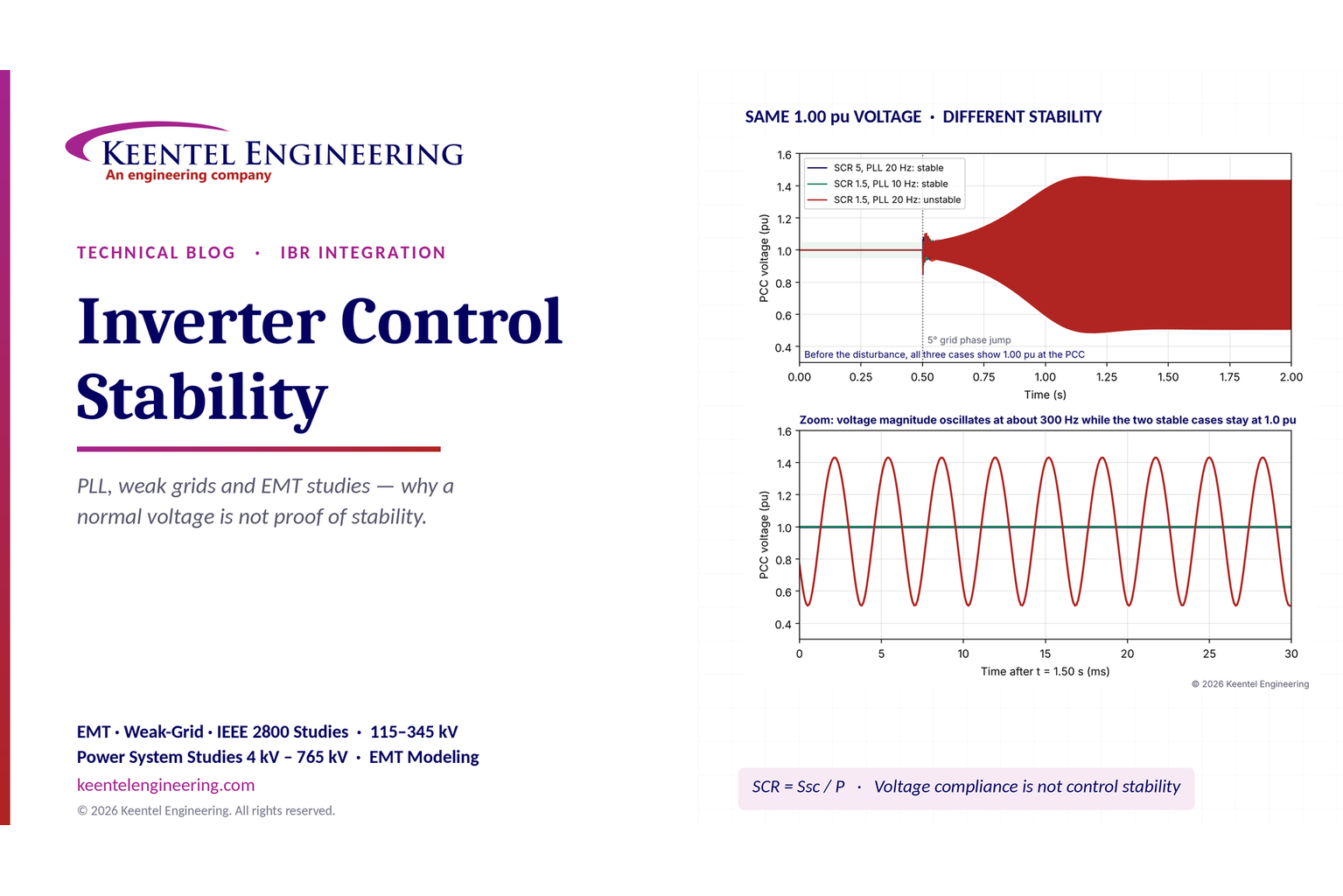
Learn why inverter controls become unstable in weak grids, how PLL bandwidth and SCR affect stability, and how PSCAD EMT studies identify and mitigate oscillations.
By SANDIP R PATEL
•
October 11, 2026
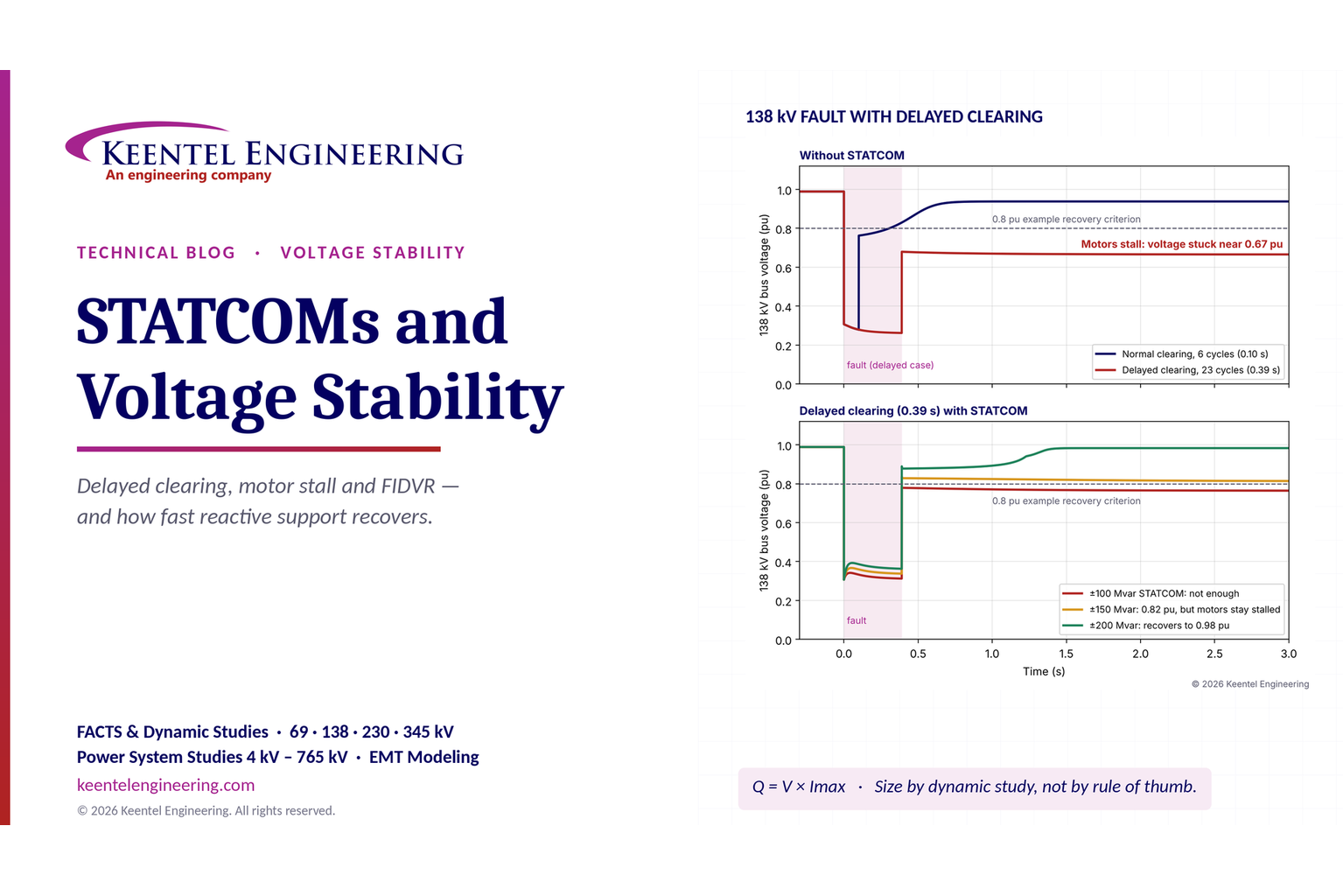
Learn how STATCOMs improve voltage stability and prevent FIDVR. Explore reactive power sizing, delayed fault clearing, NERC criteria and 138 kV simulation results.
By SANDIP R PATEL
•
October 10, 2026
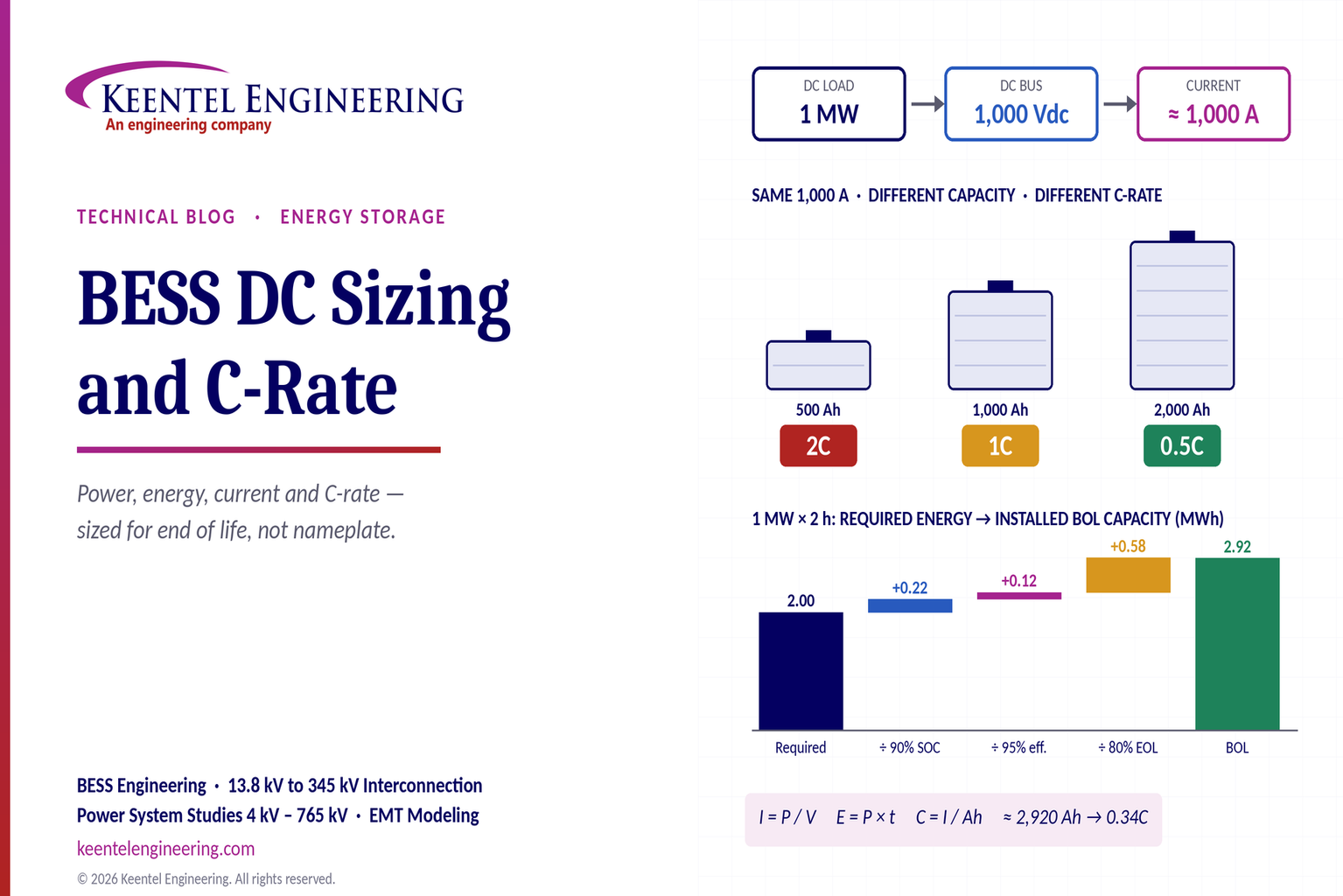
Learn BESS DC sizing with power, energy, current and C-rate calculations, battery losses, degradation and a 100 MW/400 MWh utility-scale example.
By SANDIP R PATEL
•
October 10, 2026
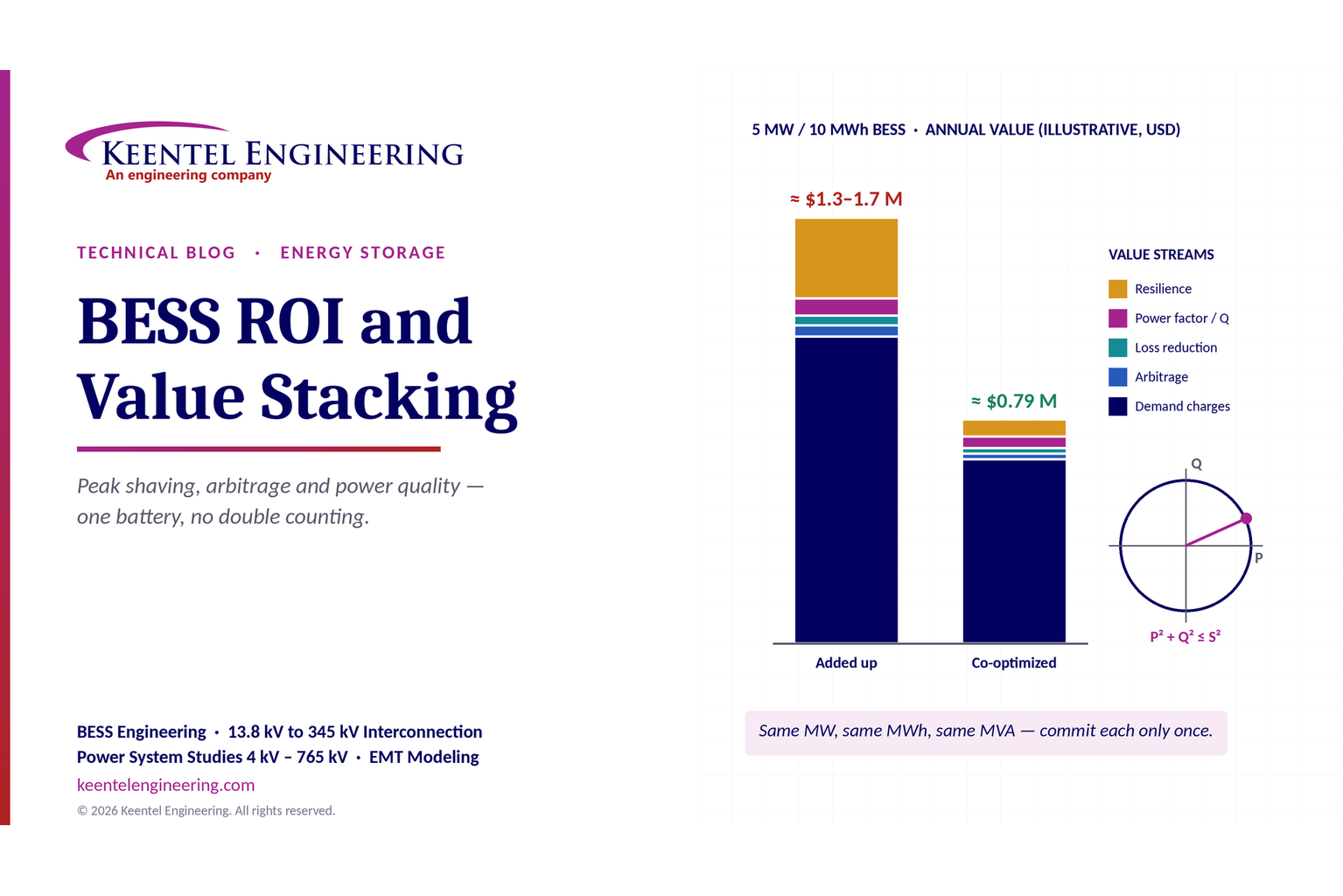
Learn how BESS ROI is calculated using peak shaving, energy arbitrage, power quality and battery storage economics, with a practical 5 MW/10 MWh example.