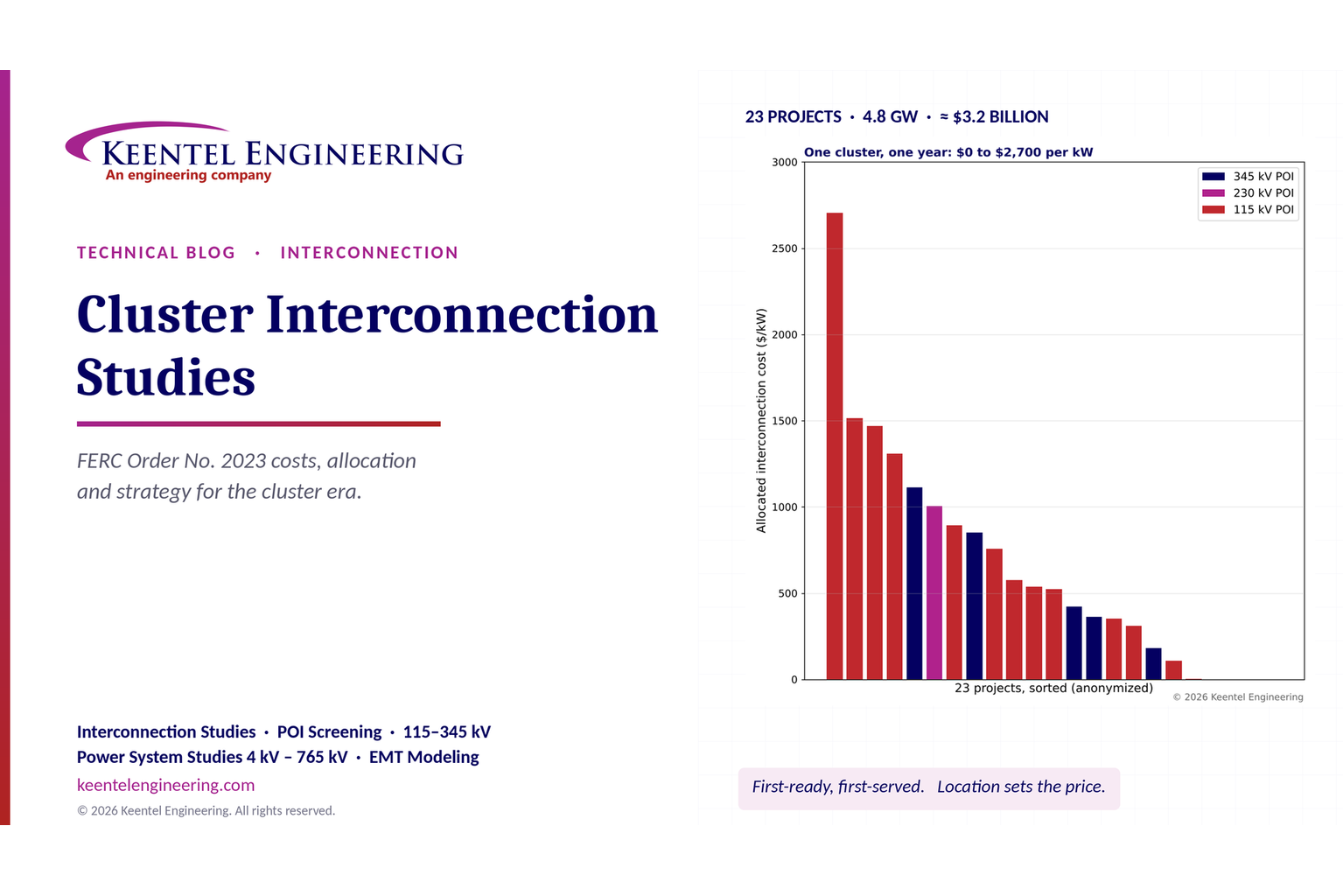


A Coordinated Electric System Interconnection Review—the utility’s deep-dive on technical and cost impacts of your project.
Challenge: Frequent false tripping using conventional electromechanical relays
Solution: SEL-487E integration with multi-terminal differential protection and dynamic inrush restraint
Result: 90% reduction in false trips, saving over $250,000 in downtime
| Category | Metric |
|---|---|
| VPP capacity (Lunar Energy) | 650 MW |
| Lunar funding raised | US$232 million |
| Data center BESS example | 31 MW / 62 MWh |
| ERCOT grid-scale batteries | 15+ GW |
| LDES tenders (H1 2026) | Up to 9.3 GW |
| Lithium-ion share of LDES by 2030 | 77% |
| FEOC initial threshold | 55% |
| BESS tariff rate (2026) | ~55% |
| Capacity gain from analytics | 5–15% |
End-to-End Substation Equipment Validation: From Design Verification to Field Commissioning (FAT to SAT) | Keentel Engineering
Mar 31, 2026 | blog
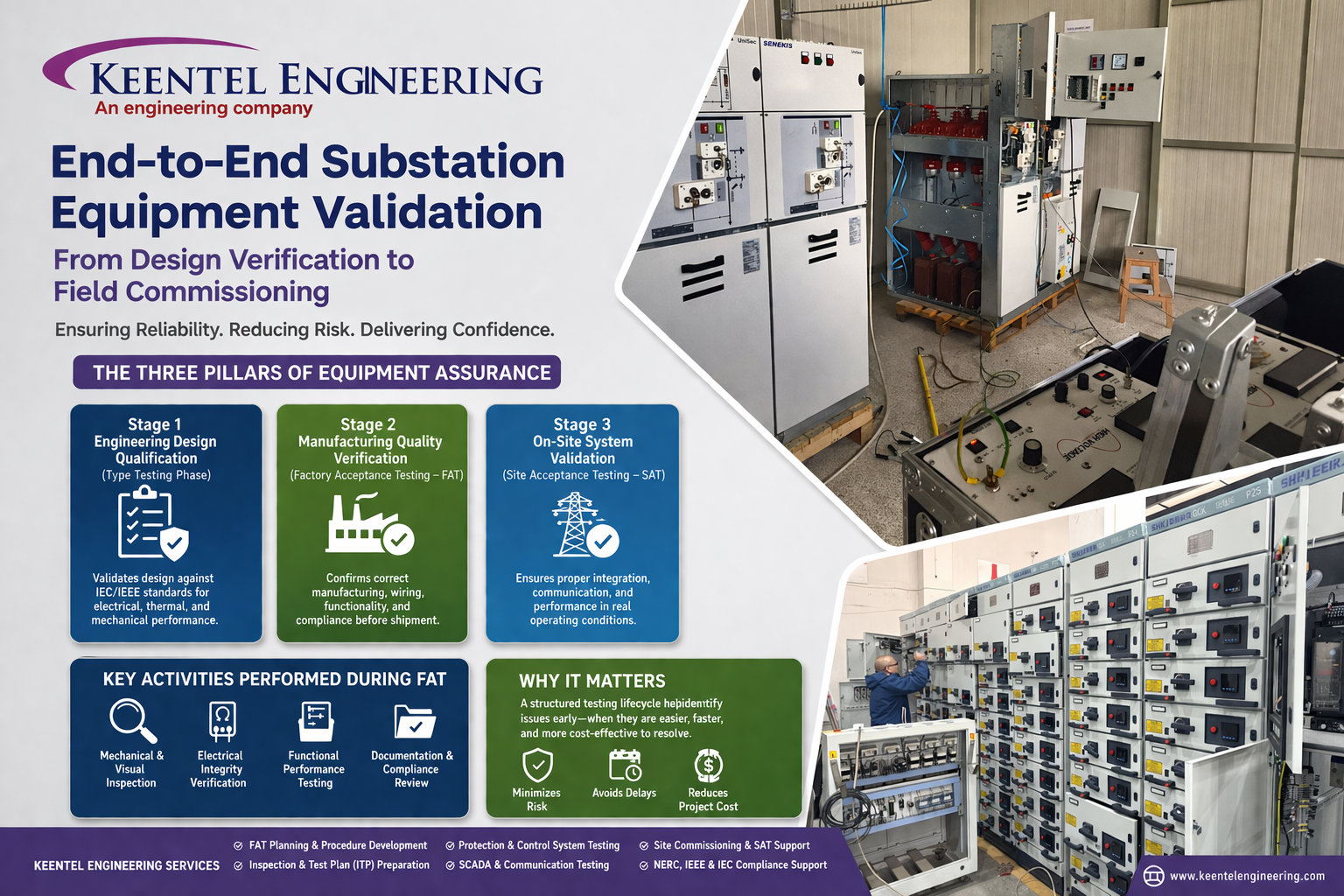
In today’s rapidly evolving power systems, reliability is not just designed—it is verified through a structured testing lifecycle. From concept validation to commissioning, every piece of substation equipment must pass through rigorous testing stages to ensure safe and reliable operation.
At Keentel Engineering, we specialize in delivering end-to-end engineering, testing, and commissioning support aligned with global standards (IEEE, IEC, NERC). This article provides a comprehensive overview of the Substation Equipment Testing Lifecycle, including Type Testing, Factory Acceptance Testing (FAT), and Site Acceptance Testing (SAT).
What is the Substation Equipment Testing Lifecycle?
The testing lifecycle is a multi-stage verification process that ensures:
- The design is compliant and technically sound
- The equipment is manufactured correctly
- The installed system operates reliably in real-world conditions
Rather than relying on a single test, this lifecycle uses progressive validation stages to minimize risk and improve quality.
Three Key Stages of Substation Equipment Testing
1. Type Testing Design Validation Stage
Key Objectives:
- Verify compliance with IEEE/IEC standards
- Validate performance under electrical, thermal, and mechanical stresses
- Confirm fault withstand capability
Examples:
- Transformer impulse and temperature rise tests
- Switchgear short-circuit and dielectric tests
- CT/VT accuracy and insulation tests
Important Insight:
Type testing validates the design not every manufactured unit.
2. Factory Acceptance Testing (FAT) – Manufacturing Verification
FAT is one of the most critical milestones in any
substation project . It ensures that what was designed is correctly built and functional before shipment.
What FAT Verifies:
- Compliance with approved drawings and specifications
- Correct wiring and assembly
- Electrical health and insulation integrity
- Functional performance of protection, control, and SCADA systems
Core FAT Activities:
- Physical Inspection: Layout, labeling, wiring
- Electrical Checks: Insulation resistance, continuity
- Functional Testing: Relay operation, interlocks, alarms
- Documentation Review: Schematics, ITP, logic diagrams
FAT acts as a quality gate, preventing defective equipment from reaching the site.
3. Site Acceptance Testing (SAT) – System Integration
SAT is performed at the
project site to confirm that the equipment works within the actual system environment.
Key Focus:
- Integration with other equipment
- Communication with SCADA/RTU
- End-to-end protection scheme verification
- Real operating condition validation
FAT proves equipment is built correctly.
SAT proves it works correctly in the real system.
Why This Testing Lifecycle is Critical
The lifecycle acts as a risk mitigation framework, identifying issues early when they are:
- Easier to fix
- Less costly
- Less disruptive to project timelines
For example:
- Design flaws caught in Type Testing avoid production failures
- Manufacturing defects caught in FAT avoid site delays
- Integration issues caught in SAT prevent operational failures
FAT in Modern Digital Substations
With the rise of IEC 61850, digital substations , and advanced automation, FAT has become more complex and more important.
Key Areas of Focus:
- Protection logic validation
- Communication mapping
- Signal exchange verification
- SCADA and RTU integration
Modern FAT is no longer just panel testing it is system-level validation in a simulated environment.
Common Issues Identified During FAT
A properly executed FAT can detect:
- Incorrect wiring or ferruling
- CT polarity errors
- Wrong relay settings
- Missing interlocks
- Incorrect SCADA signal mapping
If missed, these issues can lead to:
- Protection misoperation
- Safety hazards
- Commissioning delays
- Cost overruns
Keentel Engineering Expertise in FAT & Substation Testing
At Keentel Engineering , we provide:
- FAT planning & procedure development
- Inspection & Test Plan (ITP) preparation
- Relay and protection system validation
- SCADA and communication testing
- Site commissioning & SAT support
- NERC and IEEE compliance services
We ensure your project achieves zero-defect delivery from factory to energization.
Frequently Asked Questions (FAQs)
1. What is the difference between FAT and SAT?
FAT is conducted at the manufacturer’s facility to verify equipment build and functionality, while SAT is conducted at the site to verify system integration and real-world performance.
2. Why is FAT important in substation projects?
FAT identifies defects before equipment reaches the site, reducing costs, delays, and risks during commissioning.
3. Does type testing guarantee product quality?
No. Type testing validates the design only. Each manufactured unit must still pass FAT.
4. Who attends FAT testing?
Typically:
- Client representatives
- EPC contractors
- Consultants
- Third-party inspectors
5. What documents are required for FAT?
- Approved drawings (GA, schematics)
- Inspection & Test Plan (ITP)
- FAT procedure
- Protection logic diagrams
6. What are typical FAT tests for protection panels?
- Relay operation checks
- Trip circuit verification
- Alarm and indication checks
- Interlocking validation
7. What happens after FAT is completed?
A FAT report is issued, punch points are closed, and the equipment is approved for shipment.
8. Can FAT replace SAT?
No. FAT verifies equipment, while SAT verifies system integration under real conditions.
9. What is a punch list in FAT?
It is a list of defects or observations identified during FAT that must be corrected before shipment.
10. What are the risks of skipping FAT?
Skipping FAT can result in:
- Major site delays
- Rework costs
- Equipment failure
- Safety hazards
11. How does FAT support NERC compliance?
FAT ensures proper relay configuration, system functionality, and documentation—critical for NERC PRC compliance.
12. What industries require FAT?
- Utilities (Transmission & Distribution)
- Renewable energy (Solar, Wind, BESS)
- Industrial power systems
- Data centers
13. What is included in FAT deliverables?
- Test reports
- Checklists
- Punch list
- Signed approval documents
14. How long does FAT typically take?
It depends on equipment complexity but typically ranges from 1–5 days per system.
15. What is the role of Keentel Engineering in FAT?
Keentel provides engineering oversight, testing expertise, compliance assurance, and full lifecycle support from design to commissioning.
16. What is the biggest mistake during FAT?
Conducting FAT without finalized drawings or approved procedures.
17. What standards govern FAT?
- IEEE standards
- IEC standards
- Utility-specific requirements
18. Is FAT mandatory?
Yes, for most utility and EPC projects, FAT is a contractual requirement.
19. What equipment is typically tested in FAT?
- Transformers
- Switchgear
- Protection panels
- SCADA systems
- Battery systems
20. How does FAT reduce project costs?
By identifying issues early, FAT avoids expensive rework during installation and commissioning.
Conclusion
The substation equipment testing lifecycle—from Type Testing to FAT and SAT—is the backbone of reliable power system delivery. It ensures that every component is validated, verified, and ready for real-world operation.
At Keentel Engineering, we bring deep expertise in substation design, testing, commissioning, and compliance, helping clients deliver projects that are safe, reliable, and future-ready.

About the Author:
Sonny Patel P.E. EC
IEEE Senior Member
In 1995, Sandip (Sonny) R. Patel earned his Electrical Engineering degree from the University of Illinois, specializing in Electrical Engineering . But degrees don’t build legacies—action does. For three decades, he’s been shaping the future of engineering, not just as a licensed Professional Engineer across multiple states (Florida, California, New York, West Virginia, and Minnesota), but as a doer. A builder. A leader. Not just an engineer. A Licensed Electrical Contractor in Florida with an Unlimited EC license. Not just an executive. The founder and CEO of KEENTEL LLC—where expertise meets execution. Three decades. Multiple states. Endless impact.
Services

Let's Discuss Your Project
Let's book a call to discuss your electrical engineering project that we can help you with.

About the Author:
Sonny Patel P.E. EC
IEEE Senior Member
In 1995, Sandip (Sonny) R. Patel earned his Electrical Engineering degree from the University of Illinois, specializing in Electrical Engineering . But degrees don’t build legacies—action does. For three decades, he’s been shaping the future of engineering, not just as a licensed Professional Engineer across multiple states (Florida, California, New York, West Virginia, and Minnesota), but as a doer. A builder. A leader. Not just an engineer. A Licensed Electrical Contractor in Florida with an Unlimited EC license. Not just an executive. The founder and CEO of KEENTEL LLC—where expertise meets execution. Three decades. Multiple states. Endless impact.
Leave a Comment
We will get back to you as soon as possible.
Please try again later.