
A Coordinated Electric System Interconnection Review—the utility’s deep-dive on technical and cost impacts of your project.
Challenge: Frequent false tripping using conventional electromechanical relays
Solution: SEL-487E integration with multi-terminal differential protection and dynamic inrush restraint
Result: 90% reduction in false trips, saving over $250,000 in downtime
PJM's New EMT Model Development Guidelines for Inverter-Based Resources
Jul 03, 2026 | Blog
The Interconnection Rulebook Just Changed Again
In March 2026, PJM's System Planning Division released Revision 0 of its EMT Model Development Guidelines for Inverter-Based Resources a document that formally makes detailed electromagnetic transient (EMT) modeling a standing requirement of the PJM interconnection process. For developers of utility-scale solar, battery energy storage (BESS), Type III and IV wind, and hybrid plants, this is not an incremental paperwork update. It changes what must be delivered, when it must be delivered, and how rigorously it will be tested before your project can advance through the queue.
The headline: beginning with Transition Cycle 2, PJM will screen projects connecting in low-system-strength areas and require a PSCAD model at Decision Point II. From Cycle 1 onward, every BPS-connected project must submit a PSCAD model at Decision Point II accompanied by a 35-item Model Requirements Checklist, a Model Quality Test report spanning 18 defined test cases, and a PSCAD-to-PSS/E benchmark demonstrating that your EMT and positive-sequence models tell the same story.
If your project touches the PJM queue in 2026 or beyond, an EMT model is no longer a contingency deliverable you might be asked for. It is part of the definition of a complete submission.
This article walks through the full guideline in depth: why PJM is doing this, who must comply and on what timeline, what the PSCAD model must contain, how the 18 quality tests work, what the cross-platform benchmark demands, and where submissions most often fail. A companion FAQ follows at the end.
Why EMT? The Physics Behind the Policy
PJM's stated rationale mirrors what grid operators worldwide have learned the hard way: inverter-based resources (IBRs) connect to the grid asynchronously through power electronics, and their control systems depend on a stable terminal voltage magnitude and angle to operate. In weak grids — areas with low short-circuit strength — that terminal voltage becomes highly sensitive to the IBR's own current injections. The result can be adverse controller reactions, sub-synchronous oscillations (SSO), subcycle overvoltages, and destabilizing interactions between neighboring IBR plants.
Conventional positive-sequence phasor-domain (PSPD) tools such as PSS/E are built for the classical stability band of roughly 0.1 Hz to 10 Hz. They are the right tool for rotor-angle and voltage stability, but they simply cannot represent switching transients, torsional interactions, harmonics, fast inner-loop control dynamics, or phase-locked-loop (PLL) behavior during severe voltage depressions. Those phenomena live in the electromagnetic transient domain — microsecond time steps, three-phase instantaneous waveforms, and full converter control representations.
The regulatory scaffolding has been converging on this conclusion for years. IEEE 2800-2022 defines ride-through, reactive current support, and fast-response capabilities for transmission-connected IBRs that only EMT simulation can meaningfully verify. NERC's reliability guidance on EMT modeling for BPS-connected IBRs, the May 2025 Level 3 Alert on IBR performance, and the MOD-026-2 requirement for Transmission Planners and Planning Coordinators to jointly define dynamic model requirements for both PSPD and EMT models all push in the same direction. PJM's guideline is the region-specific implementation of that national trajectory.
When PJM Will Actually Run EMT Studies
Not every project will face a full EMT interconnection study. In the planning horizon, PJM performs EMT analysis for three scenario classes:
- Low system strength projects electrically located in weak areas where PSPD results are unreliable by construction.
- Poor stability performance in PSPD studies when the positive-sequence model already shows marginal damping or questionable recovery, EMT is used to look closer.
- Topology or conditions with stability risk configurations such as high local IBR concentration, series compensation exposure, or unusual outage conditions.
The critical point for developers: PJM decides whether an interactions study is required based on project size and electrical location but the model must be submitted regardless, so that the option is always on the table without restarting the clock.
Who Must Submit, and When: The Compliance Timeline
The guideline applies to all IBR solar PV, BESS, Type III (DFIG) and Type IV wind, and co-located or hybrid plants such as PV-plus-BESS. The submission trigger depends on where your project sits in the process:
| Project Situation | EMT Submission Requirement |
|---|---|
| Transition Cycle 2 | PJM screens for low-system-strength locations at the start of Phase II. Identified projects are notified and must submit the PSCAD model, Model Requirements Checklist, and Model Quality Test & Benchmark Report at Decision Point II. |
| Cycle 1 and beyond | All BPS-connected projects submit a PSCAD model at Decision Point II — no screening gate; the requirement is universal. |
| Necessary Study, Surplus Study, non-cycle requests | PSCAD model submitted together with the study request. (Effective date to be communicated in the next guideline revision.) |
| As-Built verification | Expanded package: PSS/E UDM, PSS/E library model, PSCAD model reflecting as-built site parameters, Model Quality Test & Benchmark Report (with more required tests than earlier stages), and a Parameter Verification Report. |
| Within 1 year of commercial operation | A tuned model set per NERC MOD-026 / MOD-027 (MOD-026-2 when effective), calibrated against field tests to reflect the actual dynamic response of the plant. |
| Any qualified change | Device updates, adding storage to a solar or wind site, or operating-mode conversions trigger a full resubmission of revised deliverables plus a change report. |
Two traps hide in this timeline. First, the as-built stage is not a copy-paste of the as-designed submission it adds a Parameter Verification Report comparing installed PPC and inverter settings against the model, and any divergence between studied and installed settings is treated as a qualified change under FAC-002-4, reviewed before commercial operation. Second, hybrid conversions are resubmission events. Adding a BESS to an operating solar plant re-opens the entire deliverable set.
What the PSCAD Model Must Contain
PJM requires the project to be modeled up to the Point of Interconnection (POI) using an aggregate or partially equivalent plant representation. Where a single physical plant is split into multiple queue positions, PJM explicitly prefers that the whole-plant model accompany each individual submission. If a plant uses more than one inverter type or design, each type gets its own aggregated unit; lumping dissimilar inverters into one equivalent machine is not acceptable.
The aggregate model must include, at minimum:
- Aggregated generation or energy storage model
- Aggregated generator (unit) transformer
- Equivalent collector branch (line or cable equivalent)
- Main step-up transformer(s)
- Generator tie line to the POI
- Supplemental devices where present STATCOMs, synchronous condensers, capacitor and reactor banks, harmonic filter banks
- Station service load
The external grid is represented by an AC source behind a Thevenin impedance, with a default short-circuit ratio (SCR) of 3 and X/R of 5 unless a specific test dictates otherwise. Models must be delivered in PSCAD™/EMTDC™-compatible formats (*.pswx, *.pscx, *.pslx).
The 35-Item Requirements Checklist: Where Model Quality Is Really Defined
The appendix checklist is the technical heart of the guideline. Every item must be reviewed and marked by the model supplier, with a written explanation for any non-conformance, and the checklist is signed by an authorized representative. The items group into four families:
Documentation and configuration control
The model must carry an identification mechanism control revision codes, settings files, or equivalent so that during commissioning PJM can verify the field settings match what was studied. Vendor name and model version must be visible in the .pscx case, and a site-specific sample test case (single-machine infinite bus at a representative SCR) must be included.
Accuracy features
This is where generic library models die. PJM requires the full detailed inner control loops of the power electronics the approximation used in transient-stability modeling is expressly insufficient. The strongly recommended path is embedding actual hardware code into a PSCAD component (a “real code” model). Models assembled from master-library blocks or translated from block diagrams require validation against hardware performance, and against field measurements at the as-built stage. Additional accuracy items: a full IGBT or firing-pulse-based switching representation (a three-phase sinusoidal source is not acceptable), plant-level control with real communication delays and ride-through mode transitions, SSO mitigation with enable/disable capability, transformer magnetizing curves, dynamic reactive devices, DFIG machine slip representation, and detailed balanced/unbalanced protection systems implemented in actual hardware code.
Usability features
Study engineers must be able to work with the model: user-accessible control and hardware options, diagnostic flags that identify why a model tripped, protection functions that can be disabled, scalable active power capacity, dispatch capability below nameplate, external reference variables changeable mid-simulation, self-initialization to ordered output without hand-holding, and tolerance of the 5–20 µs time-step range (10 µs recommended).
Efficiency features
Compatibility items that make PJM's study workflow scale: no dependence on a specific Fortran or PSCAD version (5.0.1+; Intel OneAPI HPC compiler support recommended), Visual Studio 2015+ compilation, multiple-instance support, PSCAD “timed snapshot” and “multiple run” support, no global variables, no multiple layers, replication via copy/copy-transfer, and named modeling-support contacts.
In our experience, checklist items 4 (real-code inner controls), 7 (plant-level control fidelity), 13 (protection systems), and 19 (self-initialization) account for the majority of model rejections and resubmission cycles across ISOs and utilities.
The 18 Model Quality Tests, Decoded
Section 4 of the guideline defines a standardized test battery. Every test reports total P and Q, per-phase RMS voltage (positive sequence when benchmarking against PSS/E), and frequency at both the POI and the Point of Connection, at two zoom levels full simulation and a 1–2 second window around the disturbance. For BESS projects, all tests run at both full charge and full discharge; hybrid plants must cover five operation modes (generation alone; BESS alone charging; BESS alone discharging; generation plus BESS charging; generation plus BESS discharging), with written justification for any mode that does not apply.
Functional Tests (Tests 1–6): Does the Model Behave?
| Test | Setup Highlights | What PJM Is Checking |
|---|---|---|
| 1. Flat Start | MFO, unity PF, Vpoi = 1.0 pu, SCR = 3, 15 s run | Steady state within 5 s; output variation ≤ 0.1 MW / 0.1 MVAR thereafter. Fails here usually mean initialization or PPC hunting problems. |
| 2. Active Power Step-Down | Pref stepped 1.0 → 0.9 pu at t = 10 s | P tracks the command with reasonable response time; Q stays in band. |
| 3. Frequency Step-Up (+0.3 Hz) | Full output, step at t = 10 s | Primary frequency response in the correct direction (curtailment for over-frequency). |
| 4. Frequency Step-Down (−0.3 Hz) | 80% of MFO to provide headroom | Upward primary frequency response — the headroom dispatch verifies governor-like behavior is actually wired in. |
| 5. Voltage Step-Up (+0.03 pu) | Step at t = 10 s | Q response in correct direction (absorb), stable P. |
| 6. Voltage Step-Down (−0.03 pu) | Step at t = 10 s | Q response in correct direction (inject), stable P. |
Ride-Through Performance Tests (Tests 7–18): Does the Plant Survive?
| Test | Disturbance | Key Acceptance Criteria |
|---|---|---|
| 7. Three-phase-to-ground fault | Bolted 3LG at POI, 9 cycles, SCR = 3 | Ride through with damping ratio ≥ 0.3; P recovers to pre-fault; if momentary cessation occurs, current injection resumes within 5 cycles of voltage recovery. |
| 8. Single line-to-ground fault | Bolted SLG at POI, 9 cycles | Same criteria under unbalanced conditions — this is where sequence-domain control weaknesses appear. |
| 9. Line-to-line fault | Bolted LL at POI, 9 cycles | Same criteria; negative-sequence current handling under scrutiny. |
| 10. LVRT profile | PRC-024-3 low-voltage duration profile, SCR = 50 | Rides through, injects reactive current during the event, no momentary cessation observed. |
| 11. Overvoltage ride-through | 1.2 pu for 0.20 s, SCR = 50 | Rides through, absorbs reactive current, damping ratio ≥ 0.3, no momentary cessation. |
| 12. HVRT profile | PRC-024-3 high-voltage duration profile, SCR = 50 | Rides through and recovers; reactive absorption during event. |
| 13. System strength test | SCR stepped 5 → 3 → 1.5 → 1.2, each transition under a 3-cycle 3LG fault | Positively damped response, no unit trips, for SCR of 3 and higher. This single test is the weak-grid gauntlet. |
| 14. Phase angle change +25° | Instantaneous phase jump, SCR = 50 | Ride through, no trips, damping ≥ 0.3, no momentary cessation — a direct PLL robustness test. |
| 15. Phase angle change −25° | Instantaneous phase jump, SCR = 50 | As above, opposite polarity. |
| 16. High ROCOF | ±5 Hz/s ramps between 59.5 and 60.5 Hz, 5 s holds | Ride through the full sequence and recover with adequate damping. |
| 17. HFRT profile | PRC-024-3 high-frequency duration curve | Ride through, no momentary cessation, timely recovery. |
| 18. LFRT profile | PRC-024-3 low-frequency duration curve (dwell near 57.9 Hz) | Ride through, no momentary cessation, timely recovery. |
Two design details deserve emphasis. First, momentary cessation is treated as a defect, not a feature: for the profile tests it must not be observed at all, and where equipment limitations make it unavoidable, the developer must disclose it to PJM in the test report. Second, the damping ratio floor of 0.3 is a quantitative bar oscillatory recoveries that would have skated through a qualitative review now fail on the numbers, and the required transient-zoom plots make marginal damping impossible to hide.
PSCAD vs. PSS/E: The Benchmark Requirement
Because PJM's planning workflow still runs on PSS/E, the guideline requires proof that the EMT and PSPD models agree. For as-designed submissions (cycle process, Necessary Study), PSCAD and PSS/E signals must be overlaid and aligned on every plotted signal for Tests 1–6 (functional), Test 7 (3LG), Test 10 (LVRT), and Test 12 (HVRT). For as-built submissions, the benchmark expands to the full quality-test set minus four cases that positive-sequence tools cannot legitimately represent: SLG (Test 8), line-to-line (Test 9), and both ±25° phase-angle tests (Tests 14–15). The as-built package must also include the PSS/E UDM and library model if not previously submitted.
The intent is stated plainly: the two models must align well enough that PJM can pivot to the PSCAD model to chase issues surfaced in PSS/E studies without questioning whether it represents the same plant. In practice this benchmark is where mismatched droop settings, inconsistent transformer data, and divergent protection thresholds between your PSS/E and PSCAD models get exposed.
The Deliverable Package and Submission Logistics
| # | Deliverable | Required For |
|---|---|---|
| 1 | PSCAD model (plus PSS/E UDM and library model at as-built if not already on file) | As-designed; as-built and beyond |
| 2 | PSCAD Model Requirements Checklist (35 items, signed) | As-designed; as-built and beyond |
| 3 | Model Quality Test and PSCAD-PSS/E Benchmark Reports | As-designed; as-built and beyond |
| 4 | All cases and files used for every quality test and benchmark | As-designed; as-built and beyond |
Everything is zipped and uploaded through the Data Submission Platform under Generator Information > Stability Models for Queue Point projects or Project Capability Tab > Dynamic Files for NextGen with a 250 MB upload limit (larger packages go through Secure Share via your Project Manager). Note the phrase “all cases and files”: PJM reserves the right to rerun any test, so the submission must be reproducible, not just reported.
Where Submissions Fail and How to Get Ahead of It
Having built, tested, and benchmarked PSCAD and PSS/E models across ISO/RTO processes, we see the same failure modes recur:
- Vendor model lead time. Real-code PSCAD models come from the inverter OEM, often under NDA, sometimes weeks after request. Projects that wait until Phase II to open that conversation compress their own testing window to nothing.
- Flat-start failures at SCR 3. Models tuned in vendor test benches at high SCR frequently hunt or oscillate at PJM's default weak-grid setup. Test 1 is deceptively simple and fails more often than any ride-through case.
- PSS/E-PSCAD divergence. The two models are usually built by different teams from different data snapshots. Reconciling MVA bases, transformer impedances, PPC droops, and protection settings before running the benchmark saves an entire resubmission cycle.
- Hybrid mode coverage gaps. Five operation modes, at charge and discharge extremes, across 18 tests multiplies quickly. Missing modes without documented justification is an automatic deficiency.
- As-built parameter drift. Commissioning settings that deviate from the studied model become FAC-002-4 qualified changes on the eve of commercial operation the most expensive possible moment to discover them.
Keentel Engineering supports developers, EPCs, and owners across exactly this workflow: PSCAD model development and vendor-model integration, execution of the full 18-test quality battery, PSCAD-PSS/E benchmarking, checklist certification support, EMT interconnection studies for
weak-grid POIs, and as-built parameter verification. If PJM's new guideline intersects your queue position, the time to scope the modeling effort is before Decision Point II is on the calendar not after the deficiency letter arrives.
Case Studies
Case Study 1 — 200 MW Solar PV in a Weak-Grid Pocket: Passing the Model Quality Battery at SCR 3
Background
A utility-scale solar developer held a queue position for a nominal 200 MW (AC) PV facility interconnecting to a 230 kV transmission system in a region with limited nearby synchronous generation. Grid screening identified the point of interconnection as a low-system-strength location the composite short-circuit contribution at the POI yielded an effective SCR near 2.8 at full plant output, below the guideline's default test value of 3. A PSCAD model, the 35-item Model Requirements Checklist, and a complete Model Quality Test and Benchmark Report were required at the project's next decision point.
The Challenge
- The inverter OEM's public PSS/E library model existed, but the corresponding real-code PSCAD model had to be obtained under NDA, configured for the site, and validated — with roughly ten weeks of runway.
- The plant used two inverter designs (a legacy unit for the first phase block and a newer high-voltage unit for the balance), obligating two distinct aggregated units rather than one lumped equivalent.
- Initial flat-start runs at the default SCR = 3 / X/R = 5 setup failed the most basic test in the battery: the plant-level controller hunted around its voltage setpoint with sustained ±0.8 MVAR oscillation — eight times the 0.1 MVAR steady-state tolerance.
Engineering Approach
The team first reconciled the plant electrical data — inverter nameplates, pad-mount and main power transformer impedances, and the equivalent collector branch derived from the as-designed cable schedule between the PSS/E case and the PSCAD model, eliminating the divergence that would otherwise contaminate every downstream benchmark. The two aggregated units were built with the OEM real-code components, each behind its own aggregated unit transformer and collector equivalent, joined at the collector bus ahead of the main step-up transformer and tie line to the POI.
The flat-start oscillation was traced to interaction between the power plant controller's voltage-regulation gain and the weak-grid voltage sensitivity: gains tuned by the OEM at a strong test bench (SCR ≈ 10) were unstable at SCR 3. Working within the user-accessible parameter set the checklist requires the model to expose, the PPC voltage-control response time and droop were retuned, and the coordination between the PPC and the inverters' local volt-VAR loops was corrected so the two control layers stopped fighting. The retuned settings were documented as the settings of record for both models an early payoff of the checklist's identification-mechanism requirement.
With the model stable, the full battery was executed: functional Tests 1–6, fault ride-through Tests 7–9, PRC-024-3 profile Tests 10–12 and 17–18, the system strength sequence of Test 13, phase-angle Tests 14–15, and the ROCOF sequence of Test 16 — each plotted at POI and point of connection, full-window and transient zoom.
Results
| Milestone | Outcome |
|---|---|
| Flat start (Test 1), SCR = 3 | Steady state in 3.1 s after retuning; residual variation < 0.05 MW / 0.04 MVAR — passing with margin. |
| System strength test (Test 13) | Positively damped recovery with no unit trips through the SCR = 3 stage; behavior at SCR 1.5 and 1.2 documented for PJM's information as the guideline's acceptance criterion applies at SCR ≥ 3. |
| 3LG fault (Test 7) | Damping ratio 0.42 on active-power recovery; current injection resumed 3 cycles after voltage recovery — inside the 5-cycle limit. |
| PSS/E benchmark (Tests 1–7, 10, 12) | Overlaid traces aligned within acceptable envelope after PPC retune was mirrored into the PSS/E UDM parameters. |
| Submission | Package accepted without a deficiency cycle; total effort landed inside the ten-week window with five days of float. |
Lessons Learned
- Hybrids multiply everything. Five modes × two power extremes × 18 tests is unmanageable without automation build the scripting before the testing, not during it.
- Charge-mode ride-through is a distinct behavior. A BESS that rides through faults while discharging can still fail while charging; both directions must be verified explicitly.
- Generic PPC models rarely survive contact with a multi-OEM hybrid. Plan for real-code plant control from the outset.
- Diagnostic flags are not bureaucratic garnish they turned a mystery trip into a two-week fix instead of a two-month vendor escalation.
Case Study 3 Standalone BESS at As-Built Verification: Parameter Drift, Benchmark Expansion, and a Qualified-Change Save
Background
A standalone transmission-connected BESS in the 100–150 MW class approached commissioning. The as-built stage carries the guideline's heaviest evidentiary burden: a PSCAD model reflecting installed site parameters, the PSS/E UDM and library model, an expanded Model Quality Test and Benchmark Report covering more tests than the as-designed stage, and a Parameter Verification Report demonstrating that PSCAD model parameters both PPC and inverter match the equipment actually configured in the field.
The Challenge
- Commissioning records revealed drift between studied and installed settings: the field PPC carried a different voltage-droop characteristic and a slower active-power recovery ramp than the as-designed model, and the inverters had received an OEM firmware update that revised two protection thresholds.
- The as-built benchmark scope expands beyond the as-designed set (functional tests plus 3LG, LVRT, HVRT) toward the full battery, excluding only the unbalanced faults and phase-angle jumps that positive-sequence tools cannot represent — meaning ROCOF, the frequency ride-through profiles, and the system strength test all now required PSCAD/PSS/E overlays.
- Any unresolved difference between studied and installed settings would constitute a qualified change under FAC-002-4, requiring review before commercial operation — with the COD date already fixed in offtake commitments.
Engineering Approach
A line-by-line Parameter Verification Report was built first, not last: every user-settable PPC parameter and every inverter setting exposed by the real-code model was tabulated against the commissioning configuration exports, with three disposition categories — matched, model updated to field value, and field value flagged for engineering review. The droop and ramp-rate changes fell in the second category: the PSCAD and PSS/E models were updated to the installed values, and the delta was assessed for study impact.
The firmware-revised protection thresholds required more care. One threshold change was benign; the other narrowed an undervoltage protection band in a way that could plausibly interact with ride-through performance. Rather than argue the point qualitatively, the team reran the affected ride-through tests with the installed thresholds. Results showed the plant still met every acceptance criterion — damping ratios above 0.3, no cessation, recovery inside limits — and the rerun results were packaged as the technical basis for the qualified-change review, allowing the reviewing parties to confirm existing studies remained valid without new full-scope studies.
The expanded benchmark then proceeded on the updated, verified model pair: charge and discharge runs for the functional suite, 3LG, both PRC-024-3 voltage profiles, both frequency profiles, ROCOF, and the system strength sequence, with PSCAD and PSS/E traces overlaid per signal. The final package — model files, checklist, test and benchmark reports, parameter verification report, and every runnable case — was assembled under the 250 MB platform limit by externalizing raw output data to a Secure Share transfer coordinated with the project manager.
Results
| Milestone | Outcome |
|---|---|
| Parameter Verification Report | 100% of exposed PPC and inverter parameters dispositioned; 14 field deviations identified, all reconciled into the models or resolved through review. |
| Qualified-change review | Targeted reruns demonstrated existing studies remained valid; the change was reviewed and closed ahead of the commercial operation date with no COD slip. |
| Qualified-change review | PSCAD/PSS/E overlays aligned across the required test set at both charge and discharge; exclusion of Tests 8, 9, 14, 15 documented per the guideline. |
| Post-COD posture | MOD-026/MOD-027-aligned tuning plan established so the one-year tuned-model submission draws on commissioning and field test data already in hand. |
Lessons Learned
- Parameter drift is the rule, not the exception. Firmware updates and commissioning adjustments accumulate silently between Decision Point II and COD — schedule the verification early enough to absorb what it finds.
- Quantitative reruns beat qualitative arguments in a qualified-change review. A targeted retest package converts a schedule threat into a documented non-issue.
- Treat the one-year MOD-026/MOD-027 tuned-model obligation as part of the same campaign; the marginal cost of capturing the right commissioning data is small, and the cost of recreating it later is not.
Frequently Asked Questions
Q: Does this apply to my project if it is already in the PJM queue?
It depends on your cycle. In Transition Cycle 2, only projects that PJM's Phase II screening flags as connecting in low-system-strength areas will be notified and required to submit at Decision Point II. From Cycle 1 forward, every BPS-connected project submits a PSCAD model at Decision Point II regardless of location. For Necessary Study, Surplus Study, and non-cycle requests, the requirement exists but its effective date will be set in the next guideline revision.
Q: My project is a small solar plant in a strong part of the grid. Am I exempt?
Not from the model submission. From Cycle 1 onward the submission requirement is universal for BPS-connected projects. What varies is whether PJM performs a detailed EMT interactions study — that decision is based on project size and electrical location. A strong-grid location reduces study likelihood, not the deliverable obligation.
Q: What software format is required?
Models must be compatible with PSCAD™/EMTDC™ (*.pswx project, *.pscx case, *.pslx library files). The model must run on PSCAD 5.0.1 or higher, should not be locked to a specific PSCAD or Fortran version, and should compile with Visual Studio 2015 or higher. PJM's PSPD requirement remains PSS/E per its separate Dynamic Model Development Guidelines.
Q: Can we use a generic PSCAD library model instead of the OEM's real-code model?
Only with significant caveats. The checklist requires full detailed inner control loops and actual hardware code for control and protection features; generic PPC representations are acceptable only if the final plant controller is designed to exactly match the generic model. A model assembled from master-library blocks or translated from block diagrams requires validation against actual hardware performance at the as-designed stage and against field measurements at as-built. Practically, the OEM real-code model is the low-risk path.
Q: What is the default grid strength for testing, and why does it matter?
A Thevenin equivalent with SCR = 3 and X/R = 5, unless a test specifies otherwise (the ride-through profile tests use SCR = 50 to isolate plant behavior from grid weakness, and the system strength test walks SCR from 5 down to 1.2). SCR = 3 is a genuinely weak setup — models tuned only at high SCR frequently fail the basic flat-start test here.
Q: How are BESS and hybrid plants treated differently?
Every test must be run at full charge (positive Pmax) and full discharge (negative Pmax). Hybrids must additionally cover five operation modes: generation alone, BESS alone charging, BESS alone discharging, generation plus BESS charging, and generation plus BESS discharging. Any mode that genuinely does not apply must be justified in writing in the test report.
Q: What exactly is the momentary cessation rule?
For the fault ride-through tests, if the plant enters momentary cessation (current blocking), it must resume current injection within 5 cycles of voltage recovery. For the LVRT/HVRT/HFRT/LFRT profile tests and phase-angle tests, momentary cessation must not be observed at all. Where equipment limitations make cessation unavoidable, PJM must be notified in the model quality test report — silence is treated as a deficiency.
Q: What does the 0.3 damping ratio criterion mean in practice?
Post-disturbance oscillations in P, Q, and V must decay quickly enough that the fitted damping ratio is at least 0.3 — a well-damped response, consistent with IEEE 2800-2022 expectations. Marginally stable, ringing recoveries fail even if the plant technically stays online. Because the plotting requirements mandate a 1–2 second transient zoom around each disturbance, weak damping is directly visible to reviewers.
Q: Which tests must be benchmarked against PSS/E?
As-designed submissions benchmark the six functional tests, the three-phase fault (Test 7), the LVRT profile (Test 10), and the HVRT profile (Test 12), with PSCAD and PSS/E traces overlaid on each plotted signal. As-built submissions benchmark the broader set but exclude the unbalanced faults (Tests 8–9) and the ±25° phase-angle tests (Tests 14–15), which positive-sequence tools cannot represent faithfully.
Q: What happens after commercial operation?
Two obligations continue. Within one year of commercial operation, a tuned model set aligned with NERC MOD-026/MOD-027 field testing (MOD-026-2 when effective) must be provided, reflecting the plant's measured dynamic response. And any qualified change — device updates, adding storage, operating-mode conversion — triggers a full resubmission of updated deliverables plus a report explaining the changes. Deviations between installed settings and the studied model are handled as qualified changes under FAC-002-4 and reviewed before commercial operation.
Q: How big can the submission be, and where does it go?
All files are zipped and uploaded via the Data Submission Platform — Generator Information > Stability Models for Queue Point, or Project Capability Tab > Dynamic Files for NextGen. The upload limit is 250 MB; larger packages route through Secure Share via your PJM Project Manager. Remember that the package must include every case and file needed for PJM to rerun the tests.
Q: How long should we budget for the EMT deliverable effort?
Plan backward from Decision Point II. Typical critical-path items: obtaining the OEM real-code PSCAD model under NDA (often 4–8 weeks), site-specific configuration and checklist review (1–2 weeks), the 18-test battery with charge/discharge and hybrid-mode permutations (2–4 weeks including debugging), PSS/E reconciliation and benchmarking (1–2 weeks), and report assembly. A first-time submission comfortably consumes a quarter; a practiced team with vendor models in hand can compress it substantially.
Q: Can Keentel Engineering handle this end-to-end?
Yes. We provide PSCAD model development and OEM model integration, execution of the complete PJM model quality test battery, PSCAD-PSS/E benchmarking, Model Requirements Checklist certification support, weak-grid EMT studies, and as-built parameter verification — for solar, BESS, wind, and hybrid facilities. Contact us at contact@keentelengineering.com or 813-389-7871.
Lessons Learned
- Vendor bench tuning is not grid tuning. Any model destined for a weak POI should be shaken down at SCR = 3 on day one — Test 1 is the cheapest possible place to discover a controller problem.
- Two inverter types means two aggregate models. Budget the extra configuration and testing time up front rather than discovering the requirement in checklist review.
- Retunes must propagate to both platforms. A PSCAD-only fix guarantees a benchmark failure later.
Case Study 2 — Solar-Plus-Storage Hybrid: Conquering the Operation-Mode Matrix and a Momentary Cessation Finding
Background
A hybrid facility pairing approximately 150 MW of solar PV with a co-located 4-hour BESS behind a shared POI required a complete EMT deliverable package. As a hybrid, the guideline's full operation-mode matrix applied: every quality test executed for generation alone, BESS alone charging, BESS alone discharging, generation plus BESS charging, and generation plus BESS discharging with BESS cases at both full charge and full discharge power.
The Challenge
- The raw test matrix exceeded 90 simulation cases before benchmark reruns — a volume problem as much as an engineering one.
- The PV inverters and BESS inverters came from different OEMs with different real-code models, coordinated by a third-party power plant controller whose vendor initially proposed a generic PPC block.
- During LVRT profile testing (Test 10), the BESS inverters entered momentary cessation at the deepest step of the PRC-024-3 low-voltage profile while in charging mode — a direct violation of the test's acceptance criterion that momentary cessation not be observed.
Engineering Approach
The generic PPC proposal was rejected early on checklist grounds: generic representations are acceptable only when the final controller exactly matches the generic model, and this multi-OEM hybrid demonstrably did not. The PPC vendor's actual control firmware was embedded as a real-code component, capturing the measurement filtering, communication latency between the PPC and the two inverter fleets, and the hybrid dispatch logic that arbitrates solar and storage output at the shared POI limit.
The momentary cessation finding was dissected at the inverter level using the diagnostic flags the checklist requires models to expose. The trip signature showed the BESS units' DC-side protection interacting with the charging power flow: at the profile's zero-voltage step, the units blocked current while charging although they rode through correctly while discharging. Working with the OEM, the ride-through parameter set was corrected — the low-voltage current-blocking threshold and the charge-mode ride-through behavior were aligned with the unit's actual certified capability, which supported continuous current injection. Retesting confirmed reactive current injection through the depressed-voltage window with no cessation in any operation mode.
To manage case volume, the team scripted the matrix: automated case generation, batch execution using PSCAD's multiple-run capability (itself a checklist item), and automated extraction of P, Q, RMS voltage, and frequency at both measurement points into the standardized two-zoom plot format. Human review time went into interpreting marginal results instead of producing figures.
Results
| Milestone | Outcome |
|---|---|
| Operation-mode coverage | All five hybrid modes tested at charge and discharge extremes; one non-applicable permutation (BESS charging from grid during islanded PV curtailment scenario) documented with written justification per the guideline. |
| LVRT (Test 10) after remediation | Reactive current injection sustained through the full profile in all modes; no momentary cessation observed; recovery to pre-fault output within the expected window. |
| Ride-through suite (Tests 7–18) | All damping ratios ≥ 0.35; no unit trips in any mode including the SCR 5→3→1.5→1.2 system strength sequence at SCR ≥ 3. |
| Reporting | Automated pipeline produced the full standardized plot set (POI and PoC, standard and transient zoom) for every case, keeping the report assembly to days rather than weeks. |
How Keentel Engineering Can Help
Keentel Engineering provides end-to-end EMT deliverable support for PJM and other ISO/RTO interconnection processes: PSCAD model development and OEM real-code integration, execution of full model quality test batteries, PSCAD-PSS/E benchmarking, Model Requirements Checklist certification, weak-grid EMT interconnection studies, as-built parameter verification, and NERC MOD-026/MOD-027 model tuning. Our team holds P.E. licensure and IEEE Senior Member standing, with offices in Tampa, FL and Austin, TX.

About the Author:
Sandip "Sonny" R. Patel, P.E.
IEEE Senior Member · Founder & CEO, Keentel Engineering
In 1995, Sonny Patel earned his Electrical Engineering degree from the University of Illinois. But degrees don't build legacies — action does.
For three decades, he has worked the power industry from every side of the table: 16 years as a utility engineer at Exelon/Commonwealth Edison; generation leadership across hydroelectric, industrial steam turbine, and a 9 GW renewable fleet; NERC Regional Entity Senior Compliance Engineer and Audit Team Lead, auditing some of the nation's largest utilities; and testing and commissioning lead on equipment up to 765 kV — the very top of the North American grid.Utility. Generator. Regulator. Consultant. Few engineers have seen all four seats. Fewer still have sat in them.
His experience spans nuclear, hydro, conventional generation, renewables, oil and gas, mining — and today's data centers, where he is authoring a three-book series on data center design. He is a Licensed Professional Engineer in six states and a Licensed Electrical Contractor in Florida (Unlimited EC) — he doesn't just design the work; he's qualified to stand behind its execution.Today, as Founder and CEO of Keentel Engineering, Sonny leads a nationwide team of engineers delivering substation design, power system studies, NERC compliance, and commissioning — done right, coast to coast.Three decades. Every side of the table. One standard: accountable engineering.
Services

Let's Discuss Your Project
Let's book a call to discuss your electrical engineering project that we can help you with.
About the Author:
Sandip "Sonny" R. Patel, P.E.
IEEE Senior Member · Founder & CEO, Keentel Engineering
In 1995, Sonny Patel earned his Electrical Engineering degree from the University of Illinois. But degrees don't build legacies — action does.
For three decades, he has worked the power industry from every side of the table: 16 years as a utility engineer at Exelon/Commonwealth Edison; generation leadership across hydroelectric, industrial steam turbine, and a 9 GW renewable fleet; NERC Regional Entity Senior Compliance Engineer and Audit Team Lead, auditing some of the nation's largest utilities; and testing and commissioning lead on equipment up to 765 kV — the very top of the North American grid.
Utility. Generator. Regulator. Consultant. Few engineers have seen all four seats. Fewer still have sat in them.
His experience spans nuclear, hydro, conventional generation, renewables, oil and gas, mining — and today's data centers, where he is authoring a three-book series on data center design. He is a Licensed Professional Engineer in six states and a Licensed Electrical Contractor in Florida (Unlimited EC) — he doesn't just design the work; he's qualified to stand behind its execution.
Today, as Founder and CEO of Keentel Engineering, Sonny leads a nationwide team of engineers delivering substation design, power system studies, NERC compliance, and commissioning — done right, coast to coast.Three decades. Every side of the table. One standard: accountable engineering.
Leave a Comment
Thank you for contacting us.
We will get back to you as soon as possible.
We will get back to you as soon as possible.
Oops, there was an error sending your message.
Please try again later.
Please try again later.
Related Posts
By SANDIP R PATEL
•
October 11, 2026
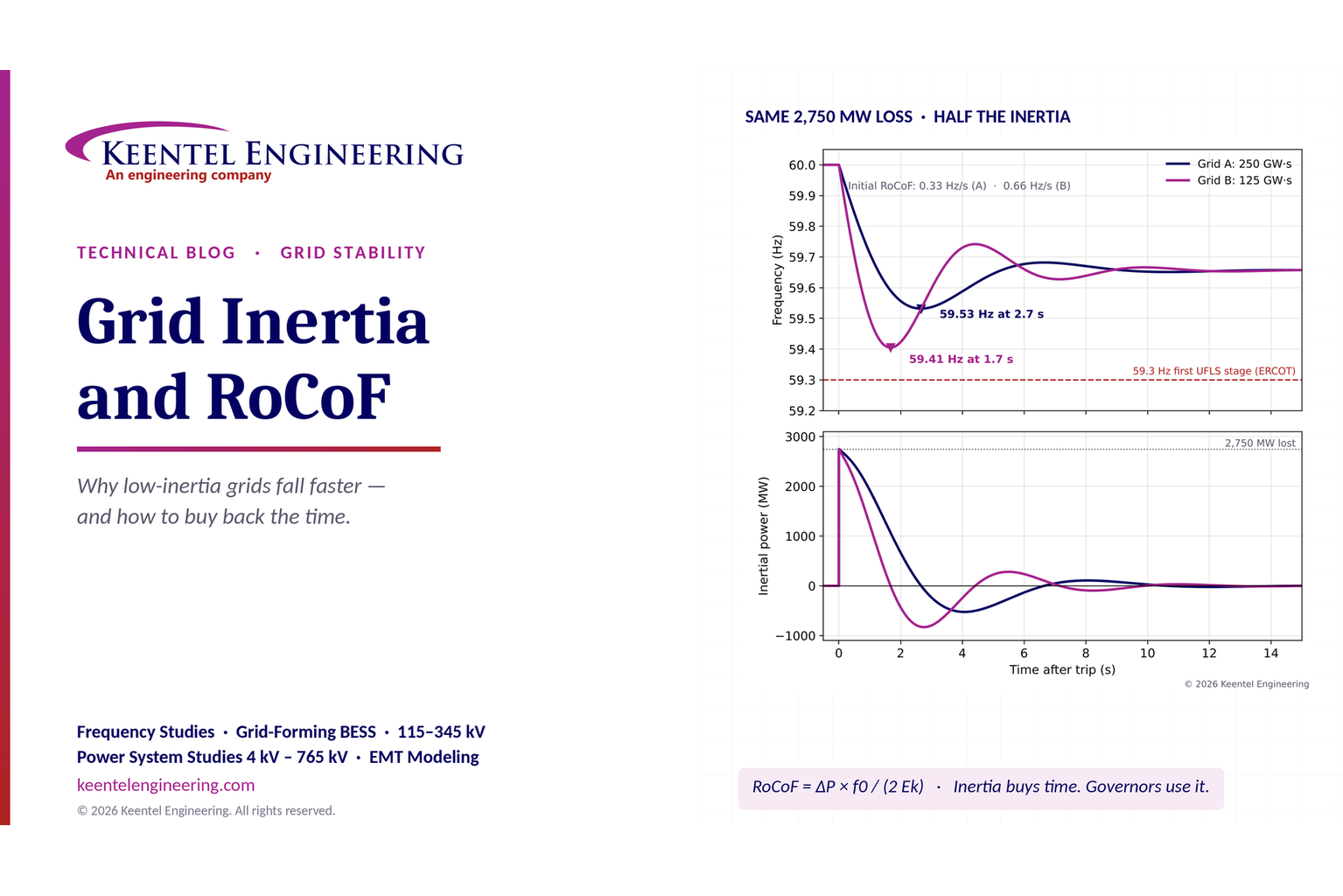
Explore grid inertia, RoCoF and frequency response, with swing equation calculations, frequency nadir analysis and US power system simulation examples.
By SANDIP R PATEL
•
October 10, 2026
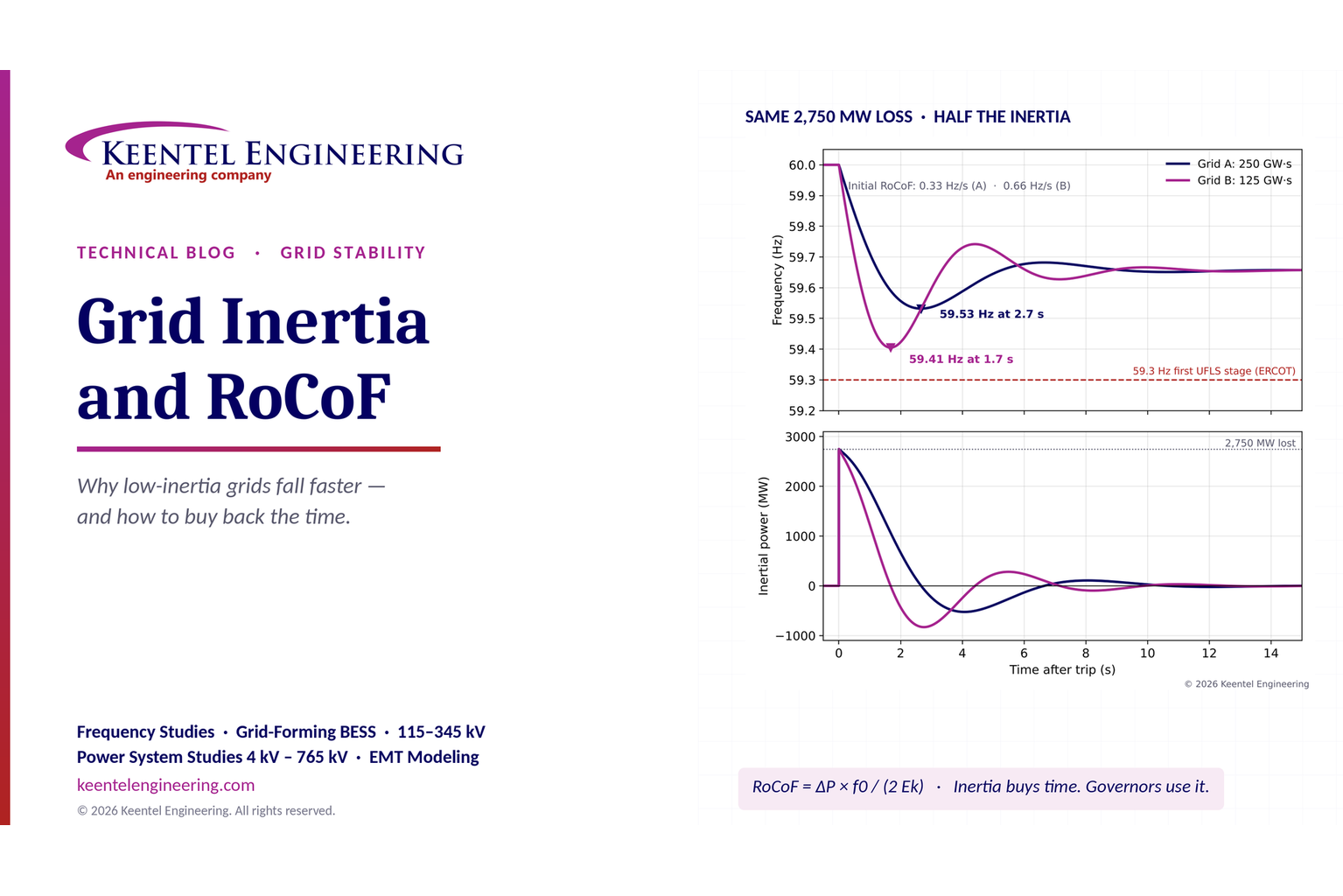
Learn how grid inertia affects RoCoF, frequency nadir and grid stability, with 2,750 MW simulation results, NERC standards and fast frequency response solutions.
By SANDIP R PATEL
•
October 10, 2026
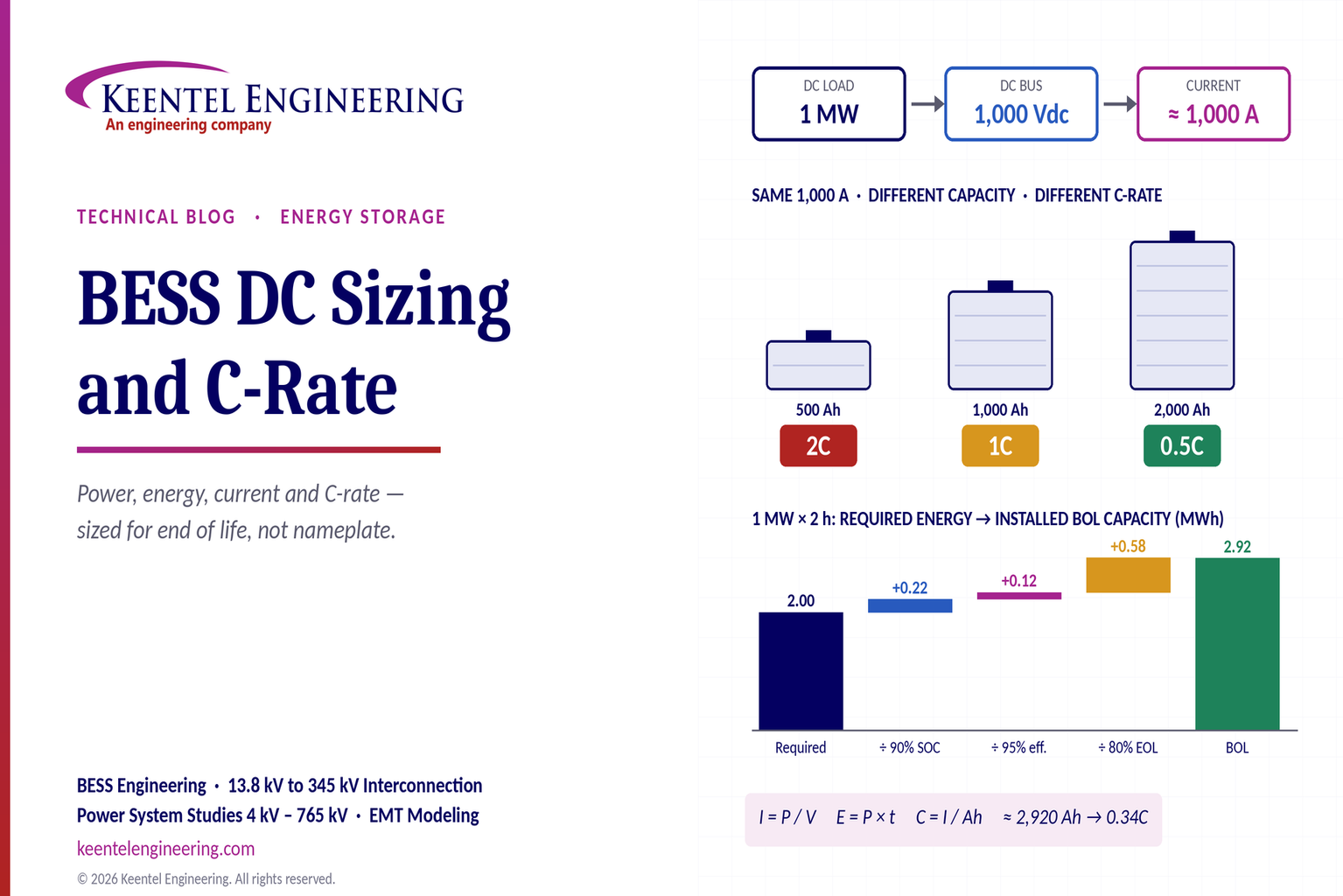
Learn BESS DC sizing with power, energy, current and C-rate calculations, battery losses, degradation and a 100 MW/400 MWh utility-scale example.
By SANDIP R PATEL
•
October 10, 2026
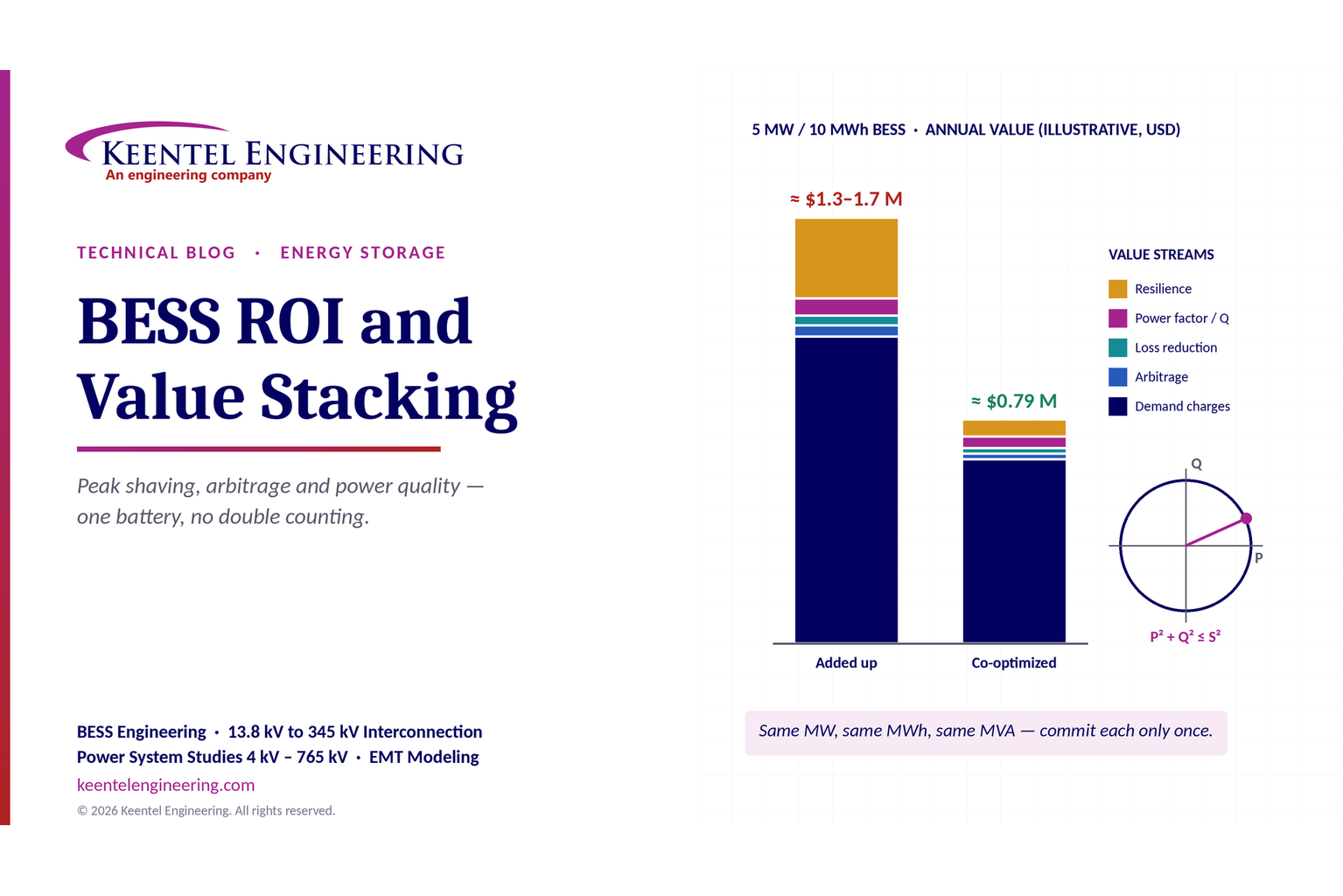
Learn how BESS ROI is calculated using peak shaving, energy arbitrage, power quality and battery storage economics, with a practical 5 MW/10 MWh example.
By SANDIP R PATEL
•
October 10, 2026
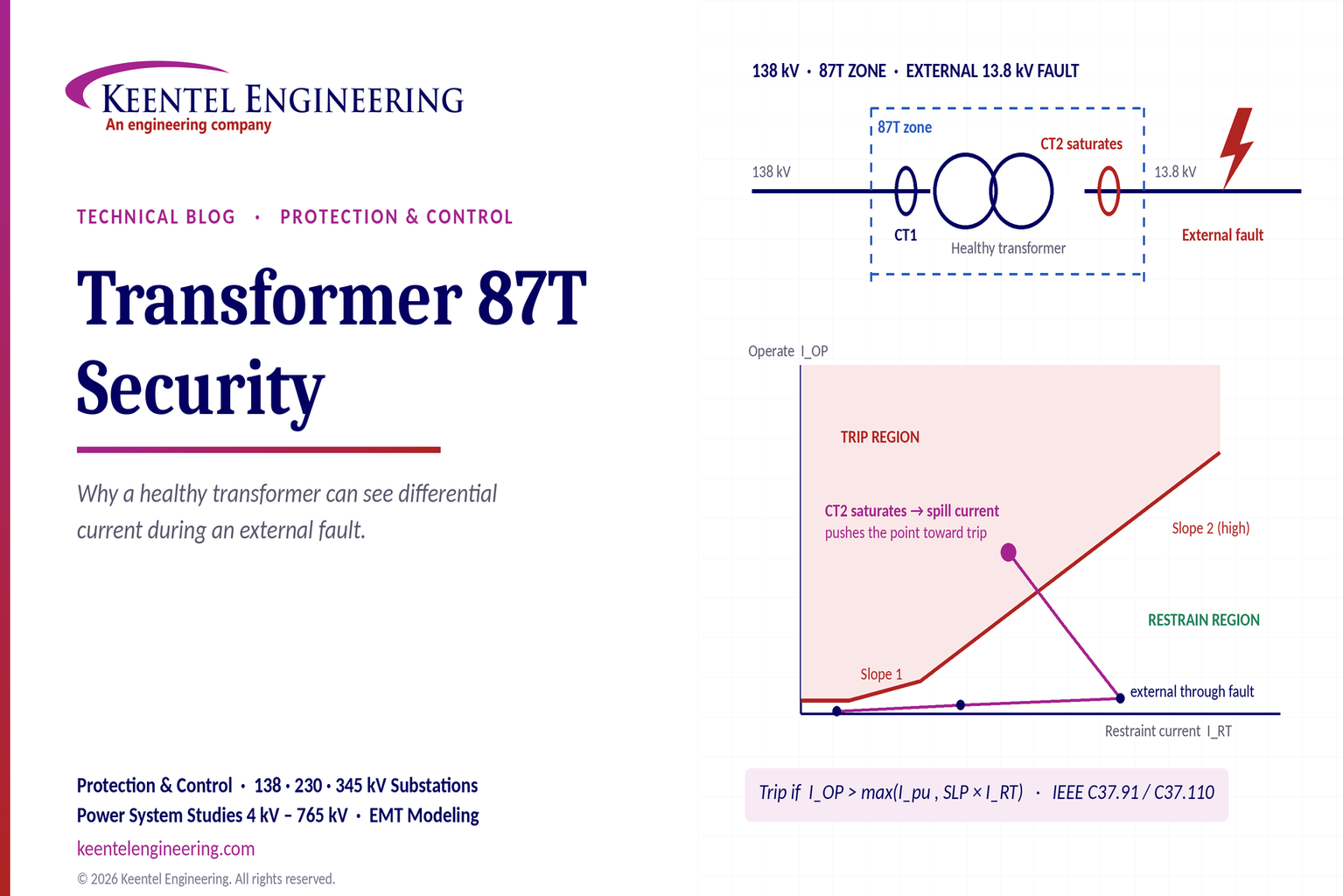
Learn why transformer differential relays detect current during external faults, how CT saturation causes spill current, and how secure 87T protection prevents trips.
By SANDIP R PATEL
•
October 10, 2026
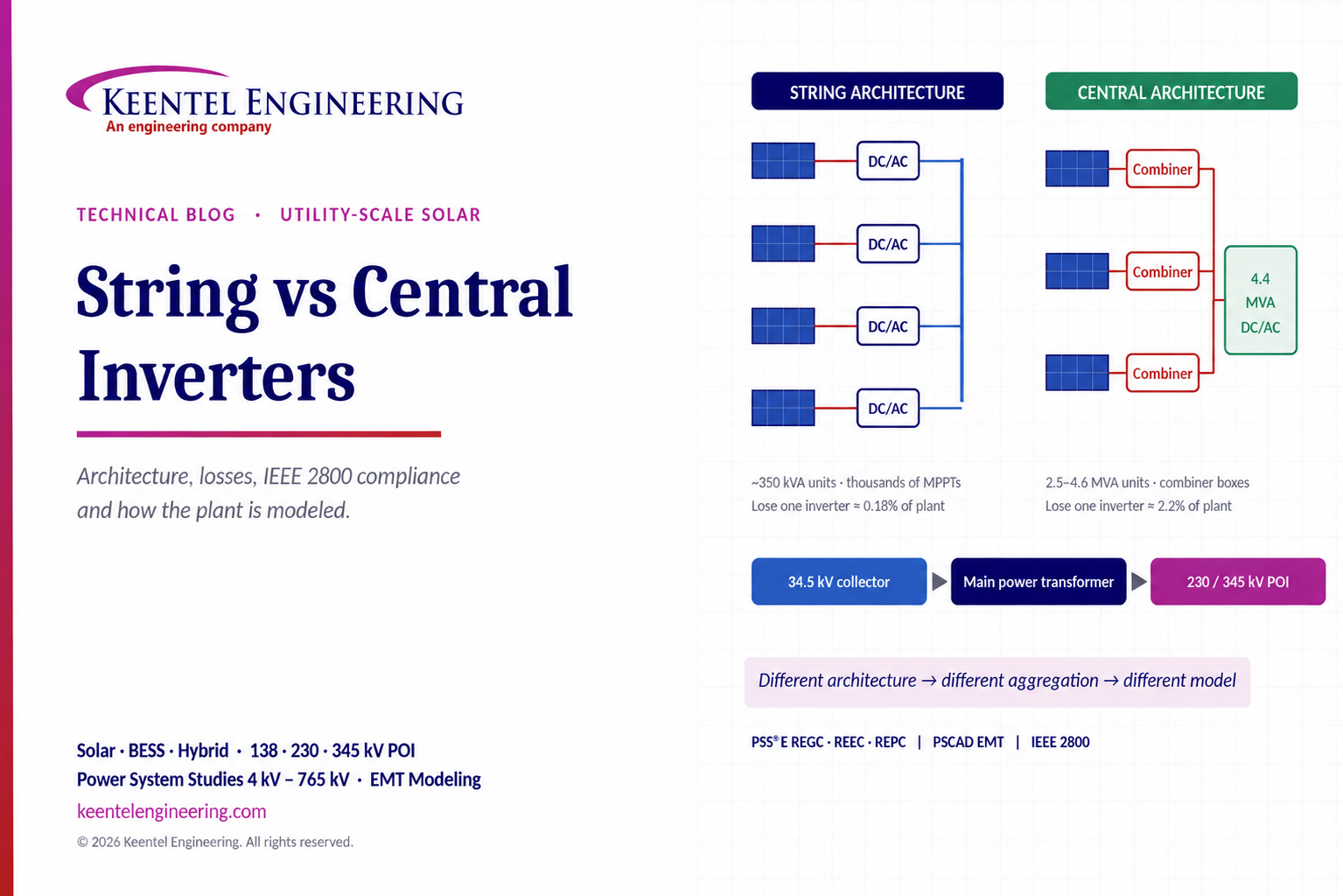
Compare string vs central inverters for utility-scale solar, including efficiency, maintenance, grid compliance, reactive power and interconnection studies.

By SANDIP R PATEL
•
October 9, 2026
Learn how insulator swing angle and conductor blowout affect transmission line ROW width, with NESC clearances, NERC FAC-003 guidance, and a 345 kV example.
Copy
By SANDIP R PATEL
•
October 3, 2026
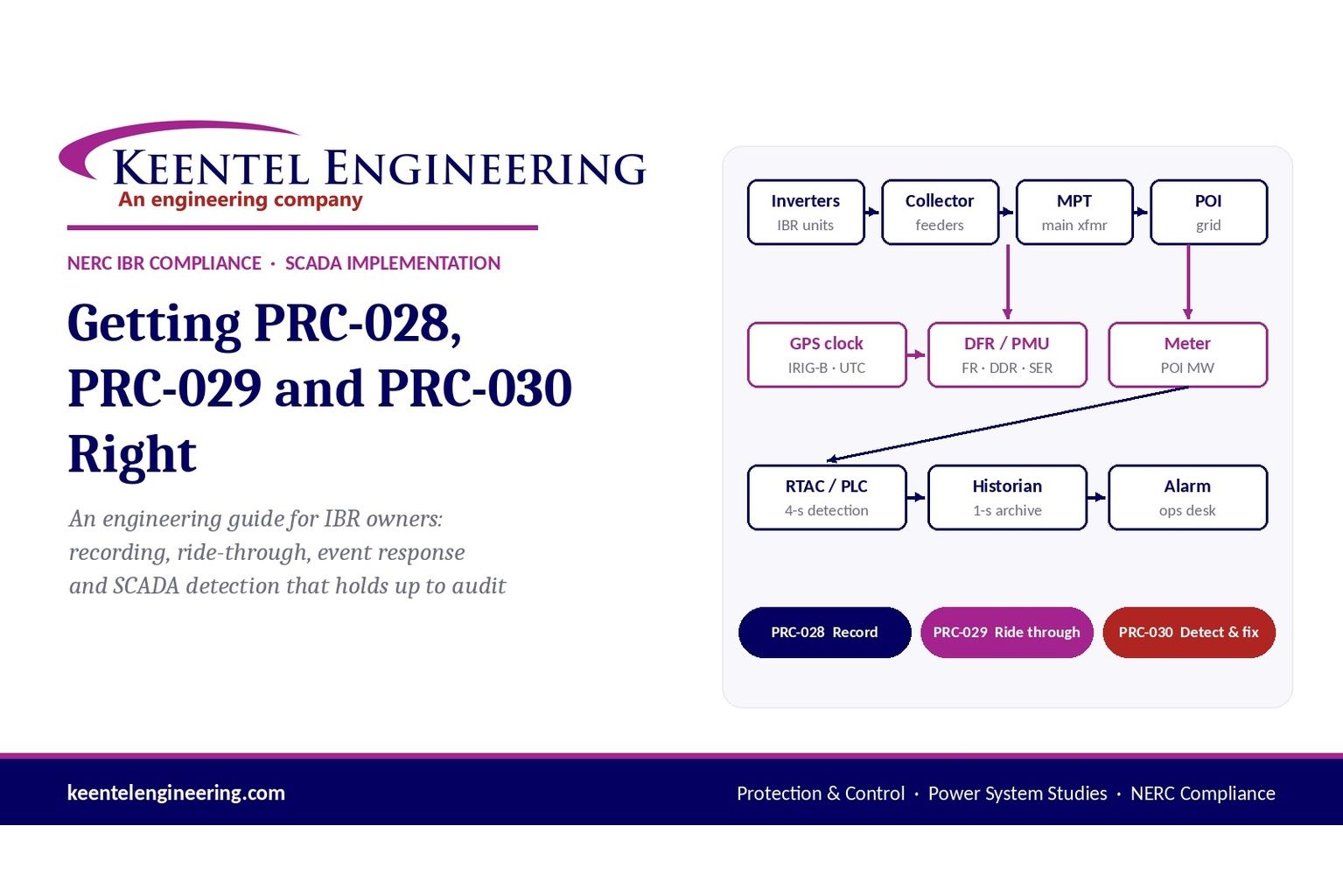
Engineering guide to PRC-028 disturbance recording, PRC-029 ride-through and PRC-030 event detection for inverter-based resources.
By SANDIP R PATEL
•
October 3, 2026
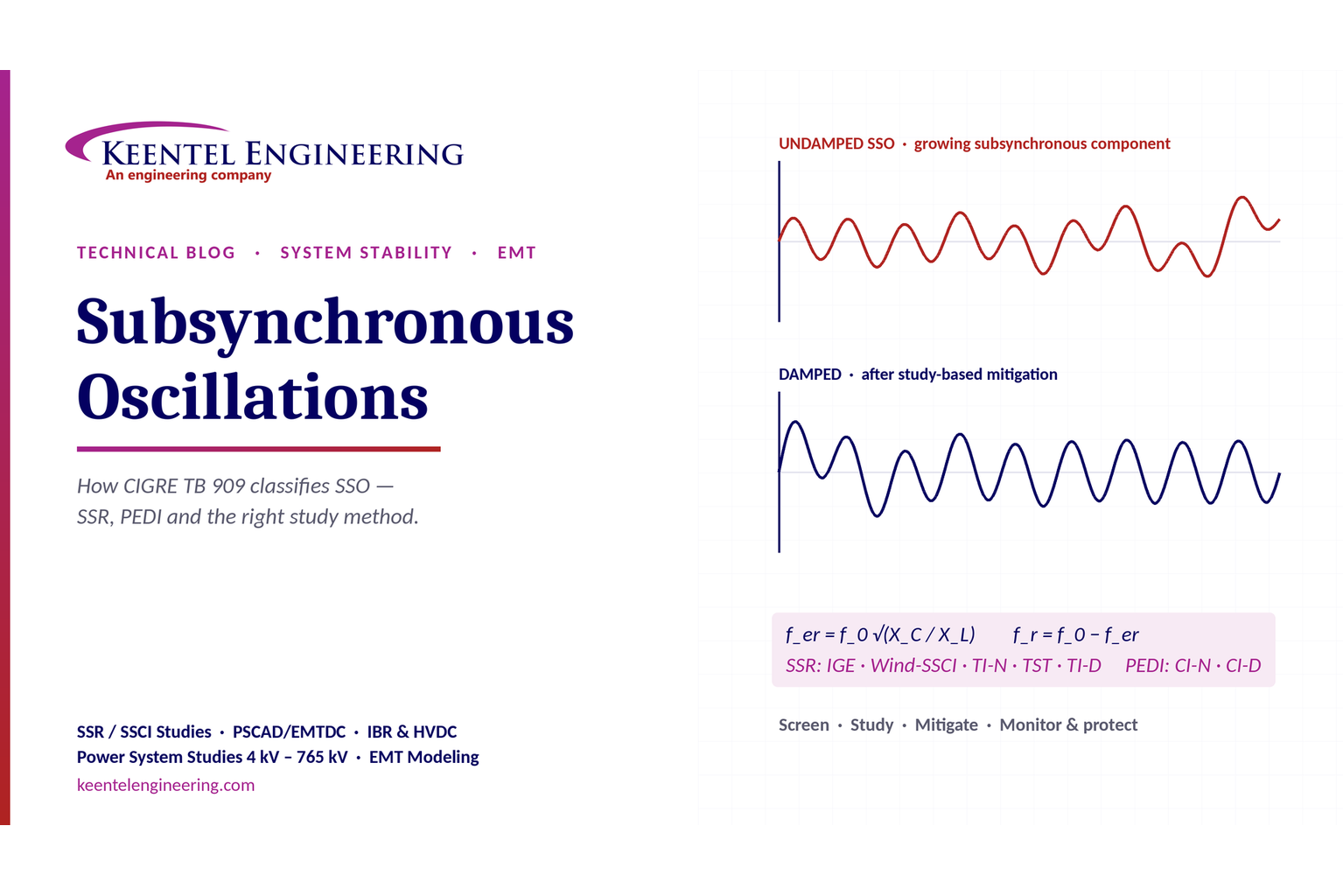
A practical guide to SSO classification, SSR, PEDI, Wind-SSCI, EMT analysis, mitigation and protection based on CIGRE TB 909.





