A Coordinated Electric System Interconnection Review—the utility’s deep-dive on technical and cost impacts of your project.
Challenge: Frequent false tripping using conventional electromechanical relays
Solution: SEL-487E integration with multi-terminal differential protection and dynamic inrush restraint
Result: 90% reduction in false trips, saving over $250,000 in downtime
ERCOT enforces all of the above through simulation, which means your model is your compliance case. The bar is now high:
- Whole-facility scope. The model must represent everything the IT load, the UPS and power conversion, the cooling plant, the protection and control systems in formats compatible with ERCOT's study platforms (PSS/E, PSCAD, TSAT).
- Real control loops, not approximations. Generic textbook representations are unacceptable. The model must capture the actual inner control behavior of your power electronics.
- Hardware-validated converter models. For electronic loads, the PSCAD model must be benchmarked against actual hardware testing including voltage ride-through and subsynchronous response. A model assembled from standard PSCAD library blocks fails by definition, because a generic block has never been tested against your vendor's hardware. The good news: validation is a hardware-type test, so results for a given converter product are reusable across every facility that uses it.
- Format migration. Facilities that previously submitted the older composite load model (CMLD) format must transition to EPRI's PERC1 format.
- Three checkpoints. Models are reviewed before the stability study begins (no model, no study), before each quarterly stability assessment, and for electronic loads one final time before energization, when you must submit as-built models with a documented comparison against the previously studied data and a sworn attestation that the model matches actual field settings. ERCOT's review takes 10 business days, extendable by 20 put it on your critical path.
- A living obligation. Change your technology, controls, or relay settings in a way that affects ride-through including converting a crypto mining site to an AI data center — and you've triggered a new interconnection study, even if your megawatts don't change.
| Parameter | Detail |
|---|---|
| System | 230 kV / 138 kV transmission corridors, wind and wet-snow icing exposure |
| Data basis | 15 years of minute-resolution forced-outage records + regional weather observations |
| Core methods | Event grouping, MVA performance curves, time-to-95%-restore, area outage rate curves, fragility modeling, rerun-history benefits, exceedance and log-domain risk metrics |
| Headline result | ≈85% of maximum resilience benefit at 60% of original capital; worst-event restoration window cut from 11 days to 5 in rerun-history terms |
| Decision supported | Capital portfolio selection; resilience plan filing; post-investment verification framework |
| System / Topic | Governing Standard(s) | What It Controls |
|---|---|---|
| Overall plant electrical distribution | IEEE 141 (Red Book); IEEE 666 | Distribution architecture, voltage selection, design of generating station auxiliary service systems |
| Power system studies | IEEE 399 (Brown Book); IEEE 551 | Load flow, symmetrical/asymmetrical short circuit, motor starting methodologies down to the lowest LV panelboard |
| Protection & coordination | IEEE 242 (Buff Book); IEEE 3004.5; IEEE C37 series | Generator relaying (21, 59N, 87G), time-current coordination, selective clearing between LV and MV tiers |
| GSU / UAT / SST transformers | IEEE C57.12.00 and C57 family | Transformer ratings, impedance, testing, loading |
| HV switchyard breakers | IEEE C37.06 | AC high-voltage circuit breaker preferred ratings |
| MV switchgear (13.8 kV) | IEEE C37.20.2; IEEE C37.20.7 | Metal-clad construction, compartmentalization, vacuum breakers; arc-resistant design with plenum venting |
| MV cable | UL 1072; ICEA S-93-639 (NEMA WC 74) | Type MV-105 shielded cable, 133% insulation level for HRG systems |
| LV switchgear (480 V) | IEEE C37.13; UL 1558 | Metal-enclosed LV power circuit breaker switchgear to 635 V, draw-out ACBs with electronic trip units |
| Motor control centers | UL 845; NEMA ICS 18 | LV-MCC construction, MCCB/MCP protection for motors under ~200 HP |
| Motors | NEMA MG-1 | Motor performance, starting characteristics, service factors |
| DC & battery systems | IEEE 485; IEEE 946 | Lead-acid battery sizing (125/250 VDC), DC auxiliary system design |
| Grounding | IEEE 80; IEEE 142 (Green Book) | Ground grid step/touch potential limits; system grounding including high-resistance grounding |
| Lightning protection | IEEE 998 | Direct-stroke shielding of switchyard and outdoor generator structures |
| Arc flash & electrical safety | IEEE 1584; NFPA 70E | Incident energy calculation; worker safety boundaries and PPE |
| Fire protection | NFPA 850 | Fire protection and risk management for combustion turbine generating plants |
| Installation code | NEC (NFPA 70); NESC | Wiring methods inside the plant fence; overhead/outdoor clearances at the switchyard |
| Interconnection & compliance | FERC LGIP; NERC MOD-025/026/027, PRC-019/024/029, FAC-008 | Interconnection process, model validation, protection/ride-through coordination, facility ratings |
| IFC / Construction Deliverable | Purpose |
|---|---|
| Stamped IFC packages | Legal basis for construction; P.E. responsible charge |
| Final relay settings & TCCs | Protection as-installed matches the coordination study |
| Calculation archive | Owner records; NERC audit evidence trail |
| Commissioning procedures | Safe, sequenced energization; MOD field testing |
| Construction support | RFIs, field changes, FAT/SAT witness |
| As-builts & model handoff | Operating baseline; future study currency |
| Metric | Outcome |
|---|---|
| Defects found pre-occupancy | Three topology defects and one settings-mismatch family corrected before load migration; the shared-switchboard defect alone would have invalidated the concurrently-maintainable claim on day one |
| IST findings | Fourteen additional discrepancies surfaced under scenario testing (control logic, alarm mapping, one generator sequencing fault) — all closed before handover instead of during operations |
| Black-building test | Passed on second execution; the first attempt exposed the generator sequencing fault under true block load, exactly the failure the compressed plan would never have found |
| Handover quality | Operations team certified on the actual failure scenarios; corrected EOPs and settings documentation delivered as controlled documents |
| Business outcome | Occupancy proceeded three weeks behind the original date — against an independent estimate that the uncorrected sequencing fault carried a high probability of a full facility outage within the first year |
Part 2 — Frequently Asked Questions: Large Load Interconnection
An electric grid must remain in continuous balance — generation onto the grid must equal consumption from it at every instant. PJM achieves this balance, and prices it, through a layered market architecture. Each layer operates on a different time horizon, and each one touches project economics differently.
| Domain | Key Standards / Codes | What They Govern |
|---|---|---|
| Fire safety | NFPA 855; UL 9540 / UL 9540A | Installation requirements, separation, gas management; system safety listing and thermal-runaway fire testing |
| Grid interconnection | IEEE 1547 (distribution); IEEE 2800 (transmission IBRs) | Ride-through, reactive capability, power quality, and performance at the point of interconnection |
| Power quality | IEEE 519 | Harmonic distortion limits at the PCC |
| Protection & grounding | IEEE 80 / 81 / 142; C37 series | Grounding system design and testing; protective relaying |
| Reliability compliance | NERC standards (incl. PRC ride-through requirements) | Registered-entity obligations for grid-connected storage |
PRC-029-1 : Deadlines, the Bottleneck and the Discretion
September 01, 2026 | Blog
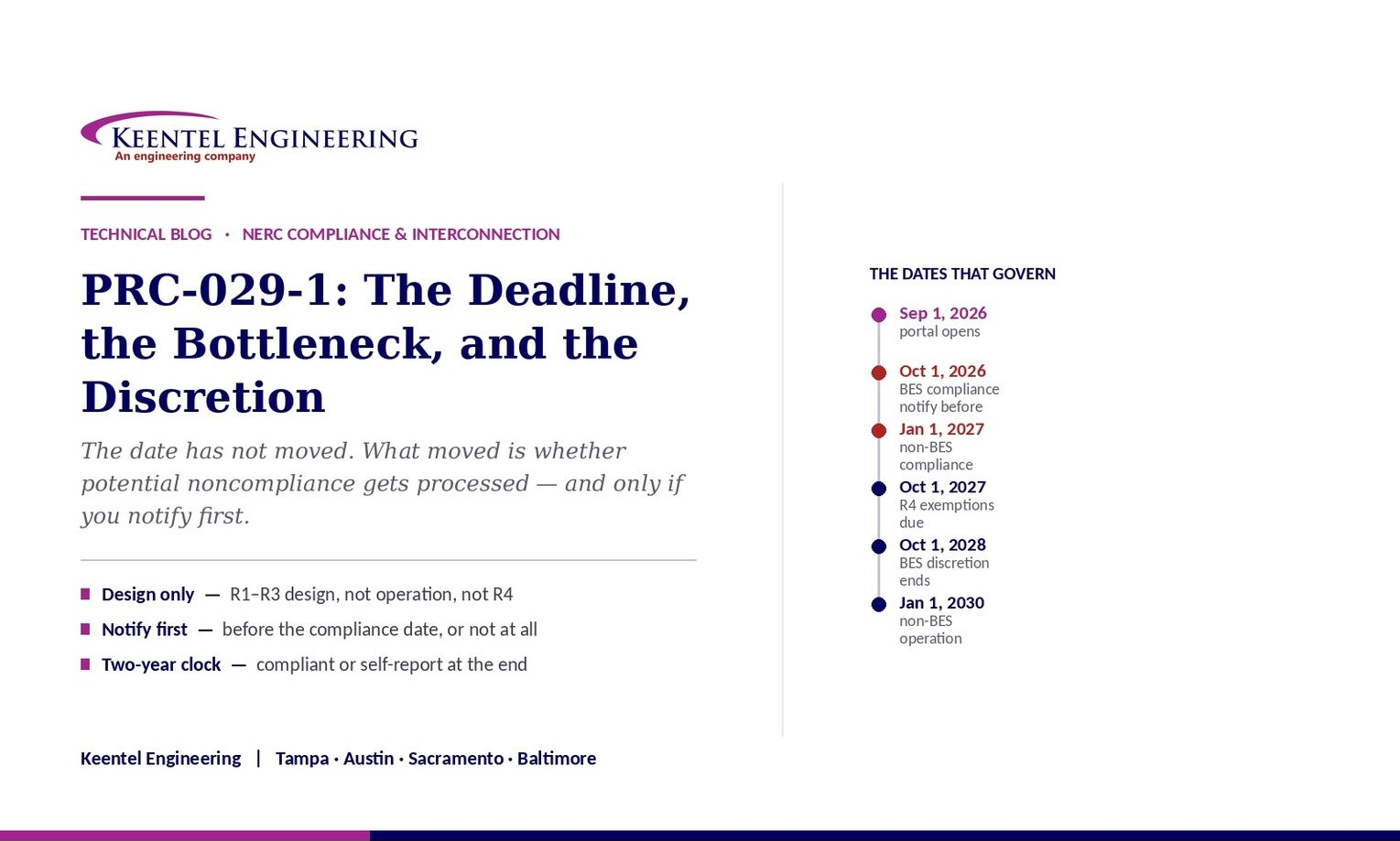
The date has not moved. What moved is whether potential noncompliance gets processed — and only if you notify first.
1. Executive Summary
PRC-029-1 takes effect on October 1, 2026. It is the standard that finally attaches enforceable frequency and voltage ride-through performance requirements to inverter-based resources, closing a reliability gap that a decade of disturbance reports had documented and that the previous protection-settings standard was never designed to close.
The industry has run into a practical wall on the way to that date. The requirements are not settings a Generator Owner can enter. They live inside inverter firmware, they are proprietary, and in most cases only the original equipment manufacturer or an authorised vendor can implement them. The vendor pool is small, the work usually requires a scheduled outage, and outages are hardest to obtain in exactly the season when the deadline falls. Many owners who started early cannot get on a schedule that lands before the compliance date.
The ERO Enterprise has responded with a Compliance Monitoring and Enforcement Program practice guide, issued in August 2026, describing when enforcement discretion may be applied to potential noncompliance with the design aspects of Requirements R1 through R3. In plain terms: an owner who genuinely sought vendor resources and could not secure them before the compliance date may find that the potential noncompliance is not processed at all. That is a broader form of relief than the familiar compliance exception or find-fix-track-and-report treatments.
It is also conditional, narrow, and time-limited, and the conditions are where projects will succeed or fail. The relief covers design only, not operation. It requires notification to the Regional Entity before the compliance date, not after. In the Western Interconnection the submission window opened on September 1, 2026 with submittals requested by October 1, 2026 — a window measured in weeks, not quarters. And the whole pathway terminates twenty-four months after the applicable design compliance date, at which point an owner is either compliant or filing a self-report.
This paper works through what the standard requires, how the implementation plan divides the population by in-service date and by Bulk Electric System status, what the discretion pathway does and does not cover, what the submission asks for, what makes a narrative credible, and what an owner should be doing in the weeks that remain. It closes with a twenty-five question FAQ.
The one sentence that decides eligibility
Notification to the Regional Entity must occur before the applicable compliance date.
An owner who discovers the problem in November and calls in December has not missed a filing deadline — they have missed the condition on which the entire pathway rests. There is no retroactive notification.
2. Two Documents, Two Different Jobs
Two distinct instruments are in play, and conflating them produces confusion about what is binding.
The Implementation Plan is part of the standard. It establishes when each requirement becomes enforceable for each category of resource, sorted by in-service date and by whether the resource is part of the Bulk Electric System. It is not discretionary and it is not guidance. Where any summary, presentation, or article conflicts with it, the standard and its implementation plan govern — a point the practice guide itself makes in a footnote.
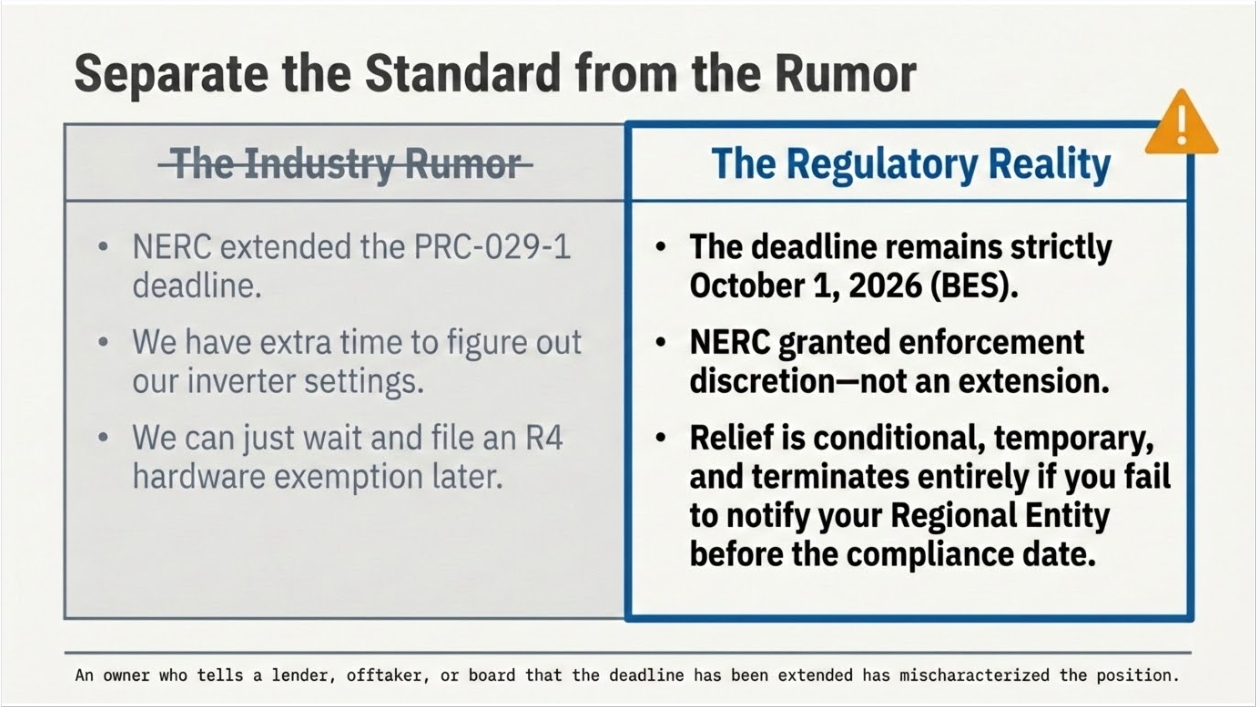
The CMEP Practice Guide is guidance developed by the ERO Enterprise for its own compliance monitoring and enforcement staff. It reflects the independent professional judgment of that staff and is published for transparency. It does not change the standard, does not extend any compliance date, and does not create a right. It describes circumstances under which enforcement staff may exercise discretion, and registered entities read it to understand how their situation is likely to be evaluated.
The distinction matters commercially. An owner who tells a lender, an offtaker, or a board that the deadline has been extended has mischaracterised the position. The deadline has not moved. What exists is a documented basis on which enforcement staff may decline to process a potential violation, subject to conditions the owner must satisfy in advance.
3. What PRC-029-1 Actually Requires
The standard applies to Generator Owners of registered inverter-based resources and expresses its requirements at the high side of the main power transformer.
- Requirement R1 obliges the Generator Owner to ensure that design and operation are such that each resource meets or exceeds the ride-through requirements defined by the must-ride-through zone in the standard’s attachment. It carries defined exception conditions: where the resource had to disconnect to clear a fault; where voltage went outside an accepted hardware limitation recognised under R4; where a positive-sequence voltage phase angle change beyond a defined threshold was initiated by a non-fault switching event on the transmission system; and where volts-per-hertz exceeded defined magnitudes for defined durations.
- Requirement R2 addresses voltage performance during a voltage excursion, with subparts covering current injection behaviour, reactive and active power prioritisation, permitted behaviour within the permissive zone, and the timing of return to pre-disturbance output after voltage recovers.
- Requirement R3 addresses frequency ride-through, recognising that inverter-based resources contribute no inherent inertia, with a wider window and defined behaviour across rate-of-change-of-frequency conditions.
- Requirement R4 is the exemption pathway for resources in service by the effective date that have known hardware limitations preventing them from meeting R1 through R3, requiring documented technical justification.
The companion standards matter too. The synchronous-machine provisions were retained in a revised protection-settings standard, while the inverter-based performance requirements moved here. Disturbance monitoring obligations for inverter-based resources sit in a separate standard and, as Section 4 explains, the operational side of this standard is deliberately tied to that monitoring capability. Post-disturbance performance analysis sits in a third standard effective on the same date.
4. The Design and Operation Split
The pivot on which the entire enforcement discretion pathway turns is the distinction the standard draws between capability-based and performance-based elements — in practice, between design and operation.
The design element is the physical implementation and configuration of ride-through settings on active units. It is a thing the owner causes to happen, at a point in time, with vendor support and usually an outage. It is verifiable by inspecting the settings actually loaded.
The operation element is the resource’s actual behaviour during real disturbances. It cannot be demonstrated on demand, because it requires disturbances to occur and requires recorded evidence of what the plant did. That is why the implementation plan ties the operational obligation for the existing fleet to the availability of disturbance monitoring capability under the companion monitoring standard, rather than to a fixed calendar date.
The enforcement discretion pathway applies to the design aspects of R1 through R3 only. It is not a general amnesty on ride-through performance, and it does not touch the operational obligation, the monitoring obligation, or R4.
Why the split is the right one to have made
Design is within the owner’s control except for the vendor bottleneck. Operation is a consequence of design plus the grid’s behaviour.
Granting discretion on the design element addresses a supply constraint the industry genuinely has. Granting it on the operational element would have suspended the reliability outcome the standard exists to produce.
5. The BES Compliance Calendar
For resources that are part of the Bulk Electric System, the implementation plan divides the population by in-service date.
| Resource category | R1–R3 design | R1–R3 operation | R4 |
|---|---|---|---|
| In operation before April 1, 2025 | 100% of units by October 1, 2026 | Met as disturbance monitoring capability becomes available, per the companion monitoring standard’s implementation plan | 100% of units by October 1, 2026 |
| In operation after April 1, 2025 and on or before July 31, 2026 | Design and operation, 100% of units by October 1, 2026 | Same date as design | 100% of units by October 1, 2026 |
| In operation after July 31, 2026 | Design and operation, 100% compliant on October 1, 2026 or the commercial operation date | Same date as design | Limited to units in service by October 1, 2026 |
Two features are worth drawing out. First, the fleet that has been in service longest gets the most relief on the operational side, because its operational obligation is paced by monitoring capability rather than by the calendar — but it gets no relief at all on design. Second, a resource reaching commercial operation after the effective date has no transition period whatsoever: it must be compliant at commercial operation. A project commissioning now is building to the standard, not migrating to it.
Separately, hardware exemption submittals under R4 for facilities with a commercial operation date before the standard’s effective date are due by October 1, 2027, for both Bulk Electric System and non-Bulk Electric System resources.
6. The Non-BES Compliance Calendar
Resources that fall outside the Bulk Electric System definition but are within the standard’s applicability follow a parallel structure on a later calendar, with one substantial difference on the operational side.
| Resource category | R1–R3 design | R1–R3 operation | R4 |
|---|---|---|---|
| In operation before May 15, 2026 | 100% of units by January 1, 2027 | 100% of units by January 1, 2030 | 100% of units by January 1, 2027 |
| In operation after May 15, 2026 and on or before July 31, 2026 | Design and operation, 100% of units by January 1, 2027 | Same date as design | 100% of units by January 1, 2027 |
| In operation after July 31, 2026 | Design and operation, 100% compliant on January 1, 2027 or the commercial operation date | Same date as design | Limited to units in service by October 1, 2026 |
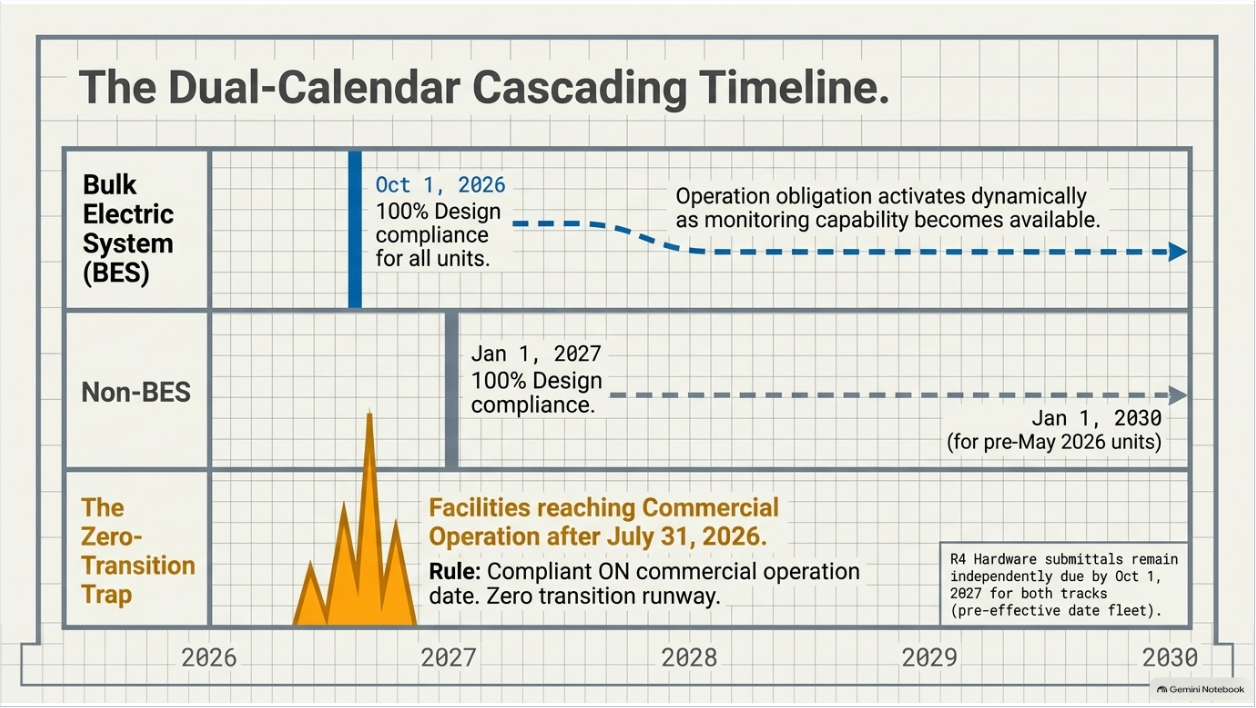
The three-year operational runway to January 1, 2030 for the existing non-Bulk Electric System fleet is the single largest accommodation anywhere in the implementation plan. It should not be read as three years of general relief: the design obligation still lands on January 1, 2027, and design is the part that requires the vendor.
7. R4 and the Hardware Exemption Pathway
Requirement R4 is often confused with the enforcement discretion pathway. They are different instruments addressing different problems, and an owner can need one, the other, both, or neither.
R4 is part of the standard. It provides a route for a resource that was in service by the effective date and has a genuine hardware limitation — something that cannot be resolved through software or settings changes — to be excused from meeting specific ride-through criteria. It requires documented technical justification, and the regulatory direction underlying the standard contemplated technical evidence beyond a manufacturer’s damage curve alone. It is a permanent, standard-based accommodation for equipment that physically cannot comply.
Enforcement discretion is not part of the standard. It is a monitoring and enforcement posture toward an owner who can comply and intends to, but could not get the work done in time because the vendor was unavailable. It is temporary and it terminates.
The practical distinction: if the inverter can accept the settings but nobody is available to load them, that is a discretion conversation. If the inverter physically cannot achieve the required performance regardless of settings, that is an R4 conversation. Mislabelling one as the other wastes the window on both.
8. Why the ERO Created Discretion
The practice guide is unusually candid about the constraint, and understanding the reasoning helps an owner frame a submission that speaks to it.
- The vendor pool is limited. There are relatively few inverter manufacturers and authorised vendors servicing the installed base, and the entire North American fleet needs the same work in the same window.
- The settings are proprietary. Generator Owners generally do not hold intellectual property rights to the inverter firmware, do not have access to the configuration software, and do not have the specialised expertise to implement internal inverter settings. This is not a staffing decision the owner can reverse by hiring.
- Outages are constrained. Implementation typically requires the units to be out of service, and generator outages are restricted during peak demand periods and under certain grid conditions — which frequently means the season immediately before the compliance date is the hardest time to obtain one.
The guide also records that multiple registered entities independently verified that setting modifications require direct vendor support. That verification is what moved this from an assertion by industry to a finding by the ERO Enterprise, and it is why the reasoning is framed as an industry-wide constraint rather than an individual entity’s failure to plan.
9. The Reliability Argument Against Rushing
The most engineering-relevant passage in the practice guide is the one explaining why forcing the deadline would have been the wrong answer on reliability grounds, not merely on fairness grounds.
Ride-through settings implemented without adequate manufacturer or vendor support introduce risk to the bulk power system. Incorrectly applied settings that were never validated by the manufacturer can cause equipment failure or unexpected tripping during grid disturbances — which is precisely the outcome the standard was written to prevent. A fleet that rushed unvalidated settings into service to meet a date could plausibly perform worse during the next system event than the fleet that missed the date.
That reasoning is worth carrying into every internal conversation about this deadline. The correct objective is a resource that actually rides through, evidenced by validated settings and by recorded performance. A settings file loaded by an unqualified party to satisfy an auditor is not that, and the ERO Enterprise has said so in writing.
10. What Enforcement Discretion Is — and Is Not
| It is | It is not |
|---|---|
| A posture toward potential noncompliance with the design aspects of R1, R2 and R3 | An extension of the compliance date, or a change to the standard |
| Potentially broader than a compliance exception or find-fix-track-and-report — it may involve no processing of the potential noncompliance at all | A guarantee. The guidance is permissive: staff may consider it, on the facts |
| Conditional on the entity having sought, and been unable to secure, manufacturer or vendor resources before the applicable design compliance date | Available to an entity that did not attempt to engage a vendor, or that cannot evidence the attempt |
| Conditional on notification to the Regional Entity before the compliance date | Available retroactively after the date has passed |
| Overseen by NERC, with regional submissions forwarded for review | A regional-only determination |
| Time-limited, ending twenty-four months after the applicable design compliance date | Open-ended, or renewable by default |
| Applicable to design only | Applicable to the operational requirements, the disturbance monitoring standard, or the R4 exemption process |
11. Notification Before the Compliance Date
Everything else in this pathway is recoverable. This condition is not.
The requirement is that the registered entity notify its Regional Entity prior to its compliance date. For Bulk Electric System resources that date is October 1, 2026. For non-Bulk Electric System resources it is January 1, 2027. In the Western Interconnection the submission portal opened on September 1, 2026, and submittals are requested by October 1, 2026.
Read those dates together and the operational reality becomes clear. An owner of Bulk Electric System resources in the West has a submission window of roughly one month, opening the day after this paper’s publication date and closing on the compliance date itself. An owner who has not yet determined whether any of its units will miss the date has a diagnostic problem to solve in weeks.
The corollary is that the analysis has to be done now even where the answer is uncertain. An owner with a vendor commitment that might slip is better served by notifying and later reporting that the work completed on time than by not notifying and discovering in October that the vendor moved the date.
12. The Submission Process
The Western Interconnection process runs in three stages, and the entity controls only the first.
- The entity submits. A form on the Regional Entity’s website captures each generation site for which discretion is sought. The information routes to a secure file transfer environment rather than being posted publicly.
- Regional review. A preliminary screen for completeness, then review by enforcement staff, then review and acceptance by enforcement management. A request for information may arrive at any point in the process.
- NERC review. Accepted requests are forwarded monthly. NERC reviews and either accepts or requests further information, and the Regional Entity notifies the entity of the outcome.
Two mechanical points are easy to miss. One submission is made per registered entity identification number, listing each applicable unit — not one submission per unit. And where an entity is under coordinated oversight, the multi-region registered entity coordinator submits to the lead region rather than the entity submitting to each region separately.
13. What the Submission Asks For
The template has two layers: entity-level information and a per-unit inventory. The per-unit layer is where most of the preparation effort sits, and several fields require data an owner may not have assembled before.
| Field | What it wants | Where owners get caught |
|---|---|---|
| Registered entity name | Exactly as it appears in the compliance registry | Corporate names drift after financing events and portfolio transfers; the registry name and the operating name often differ |
| Registry identification number | The compliance registry number, using the lead region number where under coordinated oversight | Portfolios registered under multiple numbers must resolve which applies before submitting |
| Date of notification | The date the entity notified the region — which must precede the compliance date | This is the eligibility gate, and it is a field on the form |
| Resource name, city, state | Per unit, using the asset inventory name where possible | Inconsistency between asset inventory names, interconnection agreement names, and market resource identifiers |
| Resource type | Whether the resource is Bulk Electric System or not | Determines which compliance date and which calendar applies; misclassification invalidates the rest of the row |
| Commercial operation date | Per unit | Dates on or after the effective date may not be eligible, and a date past the effective date will prompt a regional conversation about the facts |
| Capacity in MVA | Per unit; where only part of a facility is affected, the total facility capacity with the affected portion explained in the narrative | Partial-facility situations are common and are handled in the narrative, not by adjusting the capacity figure |
| Planned setting implementation date | The planned field implementation date, or an honest to-be-determined where none exists | An invented date is worse than an honest unknown, because it becomes the benchmark the entity is measured against |
| Manufacturer | The majority manufacturer at the site, with others identified in notes | Mixed-manufacturer sites need the notes field used properly |
| Vendor documentation narrative | A description of interactions, agreements and contracts that have occurred or are planned, with supporting material available on request | This is the substance of the submission and the part most often written thinly |
14. What Makes a Strong Narrative
The guidance asks the entity to tell the story of the issue or delay, structured around three questions: what is the problem, what has been done so far, and what is the plan going forward. That structure is worth following literally.
14.1 What Is the Problem
State the constraint specifically and attribute it correctly. A vendor whose earliest availability is a named month in 2027 is a different problem from a vendor that has not responded, which is different again from a manufacturer that has ceased trading, which is different from a software platform that is no longer supported. Each has a different remedy and a different credible timeline, and the reviewer is looking for a constraint that is real and external rather than a scheduling preference.
14.2 What Has Been Done
This is where the submission is won or lost. The reviewer is explicitly seeking to understand the communication between the entity and the manufacturer or vendor. Dated contact records, the number of manufacturers approached, the methods used, signed agreements with dates, outage requests submitted and their disposition, and any contract naming an implementation date all belong here in summary form, with the underlying material retained and available on request. An entity that began engaging vendors a year ago and can show it presents very differently from one that made a single call in September.
14.3 What Is the Plan
Provide a best estimate of when compliance will be achieved, and make it defensible. A date supported by a signed agreement is strong. A date supported by a vendor’s verbal indication is weaker but honest. No date at all, accompanied by a described plan of action to obtain one, is acceptable where that is the truth. What does not work is a date chosen because it sounds acceptable, because the entity will be measured against it and the process for submitting updates is still being developed.
Two practical instructions from the guidance
Where only part of a generation facility is affected, put the total facility capacity in the capacity fields and explain the affected portion in the narrative rather than adjusting the number.
Maintain the supporting evidence. The narrative is a summary; the Regional Entity may ask for the underlying correspondence, contracts, and outage records later.
15. Circumstances That May Qualify
The outreach material illustrated the kinds of circumstance that may support a request. They group into three categories, and the grouping is useful because it tells an owner which facts to assemble.
| Category | Illustrative circumstance | What the evidence needs to show |
|---|---|---|
| Resource availability | The entity approached a vendor before the compliance date and the vendor’s earliest availability falls in the following year, so the work was scheduled for that slot | Dated contact, the vendor’s stated availability, and the scheduled date |
| Resource availability | The original equipment manufacturer has ceased trading, and the entity is seeking an alternative vendor able to implement the settings | Evidence of the attempt to engage before the date, and the plan to identify and engage an alternate |
| Resource availability | The entity contacted a vendor repeatedly before the date and received no response, so no implementation date exists | The record of repeated contact and a documented plan of action to keep pursuing it |
| Resource availability | The vendor no longer supports the installed software, requiring an update or new purchase before settings can be implemented | The vendor’s statement and the resulting implementation plan |
| Outage availability | Vendor resources were available before the date but the required outage was not approved, so the work moved to a later window when both align | The outage request, its disposition, and the rescheduled date |
| Vendor consideration | A third party could implement the settings, but doing so may void maintenance or warranty coverage, and the manufacturer has not responded to the enquiry | The enquiry to the manufacturer, the warranty concern, and the fallback plan to schedule with the manufacturer |
The common thread across all six is that the entity acted before the compliance date, the obstacle was external, and there is a plan. An owner whose facts do not contain those three elements should be candid with itself about that before submitting.
16. The Twenty-Four Month Clock
Enforcement discretion under this guidance terminates twenty-four months after the applicable design compliance date. That produces two hard dates.
- October 1, 2028 for Bulk Electric System inverter-based resource facilities.
- January 1, 2029 for non-Bulk Electric System inverter-based resource facilities.
On those dates the position is binary: be compliant, or file a self-report. There is no third option and no indication that the pathway renews. Two years is a substantial runway, and it is also exactly the sort of runway that gets consumed by other priorities until it is a quarter.
The right way to treat it is as a project with a fixed end date and a defined deliverable, tracked at the same level as any other capital commitment: vendor engaged under contract, outage secured, settings implemented and verified against the standard’s attachments, evidence retained, and the compliance position closed out before the clock expires.
17. What Discretion Does Not Cover
The scope is narrow and the boundaries are worth stating explicitly, because an owner who assumes broader coverage will be exposed on the items outside it.
- It covers the design aspects of R1, R2 and R3. It does not cover the operational aspects of those requirements.
- It does not cover R4. Hardware exemption submittals remain due on their own schedule.
- It does not cover the disturbance monitoring standard, whose obligations run on their own implementation plan and which the operational side of this standard depends upon.
- It does not cover the post-disturbance performance analysis standard effective on the same date.
- It does not cover modelling obligations. The consolidated model verification and validation standard requires updated models after changes affecting dynamic response — and implementing ride-through settings is exactly such a change.
- It does not cover facilities reaching commercial operation on or after the effective date, which may not be eligible and will at minimum prompt a factual enquiry from the Regional Entity.
- It does not relieve any obligation to have a compliance programme, retain evidence, or respond to requests for information.
18. An Action Plan by Situation
18.1 If You Own BES Inverter-Based Resources and Have Not Assessed Them
This is the urgent case. Within days, establish for each unit whether the required ride-through settings are implemented, whether a vendor is engaged, and whether an implementation date exists that falls before October 1, 2026. Where the answer is no or unknown, notify the Regional Entity and prepare the submission. Uncertainty is a reason to notify, not a reason to wait.
18.2 If You Have a Vendor Commitment That Might Slip
Notify anyway. The cost of notifying and then completing on time is a withdrawn or unused submission. The cost of not notifying and then slipping is the loss of the entire pathway, permanently, for those units.
18.3 If Your Units Are Non-BES
The compliance date is January 1, 2027 and the notification must precede it. The additional quarter is real but it is not large, and the same vendor constraint applies to a population that is often lower priority in a vendor’s queue. Assess now on the same basis and plan the notification.
18.4 If You Believe You Have a Hardware Limitation
That is the R4 pathway, not this one, and it needs technical documentation demonstrating that the limitation cannot be resolved through software or configuration changes. Start assembling the evidence, and be prepared to support the claim with analysis rather than a manufacturer statement alone. Where the position is uncertain, the two pathways are not mutually exclusive and the timing of each should be planned deliberately.
18.5 If You Are Commissioning a New Facility
There is no transition. A resource reaching commercial operation after the effective date must be compliant at commercial operation. Ride-through settings, their verification, and the associated model updates belong in the commissioning scope and the equipment procurement specification, not in a post-commercial-operation work plan.
18.6 In Every Case
Implementing ride-through settings changes the plant’s dynamic response. That triggers model update obligations, it invalidates prior study work that assumed the previous configuration, and it should be verified by measurement rather than assumed from a vendor’s confirmation that the file was loaded. Treat the settings change as an engineering change, not an administrative one.
19. Reading the Guidance Correctly
The standard governs, not the summary
Presentation graphics, industry articles, and summaries — including this one — compress a detailed implementation plan into readable form, and compression introduces error. Earlier industry commentary circulated a single design date of January 1, 2027 for all resources, which does not reflect the earlier Bulk Electric System date. Verify every date against the standard and its implementation plan before acting on it.
"May" is doing real work
The guidance says the ERO Enterprise may consider the use of enforcement discretion. It is not an entitlement triggered by filing a form. The facts matter, the evidence matters, and staff will form a judgment.
This is not an extension
The compliance date has not moved. The obligation is unchanged. What may change is whether potential noncompliance is processed. Characterising it internally or externally as an extension will produce the wrong behaviour and, in a financing or diligence context, an inaccurate representation.
The monitoring strategy is still developing
The ERO Enterprise has said it is developing a strategy to better understand entity-specific circumstances, and the process for submitting updates is still being built. Expect requests for information, expect the process to evolve, and maintain the underlying evidence so that a later request can be answered from records rather than recollection.
20. Keentel Electrical Power Engineering Services
Keentel Engineering supports Generator Owners, developers, and independent engineers across the technical and compliance work this standard creates — from establishing what a fleet actually does today to verifying what it does after the settings change.
20.1 PRC-029-1 Readiness and Compliance Support
- Fleet gap assessment: unit-by-unit determination of current ride-through configuration against the standard’s voltage and frequency requirements, including the exception conditions and the measurement point at the high side of the main power transformer.
- Simulation-based ride-through studies demonstrating performance against the required disturbance profiles, using validated manufacturer models at the configuration actually deployed.
- R4 hardware limitation evaluation and technical documentation, including analysis supporting a limitation claim beyond manufacturer-supplied curves alone.
- Enforcement discretion submission support: unit inventory assembly, classification of resources by applicability and compliance date, narrative development, and evidence structure.
- Settings verification after implementation, and measurement-based confirmation that the loaded configuration produces the required behaviour.
20.2 Modelling and Model Validation
- Positive-sequence and electromagnetic transient model development and cross-validation, and submittal packages prepared to the Transmission Planner’s format — including the model updates that a ride-through settings change triggers.
- Model verification against staged test data and disturbance records, including step-response test design and parameter calibration.
- Baseline model and settings management across commissioning and through firmware, control mode, or settings changes.
20.3 Related NERC Compliance Support
- Disturbance monitoring architecture and data lifecycle design supporting the monitoring standard and the operational demonstration that depends on it.
- Post-disturbance performance analysis programmes, facility ratings, relay loadability, and voltage control coordination.
- Registration threshold screening and applicability assessment across modelling, registration, and market criteria.
20.4 Interconnection, Studies, and Design
- Point-of-interconnection engineering, substation and collector design, and interconnection application and study-phase support.
- Short-circuit, protective coordination, arc-flash, load flow, harmonic, grid strength, and transient stability studies, with inverter-based resources modelled as current-limited sources.
- Owner’s engineer services, design review of vendor and contractor submittals, and QA/QC of third-party study packages.
Keentel Engineering holds a Florida Certificate of Authorization and maintains offices in Tampa, Austin, Sacramento, and Baltimore, supporting projects across the interconnections.
21. Frequently Asked Questions
It is the NERC Reliability Standard establishing frequency and voltage ride-through requirements for inverter-based resources, obliging Generator Owners to ensure their resources remain connected and continue operating through defined voltage and frequency disturbances. It takes effect October 1, 2026.
The previous protection-settings standard was written around synchronous machines and set protection-setting limits rather than performance requirements for inverter-based resources. Successive disturbance investigations documented large volumes of inverter-based generation disconnecting or ceasing injection during faults that transmission protection cleared normally. The inverter-based performance requirements were moved into this standard, with the synchronous provisions retained in a revised protection-settings standard.
R1 requires the Generator Owner to ensure design and operation meet or exceed the must-ride-through zone in the standard’s attachment, with defined exception conditions. R2 addresses voltage performance during voltage excursions, including current injection, prioritisation, permissive-zone behaviour, and recovery timing. R3 addresses frequency ride-through, with a wider window recognising that inverter-based resources provide no inherent inertia. R4 is the exemption pathway for in-service resources with documented hardware limitations.
At the high side of the main power transformer. This matters because collector-system and inverter-terminal quantities differ from what the standard evaluates, and a demonstration performed at the wrong point does not demonstrate the requirement.
Design is the physical implementation and configuration of the ride-through settings on active units — something the owner causes to happen at a point in time. Operation is the resource’s actual behaviour during real disturbances, which requires disturbances to occur and recorded evidence of what happened. The implementation plan paces the operational obligation for the existing fleet to the availability of disturbance monitoring capability rather than to a fixed date.
Design for R1 through R3, and R4, for 100 percent of units by October 1, 2026. For units in operation before April 1, 2025, the operational side is met as disturbance monitoring capability becomes available under the companion standard. Units in operation after April 1, 2025 and on or before July 31, 2026 must meet design and operation by October 1, 2026. Units in operation after July 31, 2026 must be compliant on October 1, 2026 or at commercial operation.
Design and R4 by January 1, 2027 for the existing fleet, with the operational side for units in operation before May 15, 2026 running to January 1, 2030. Units in operation after May 15, 2026 and on or before July 31, 2026 must meet design and operation by January 1, 2027. Units in operation after July 31, 2026 must be compliant on January 1, 2027 or at commercial operation.
For facilities with a commercial operation date before the standard’s effective date, October 1, 2027, for both Bulk Electric System and non-Bulk Electric System resources.
A position described in an ERO Enterprise CMEP practice guide under which enforcement staff may decline to process potential noncompliance with the design aspects of R1 through R3 where a registered entity sought, but could not secure, manufacturer or vendor resources before the applicable design compliance date. In these circumstances it may involve no processing of the potential noncompliance at all, which is broader relief than a compliance exception or find-fix-track-and-report.
No, and the distinction matters. The compliance date is unchanged and the obligation is unchanged. What may change is whether potential noncompliance is processed. Describing it as an extension to a lender, an offtaker, or a board mischaracterises the position.
Because the constraint is industry-wide and structural. The pool of manufacturers and authorised vendors servicing inverter-based resources is limited; Generator Owners generally lack the intellectual property rights, software access, and specialised expertise to implement internal inverter settings themselves; outages needed for the work are restricted during peak demand; and multiple registered entities independently verified that setting modifications require direct vendor support.
That forcing the date could make things worse. Settings implemented without adequate manufacturer or vendor support introduce risk to the bulk power system, and incorrectly applied settings that were never validated can cause equipment failure or unexpected tripping during disturbances — the exact opposite of the standard’s intent.
Failing to notify the Regional Entity before the compliance date. Notification must precede the date. There is no retroactive notification, and an entity that discovers the problem afterwards has lost the pathway for those units.
The submission portal opened September 1, 2026 and submittals are requested by October 1, 2026 for Bulk Electric System resources. That is a window of roughly one month, closing on the compliance date itself.
Three stages. The entity submits a form on the Regional Entity’s website covering each generation site, routed to a secure file transfer environment rather than a public site. The Regional Entity screens for completeness, has enforcement staff review it, and accepts it at management level, with requests for information possible at any point. Accepted requests are forwarded to NERC monthly, NERC accepts or asks for more, and the Regional Entity notifies the entity.
One submission per registered entity identification number, listing each applicable unit. Where an entity is under coordinated oversight, the multi-region registered entity coordinator submits to the lead region.
The story of the issue: what the problem is, what has been done so far, and what the plan is going forward. Reviewers are explicitly looking to understand the communication between the entity and the manufacturer or vendor, and the size and location of the resources at issue. Dated contacts, the number of manufacturers approached, signed agreements and their dates, outage requests and their disposition, and a defensible estimate of when compliance will be achieved.
Provide the total facility capacity in the capacity fields and describe the affected portion in the narrative. Do not adjust the capacity figure to represent only the affected part.
State that honestly and describe the plan of action to obtain one. An invented date is worse than an acknowledged unknown, because the entity will be measured against whatever date it provides and the process for submitting updates is still being developed.
The material underlying the narrative: correspondence with manufacturers and vendors, contracts and agreements with dates, outage requests and responses, and internal records of the assessment. The narrative is a summary and the Regional Entity may request the underlying material later.
Twenty-four months after the applicable design compliance date — October 1, 2028 for Bulk Electric System facilities and January 1, 2029 for non-Bulk Electric System facilities. On those dates the entity is either compliant or files a self-report.
No. It applies to the design aspects of R1, R2 and R3 only. The operational obligations, the disturbance monitoring standard, the post-disturbance analysis standard, and the R4 exemption process are all outside it.
R4 is part of the standard and addresses resources that physically cannot meet the requirements because of hardware limitations that cannot be resolved through software or configuration changes. Enforcement discretion is not part of the standard and addresses resources that can comply but could not get the work scheduled in time. If the inverter can accept the settings but nobody is available to load them, that is discretion. If the inverter cannot achieve the performance regardless of settings, that is R4.
Facilities with a commercial operation date on or after the effective date may not be eligible, and a commercial operation date past that point will prompt a factual enquiry from the Regional Entity. A resource reaching commercial operation after the effective date is required to be compliant at commercial operation, with no transition period — so ride-through settings and their verification belong in the commissioning scope.
Treat it as an engineering change rather than an administrative one. Verify that the loaded configuration produces the required behaviour rather than accepting confirmation that a file was loaded. Update the positive-sequence and electromagnetic transient models, because a settings change that alters dynamic response triggers model update obligations. Re-examine any study work that assumed the previous configuration. Then close out the compliance position with the evidence retained.
References and Further Reading
The primary sources for this paper are the Reliability Standard and its implementation plan, the ERO Enterprise practice guide, and Regional Entity outreach material. Where any summary conflicts with the standard, the standard governs. Links were current at the date of publication.
Primary Authority
- Reliability Standard PRC-029-1, Frequency and Voltage Ride-through Requirements for Inverter-based Resources, together with its Implementation Plan and associated documents — North American Electric Reliability Corporation
https://www.nerc.com/globalassets/standards/approved-standards/prc/prc-029-1.pdf - ERO Enterprise CMEP Practice Guide: PRC-029-1 Enforcement Discretion, dated August 10, 2026 — North American Electric Reliability Corporation
https://www.nerc.com/pa/comp/guidance/Pages/default.aspx - Reliability Standards PRC-024-4 (frequency and voltage protection settings for synchronous generation), PRC-028-1 (disturbance monitoring and reporting for inverter-based resources) and PRC-030-1 (post-disturbance performance analysis), and their implementation plans — North American Electric Reliability Corporation
https://www.nerc.com/pa/Stand/Pages/ReliabilityStandards.aspx - FERC Order No. 909, approving Reliability Standards for frequency and voltage protection settings and ride-through for inverter-based resources, and the associated Federal Register notice — Federal Energy Regulatory Commission
https://www.federalregister.gov/documents/2025/01/21/2025-00263/reliability-standards-for-frequency-and-voltage-protection-settings-and-ride-through-for
Regional Process and Compliance Guidance
- WECC Compliance — United States, including the PRC-029 enforcement discretion directions and submission template under the Enforcement section, and the associated outreach materials — Western Electricity Coordinating Council
https://www.wecc.org/ - ERO Enterprise Compliance Guidance Policy, describing the role and status of Implementation Guidance and CMEP Practice Guides — North American Electric Reliability Corporation
https://www.nerc.com/pa/comp/guidance/Pages/default.aspx
Registered entities outside the Western Interconnection should obtain the equivalent submission directions and template from their own Regional Entity, as process mechanics, portals, and requested submittal dates differ by region even where the underlying compliance dates do not.
Related Technical References
- IEEE Std 2800 Standard for Interconnection and Interoperability of Inverter-Based Resources Interconnecting with Associated Transmission Electric Power Systems — IEEE Standards Association
https://standards.ieee.org/ieee/2800/10453/ - Reliability Standard MOD-026-2, verification of models and data for generator excitation control systems, plant volt-var control functions and turbine-governor systems, including the electromagnetic transient model obligations triggered by changes affecting dynamic response — North American Electric Reliability Corporation
https://www.nerc.com/pa/Stand/Pages/ReliabilityStandards.aspx
Notice and Disclaimer
This document is original technical content prepared by Keentel Engineering LLC for general professional information. It is not legal advice, regulatory advice, or project-specific engineering advice, and it does not constitute a compliance determination, a filing recommendation, or a representation about how any Regional Entity or NERC will treat any submission.
Descriptions of compliance dates, implementation plan categories, practice guide content, and regional submission processes are summaries prepared for orientation and are current to the date of publication to the best of our knowledge. Compliance dates, guidance, and regional process mechanics are subject to revision, and process details differ between Regional Entities. The Reliability Standard and its implementation plan govern in the event of any conflict with this or any other summary, and registered entities should verify every date and requirement directly against the governing documents and with their Regional Entity before acting.
Enforcement discretion as described in the referenced practice guide is permissive rather than automatic. Nothing in this document should be read as assurance that any request will be accepted, or that any particular set of facts will be viewed favourably by CMEP staff.
Keentel Engineering LLC is an independent engineering consultancy. Reference to any standard, regulator, regional entity, industry organisation, manufacturer, or equipment category in this document does not imply affiliation with, endorsement by, or sponsorship from any such organisation.

About the Author:
Sandip "Sonny" R. Patel, P.E.
IEEE Senior Member · Founder & CEO, Keentel Engineering
In 1995, Sonny Patel earned his Electrical Engineering degree from the University of Illinois. But degrees don't build legacies — action does.
For three decades, he has worked the power industry from every side of the table: 16 years as a utility engineer at Exelon/Commonwealth Edison; generation leadership across hydroelectric, industrial steam turbine, and a 9 GW renewable fleet; NERC Regional Entity Senior Compliance Engineer and Audit Team Lead, auditing some of the nation's largest utilities; and testing and commissioning lead on equipment up to 765 kV — the very top of the North American grid.Utility. Generator. Regulator. Consultant. Few engineers have seen all four seats. Fewer still have sat in them.
His experience spans nuclear, hydro, conventional generation, renewables, oil and gas, mining — and today's data centers, where he is authoring a three-book series on data center design. He is a Licensed Professional Engineer in six states and a Licensed Electrical Contractor in Florida (Unlimited EC) — he doesn't just design the work; he's qualified to stand behind its execution.Today, as Founder and CEO of Keentel Engineering, Sonny leads a nationwide team of engineers delivering substation design, power system studies, NERC compliance, and commissioning — done right, coast to coast.Three decades. Every side of the table. One standard: accountable engineering.
Services

Let's Discuss Your Project
Let's book a call to discuss your electrical engineering project that we can help you with.
About the Author:
Sandip "Sonny" R. Patel, P.E.
IEEE Senior Member · Founder & CEO, Keentel Engineering
In 1995, Sonny Patel earned his Electrical Engineering degree from the University of Illinois. But degrees don't build legacies — action does.
For three decades, he has worked the power industry from every side of the table: 16 years as a utility engineer at Exelon/Commonwealth Edison; generation leadership across hydroelectric, industrial steam turbine, and a 9 GW renewable fleet; NERC Regional Entity Senior Compliance Engineer and Audit Team Lead, auditing some of the nation's largest utilities; and testing and commissioning lead on equipment up to 765 kV — the very top of the North American grid.
Utility. Generator. Regulator. Consultant. Few engineers have seen all four seats. Fewer still have sat in them.
His experience spans nuclear, hydro, conventional generation, renewables, oil and gas, mining — and today's data centers, where he is authoring a three-book series on data center design. He is a Licensed Professional Engineer in six states and a Licensed Electrical Contractor in Florida (Unlimited EC) — he doesn't just design the work; he's qualified to stand behind its execution.
Today, as Founder and CEO of Keentel Engineering, Sonny leads a nationwide team of engineers delivering substation design, power system studies, NERC compliance, and commissioning — done right, coast to coast.Three decades. Every side of the table. One standard: accountable engineering.
Leave a Comment
Thank you for contacting us.
We will get back to you as soon as possible.
We will get back to you as soon as possible.
Oops, there was an error sending your message.
Please try again later.
Please try again later.
Related Posts
By SANDIP R PATEL
•
October 13, 2026
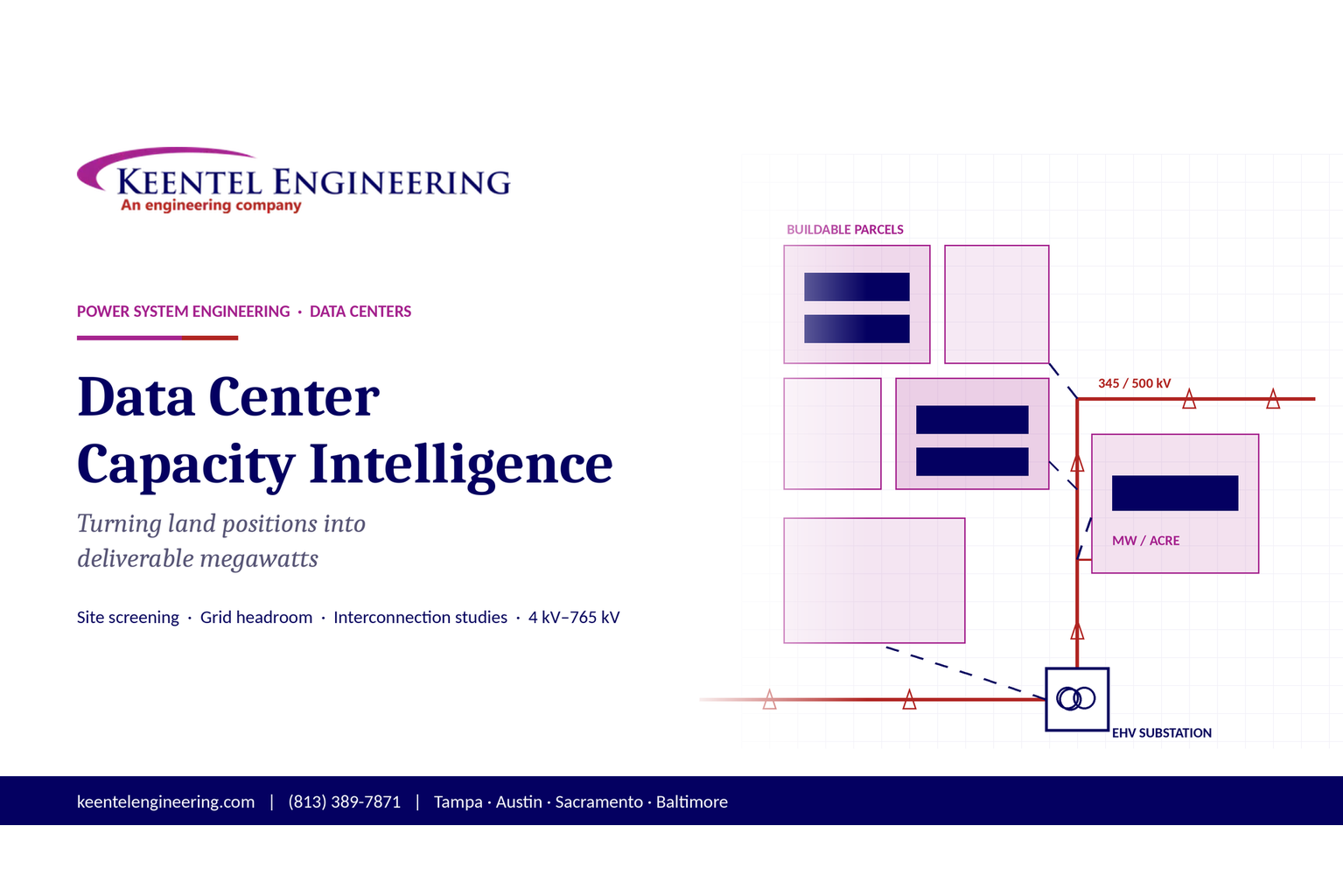
Plan data center capacity with land screening, MW-per-acre estimates, grid power availability and interconnection feasibility studies from Keentel Engineering.
By SANDIP R PATEL
•
October 11, 2026
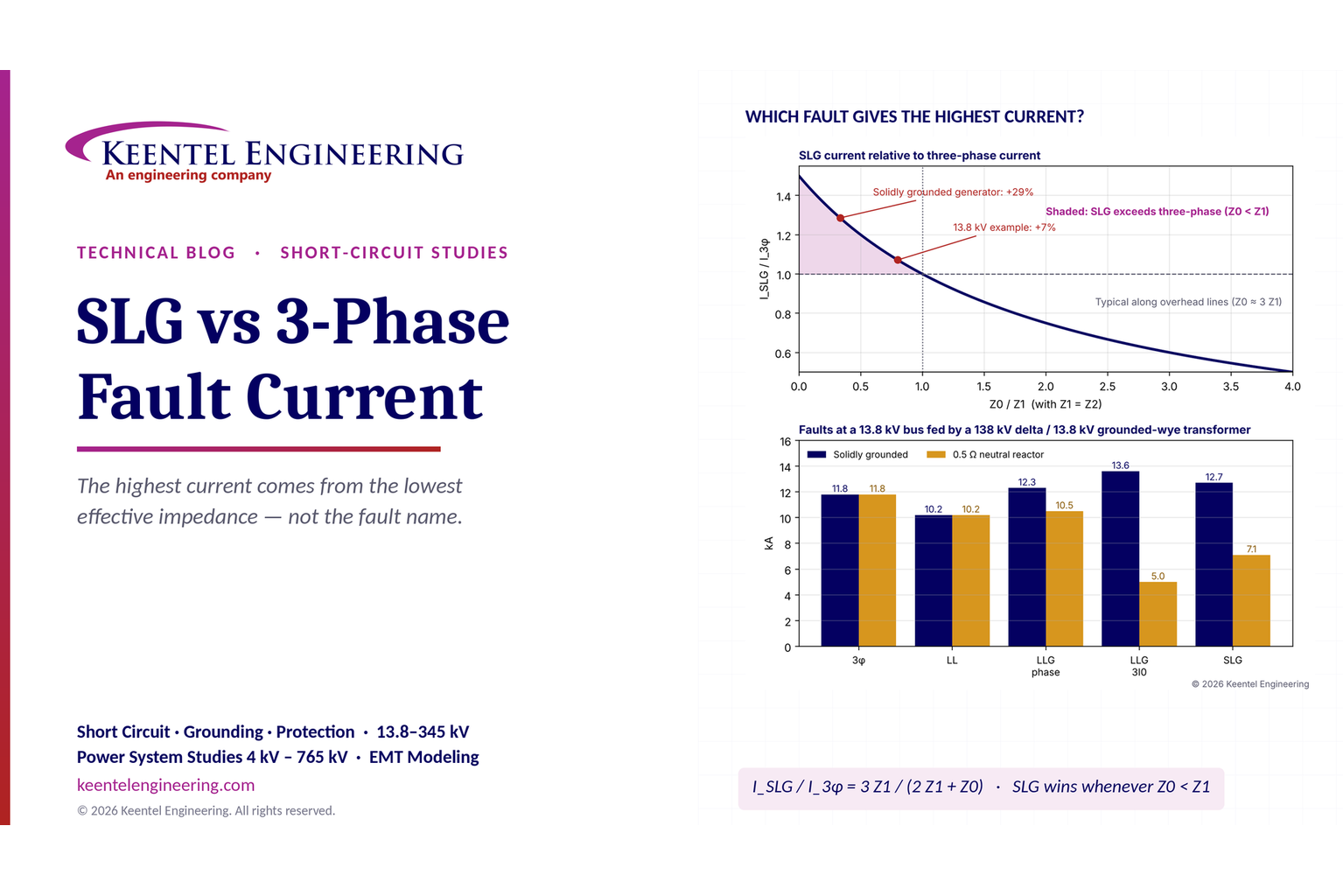
Learn which fault produces the highest current at a bus, why SLG faults can exceed three-phase faults, and how symmetrical components determine fault duty.
By SANDIP R PATEL
•
October 11, 2026
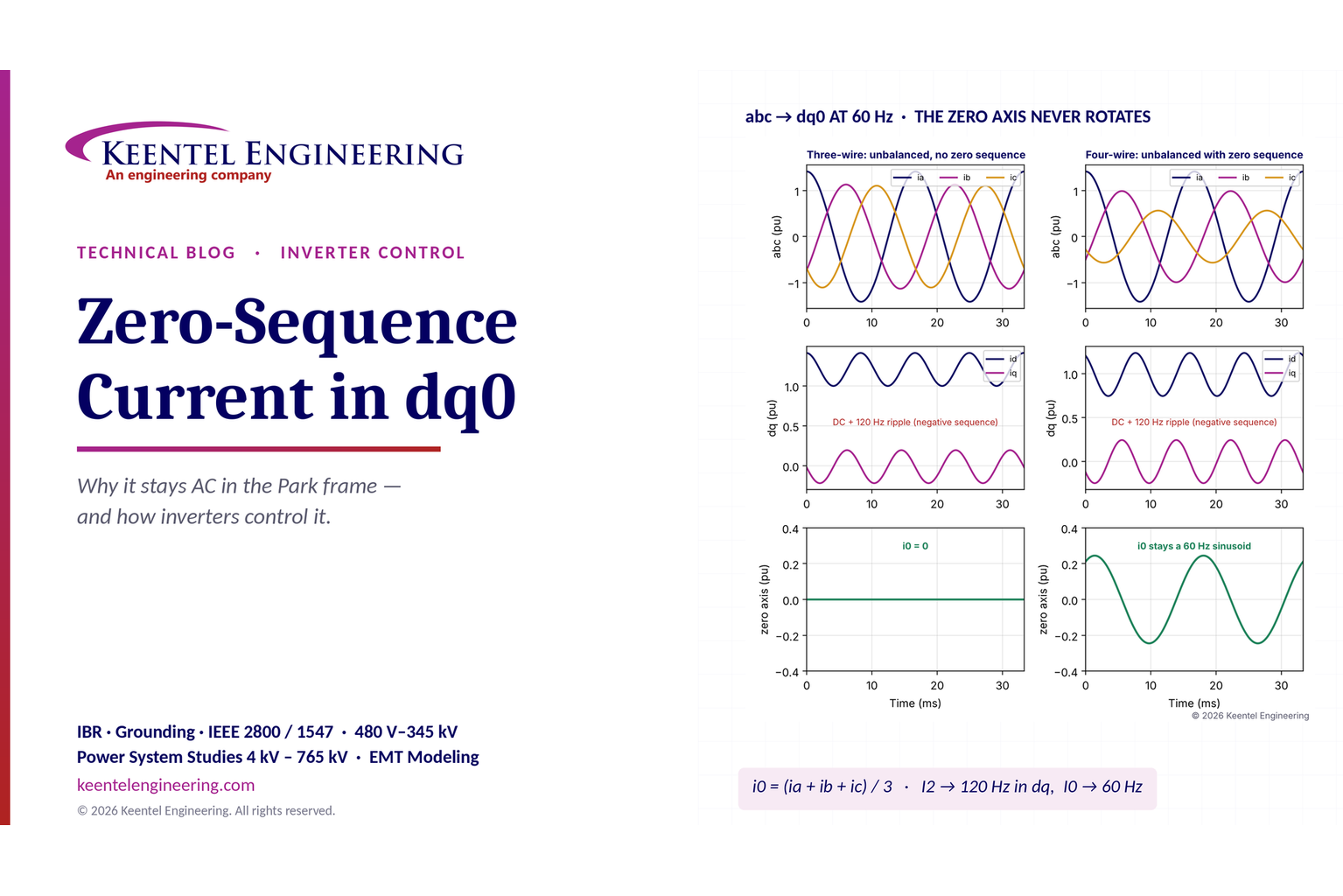
Learn why zero-sequence current pulsates in the dq0 frame, how Park's transformation works, and how inverter controls handle unbalance and ground faults.
By SANDIP R PATEL
•
October 11, 2026
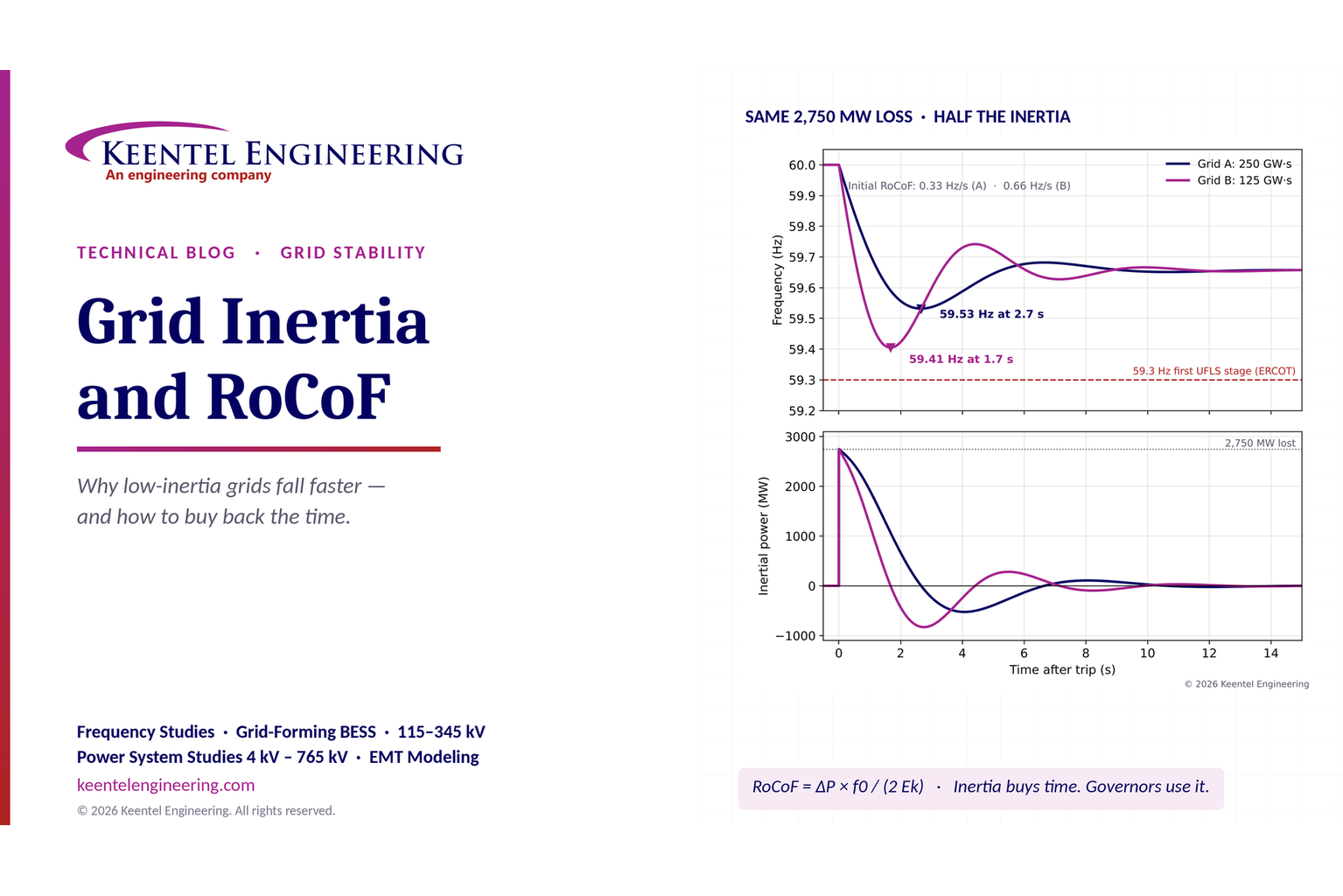
Explore grid inertia, RoCoF and frequency response, with swing equation calculations, frequency nadir analysis and US power system simulation examples.
By SANDIP R PATEL
•
October 11, 2026
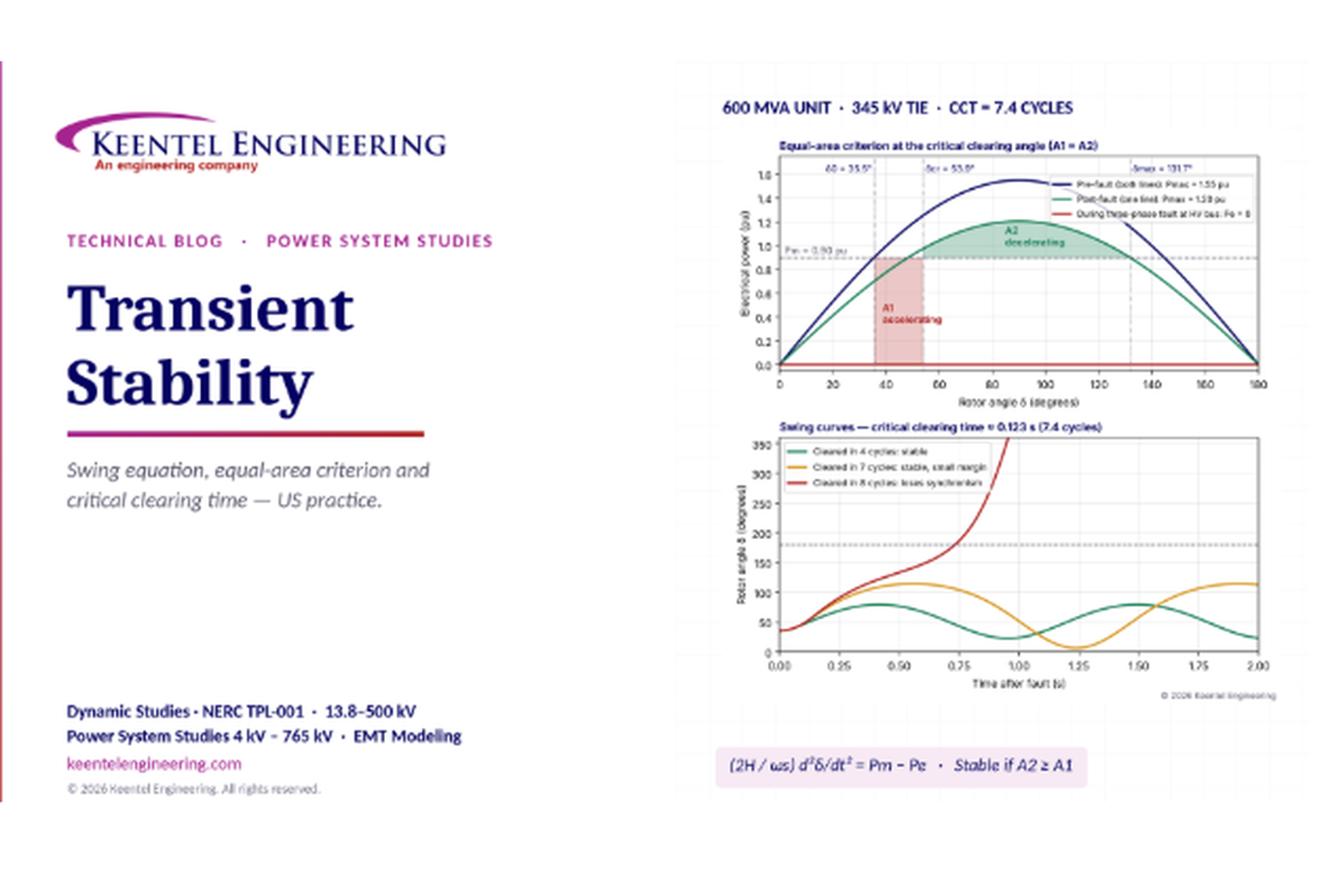
Learn transient stability analysis, swing equation, equal-area criterion and critical clearing time with a 345 kV worked example and NERC TPL-001 guidance.
By SANDIP R PATEL
•
October 11, 2026
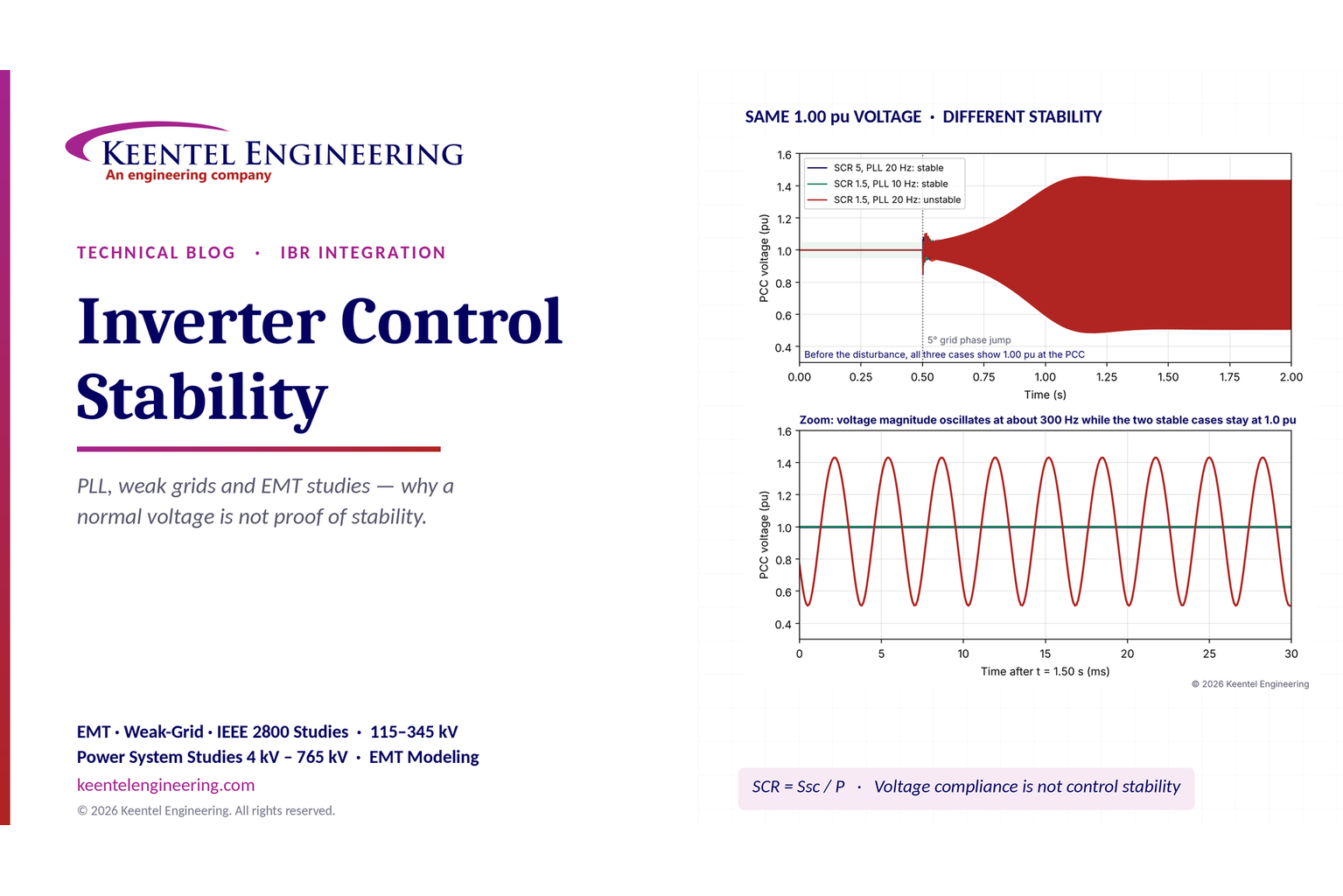
Learn why inverter controls become unstable in weak grids, how PLL bandwidth and SCR affect stability, and how PSCAD EMT studies identify and mitigate oscillations.
By SANDIP R PATEL
•
October 11, 2026
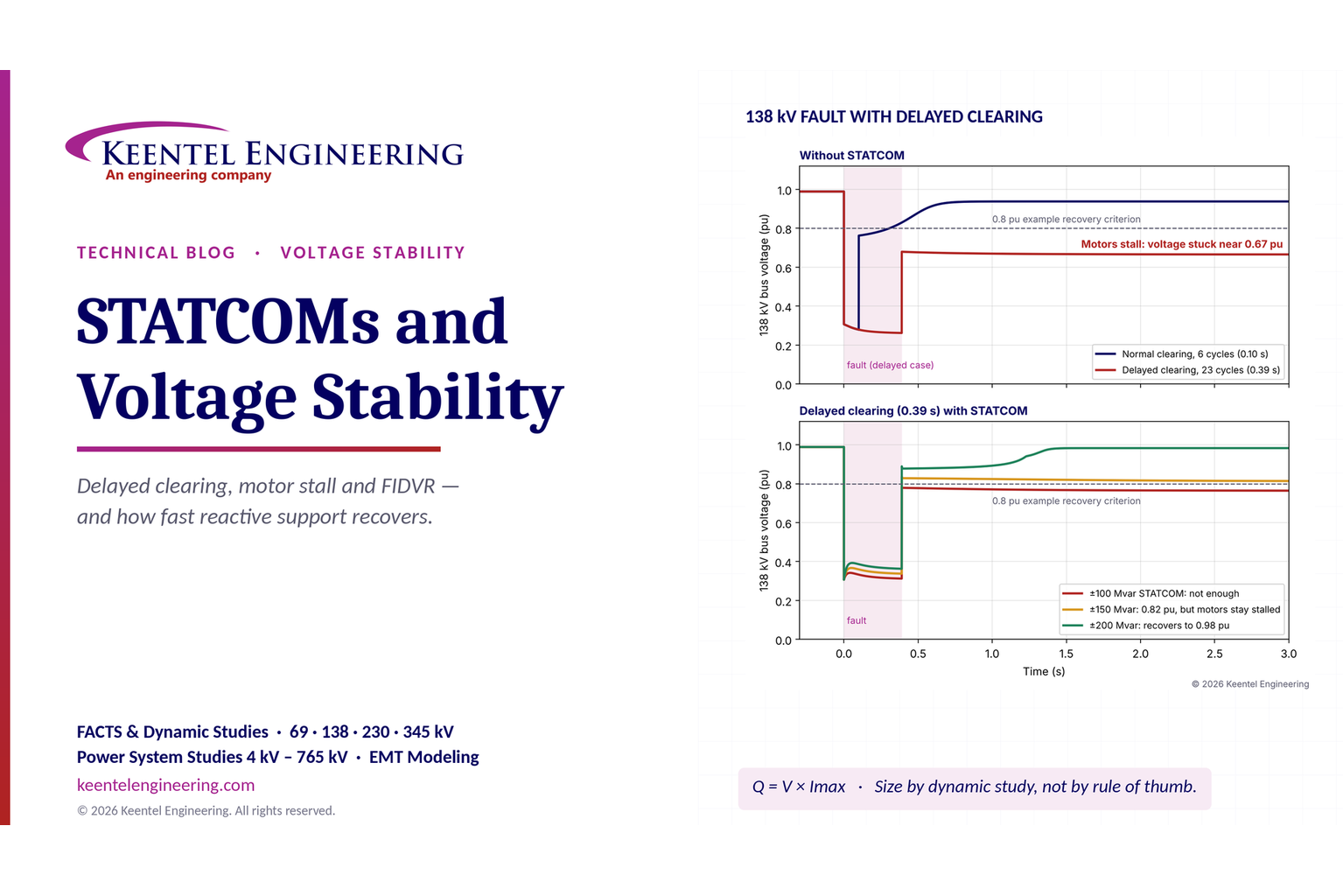
Learn how STATCOMs improve voltage stability and prevent FIDVR. Explore reactive power sizing, delayed fault clearing, NERC criteria and 138 kV simulation results.
By SANDIP R PATEL
•
October 10, 2026
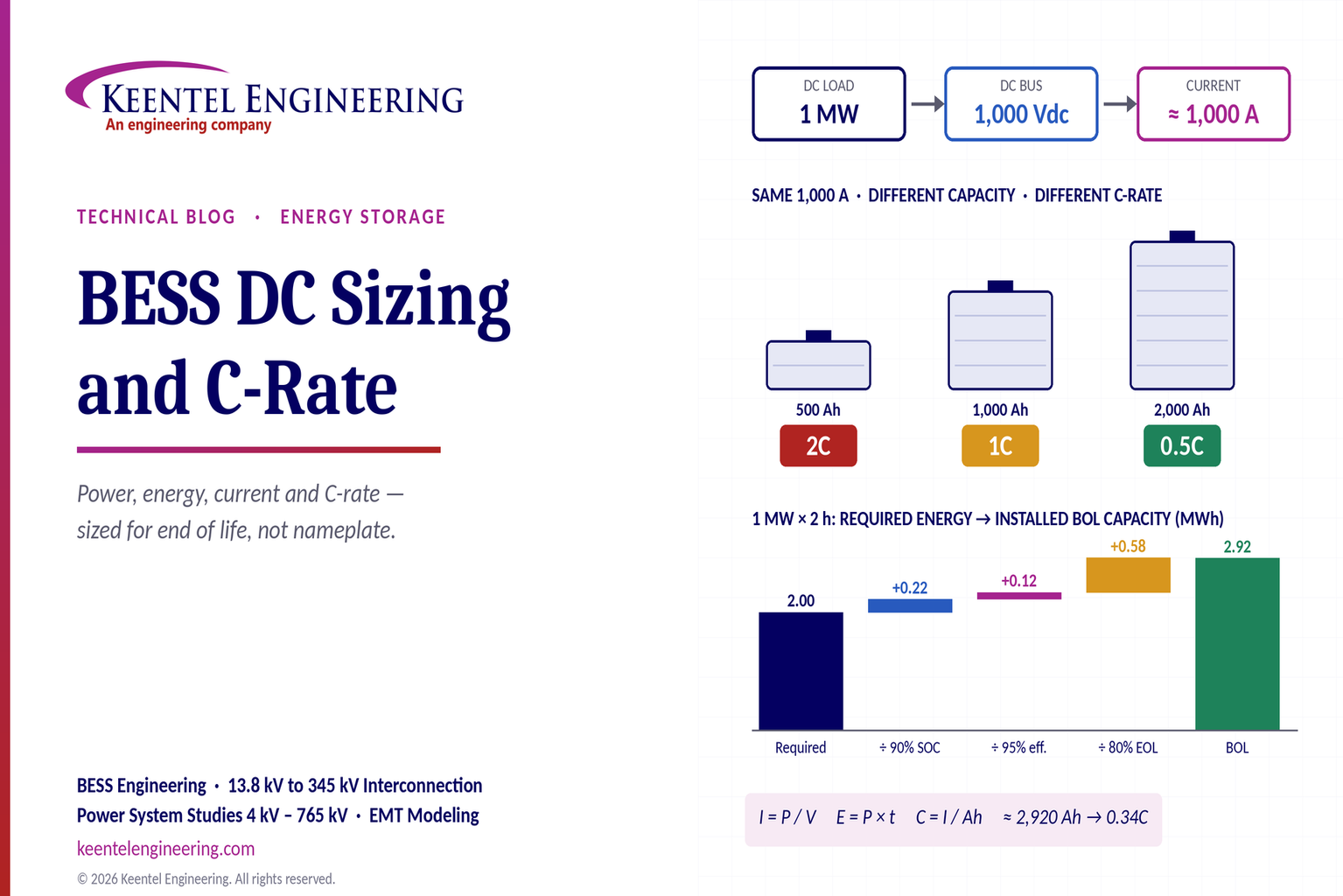
Learn BESS DC sizing with power, energy, current and C-rate calculations, battery losses, degradation and a 100 MW/400 MWh utility-scale example.
By SANDIP R PATEL
•
October 10, 2026
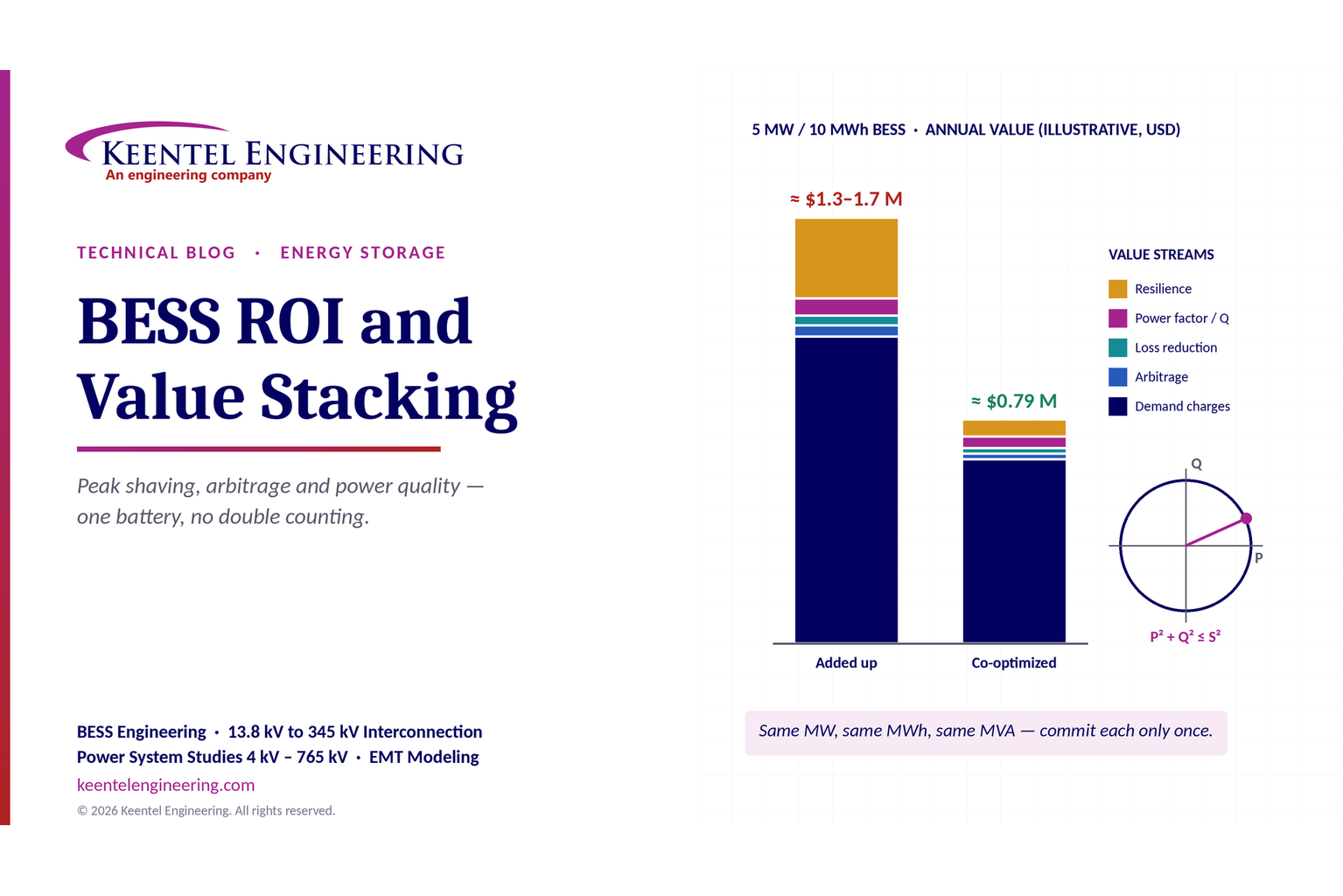
Learn how BESS ROI is calculated using peak shaving, energy arbitrage, power quality and battery storage economics, with a practical 5 MW/10 MWh example.